A monthly look at astronomical events in the sky and on Earth
Compiled and written by Steve Sawyer

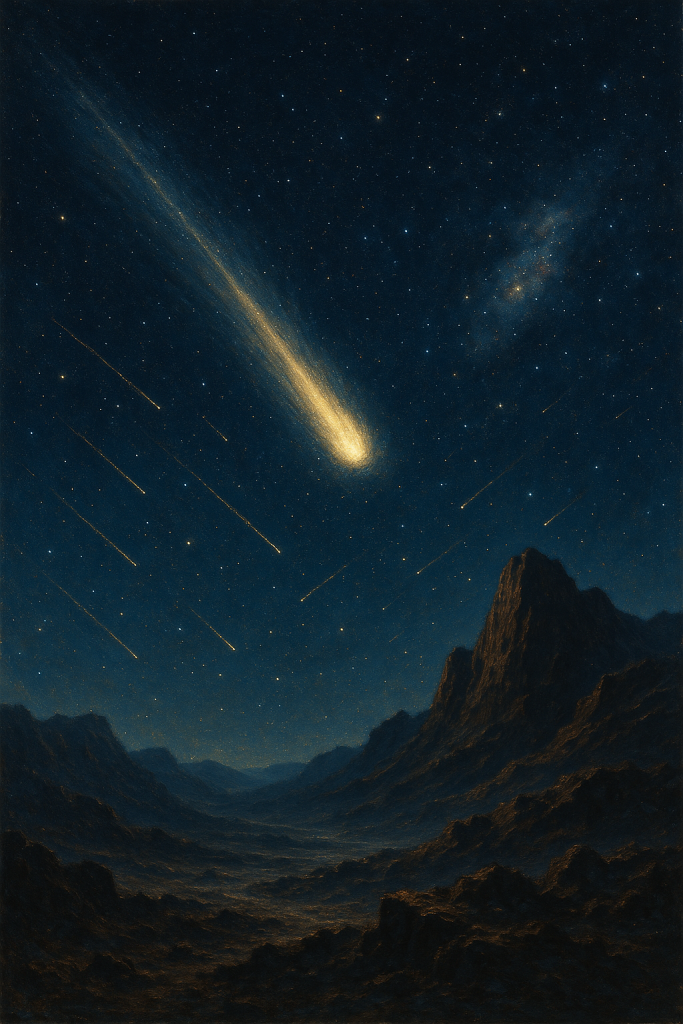
This month the images are being inspired by space artist Chesley Bonestell. More info:- Meet Chesley Bonestell, the most important space artist you’ve probably never heard of | Astronomy.com
Welcome to May’s What’s Up , this month we have the annual Eta Aquariid meteor shower, Mars crossing the beehive cluster and the possibility of more Aurora or even early noctilucent clouds.
Here’s what’s up this month!
This Months York Astro Presentations
This month we can look forward to

And on the 16th of May How it Began: The Origins of Lunar Exploration: 1958–1976 by Peter Rea.
Other upcoming events
Upcoming events to put in your diary
| Date | Title | Speaker |
|---|---|---|
| 06/06/2025 | Subject to be announced | |
| 20/06/2025 | Visual Astronomy: Alive and Kicking! | Simon Bennett |
For further details see the events page Astronomy Presentations by guest speakers | York Astro and our Facebook group (20+) The York Astronomical Society Chat Group | Facebook
So what’s on this month?
As May nights deepen, Cassiopeia sinks low over the northern horizon, and Perseus and Auriga slip from view, though the Double Cluster remains visible. Lyra, Cepheus, Ursa Minor, and Draco are well placed, while Gemini and Capella edge toward the west. In the east, Vega and Deneb shine prominently, and Altair begins to rise, completing the Summer Triangle. Hercules climbs high with M13 visible to the naked eye, while fainter constellations like Lacerta, Camelopardalis, and Lynx are still traceable before summer’s brighter skies take over.
Later in the night, Pegasus and Andromeda creep into view along the northeastern horizon. Overhead, Alkaid marks the zenith as Ursa Major shifts westward. Virgo stands due south early in the evening, with Leo nearby and Libra and Antares rising later. The Virgo Cluster, a rich field of galaxies, awaits telescope users. Meanwhile, Arcturus blazes high in the south, with Corona Borealis to its east, and Ophiuchus — the overlooked ‘thirteenth zodiac’ constellation — steadily climbs in the east.
Sky Diary
This table captures the astronomical events for May, including phases of the moon, planetary alignments, and other notable occurrences.
| Date | Event |
|---|---|
| May 2 | Minor planet Vesta reaches opposition (magnitude 5.7) |
| May 3 | Pollux passes 2.2° north of the Moon |
| May 3 | Mars (mag. 1.0) passes 2.1° south of the Moon |
| May 4 | First Quarter Moon |
| May 5 | Eta Aquariid meteor shower at maximum |
| May 5 | Regulus passes 2.2° south of the Moon |
| May 10 | Spica passes 0.4° north of the Moon |
| May 11 | Moon at apogee (406,245 km) |
| May 12 | Full Moon |
| May 14 | Antares passes 0.3° north of the Moon |
| May 20 | Last Quarter Moon |
| May 22 | Saturn (mag. 0.9) passes 2.8° south of the Moon |
| May 23 | Venus (mag. –4.4) passes 4.0° south of the Moon |
| May 26 | Moon at perigee (359,023 km) |
| May 27 | New Moon |
| May 28 | Jupiter (mag. –1.9) passes 5.2° south of the Moon |
| May 30 | Pollux passes 2.4° north of the Moon |
| May 31 | Mercury reaches perihelion |
Sky Maps
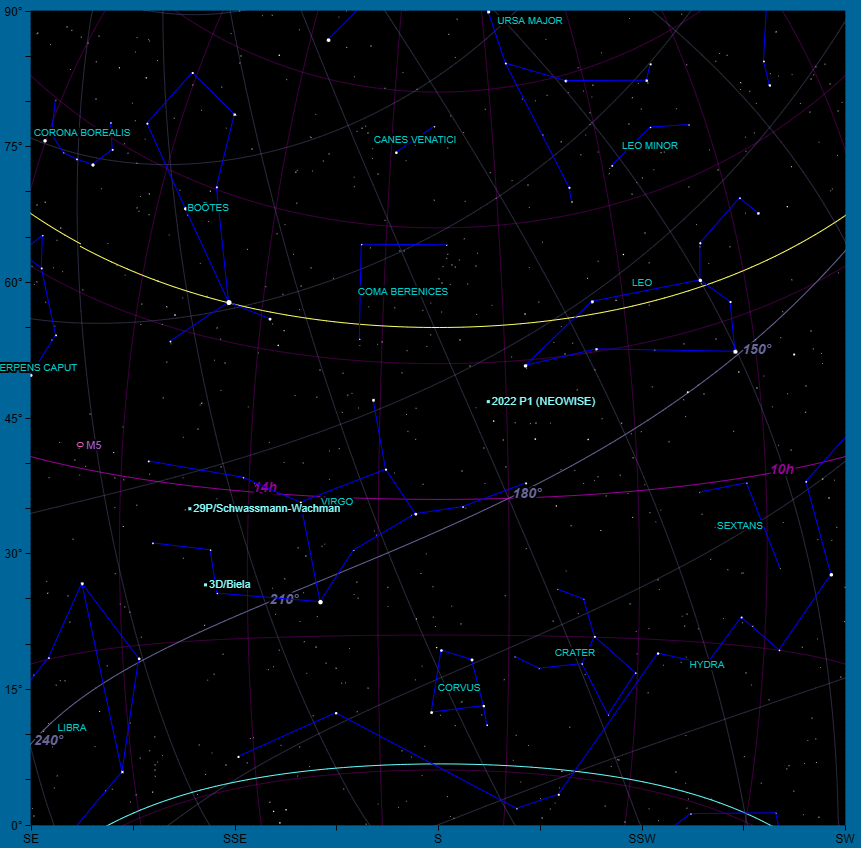
Looking South on the 15th at 22:00
Looking North on the 15th at 22:00
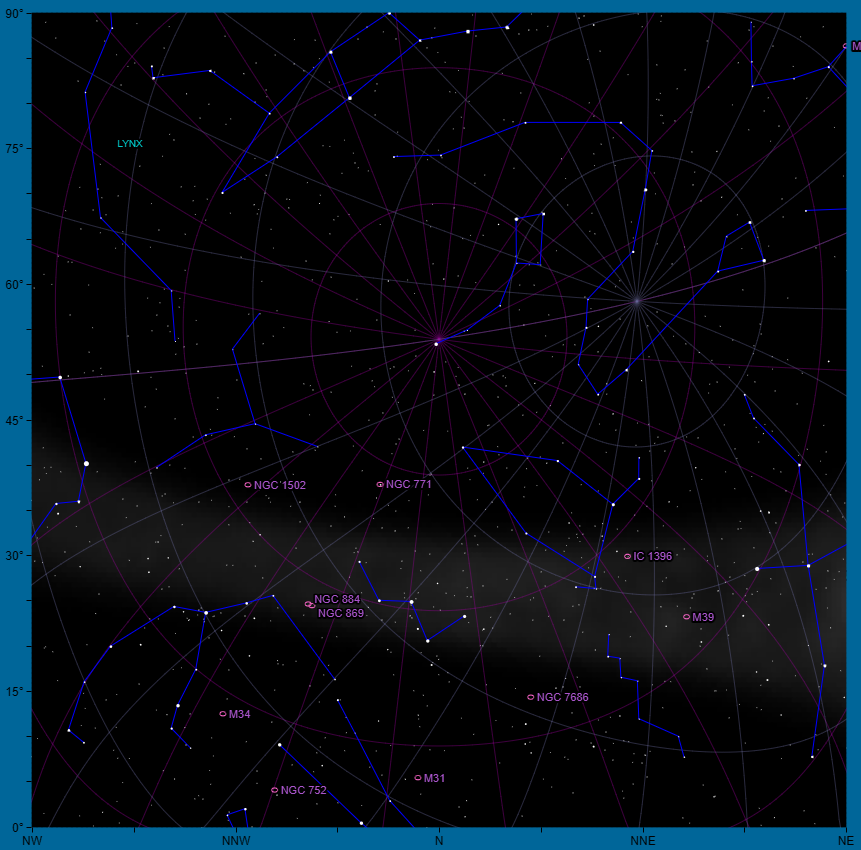
The two charts above show all DSOs of magnitude 6.0 or brighter. They are both taken from
SkyViewCafe.com and correct for the 15th of the month. For a clickable list of Messier objects with images, use the Wikipedia link.

May’s Objects
Noctilucent cloud season is underway over the next few months, and I’ll try to post some forecasts here when I can.
Noctilucent clouds, also known as “night-shining” clouds, are high-altitude clouds that glow after sunset or before sunrise. They form around 80 km above Earth’s surface, where the atmosphere is extremely cold and thin. These clouds are composed of tiny ice crystals that catch the Sun’s rays, creating bright, ghostly displays.
In the Northern Hemisphere, noctilucent clouds typically appear between late May and mid-August, mainly between latitudes 50° and 70°. In the Southern Hemisphere, they are visible from late November to mid-February. To spot them, look low on the northern (or southern) horizon about an hour or two after sunset or just before sunrise, under clear, dark skies. Visibility can vary from faint, delicate wisps to striking, vibrant formations depending on conditions.
For more information, check out Noctilucent clouds – Met Office, and here’s a beautiful video capturing them:
Watch on YouTube
The Sun
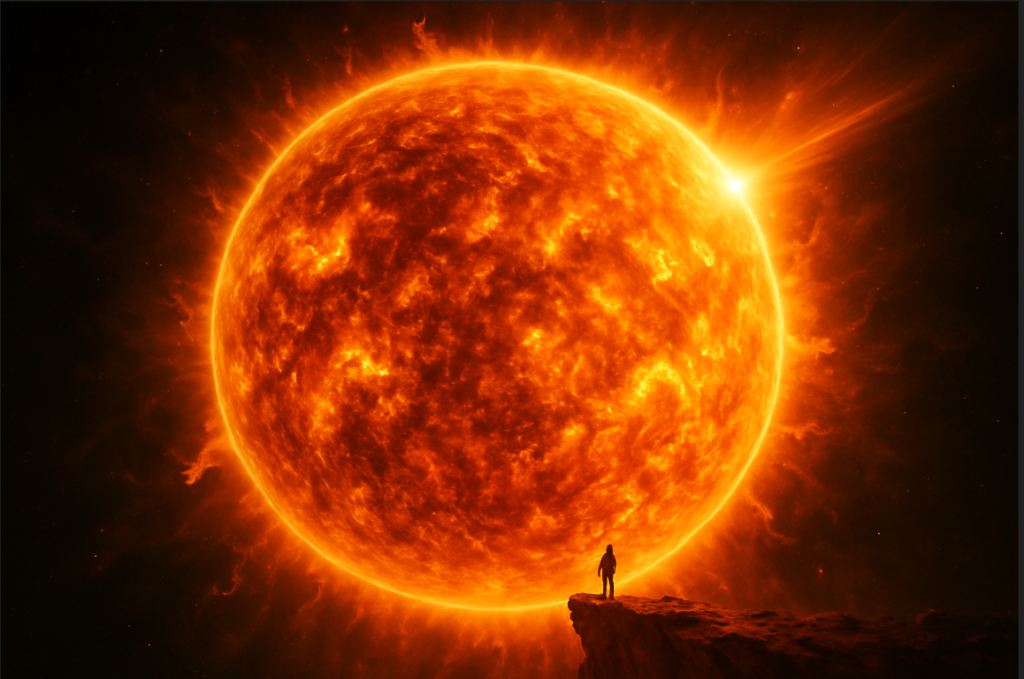
🛰️ Space Weather Forecast – Early to Late May 2025
Overview:
Solar activity is expected to stay moderate throughout May, with the 10.7 cm solar flux hovering between 140 and 165.
Geomagnetic conditions will generally be quiet to unsettled, with occasional periods of active geomagnetic activity (Kp 4–5) around mid-month.
Key Highlights:
- Late April into early May (April 28 – May 4):
- Solar flux remains around 140–150.
- Geomagnetic conditions stay mostly quiet, though April 28 and May 2 show some minor disturbances (Kp 4).
- May 5–10:
- A period of increased solar activity.
- Solar flux rises to 160–165, and geomagnetic activity reaches Kp 5 (minor geomagnetic storms possible) on May 5–6 and again around May 18.
- Good chance for aurora sightings at higher latitudes around these dates.
- Mid-May (May 11–17):
- Solar flux stabilizes around 155–160.
- Geomagnetic conditions become mostly quiet again (Kp 2–3), except for May 16–17, where minor disturbances (Kp 4) are forecast.
- Late May (May 18–24):
- A brief spike in geomagnetic activity is forecast on May 18 (Kp 5), potentially sparking active auroras at higher latitudes.
- Otherwise, solar and geomagnetic activity should ease back to quiet levels (Kp 2–3) by May 22–24.
Quick Forecast Summary:
| Period | Solar Flux | Kp Index | Notes |
|---|---|---|---|
| Apr 28 – May 4 | 140–150 | 2–4 | Mostly quiet, slight disturbances |
| May 5 – May 10 | 150–165 | 4–5 | Increased activity, minor storm chances |
| May 11 – May 17 | 155–160 | 2–4 | Generally quiet |
| May 18 – May 24 | 155–160 | 2–5 | Brief spike on May 18, then settling down |
📡 Notes for Skywatchers:
- Best chance for aurora: May 5–6 and May 18.
- Solar observation: The slightly higher solar flux could make radio propagation on Earth better than average for amateur radio users (especially on higher bands like 15m, 12m, and 10m).
- Deep-sky observations: Conditions around the New Moon on May 27 should coincide with low geomagnetic activity, perfect for astrophotography and faint object hunting.
Resources
For more info on the sun and solar weather look here : –
Space Weather Enthusiasts Dashboard | NOAA / NWS Space Weather Prediction Center
Auroa Forecasts
A bit US centred but still useful
Aurora Dashboard (Experimental) | NOAA / NWS Space Weather Prediction Center
And our own Met-office have an excellent space weather forecast page here Space Weather – Met Office
The Moon
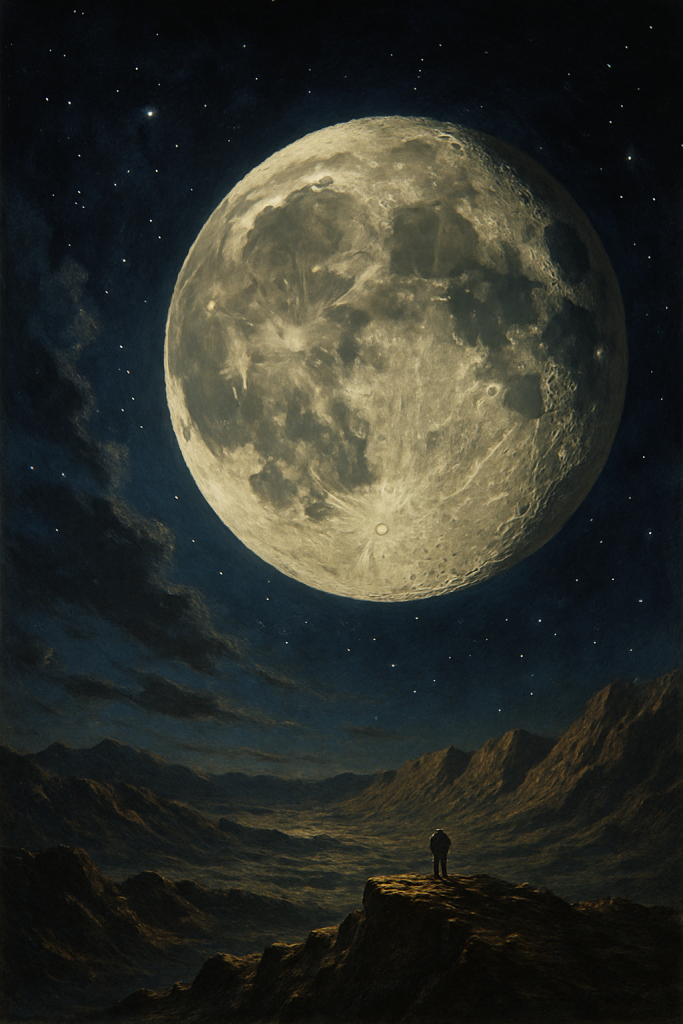
May Lunar Calendar
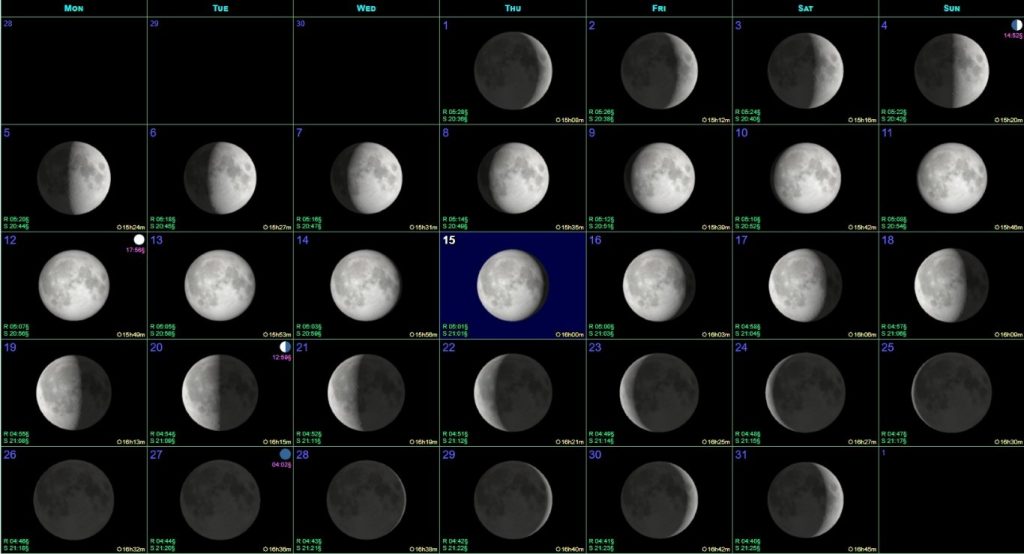
May’s moon calendar from Sky View Café (skyviewcafe.com)
A full yearly lunar calendar can be found here :-
https://www.mooninfo.org/moon-phases/2025.html
🌙 Moon Positions & Events – May 2025
| Date | Lunar Event | Moon Phase |
|---|---|---|
| May 3 | Pollux passes 2.2° north of the Moon | 🌒 Waxing Crescent |
| May 3 | Mars passes 2.1° south of the Moon | 🌒 Waxing Crescent |
| May 4 | First Quarter Moon | 🌓 First Quarter |
| May 5 | Regulus passes 2.2° south of the Moon | 🌓 First Quarter |
| May 10 | Spica passes 0.4° north of the Moon | 🌔 Waxing Gibbous |
| May 11 | Moon at apogee (406,245 km) | 🌔 Waxing Gibbous |
| May 12 | Full Moon | 🌕 Full Moon |
| May 14 | Antares passes 0.3° north of the Moon | 🌖 Waning Gibbous |
| May 20 | Last Quarter Moon | 🌗 Last Quarter |
| May 22 | Saturn passes 2.8° south of the Moon | 🌘 Waning Crescent |
| May 23 | Venus passes 4.0° south of the Moon | 🌘 Waning Crescent |
| May 26 | Moon at perigee (359,023 km) | 🌘 Waning Crescent |
| May 27 | New Moon | 🌑 New Moon |
| May 28 | Jupiter passes 5.2° south of the Moon | 🌑 New Moon |
| May 30 | Pollux passes 2.4° north of the Moon | 🌒 Waxing Crescent |
Moon Feature
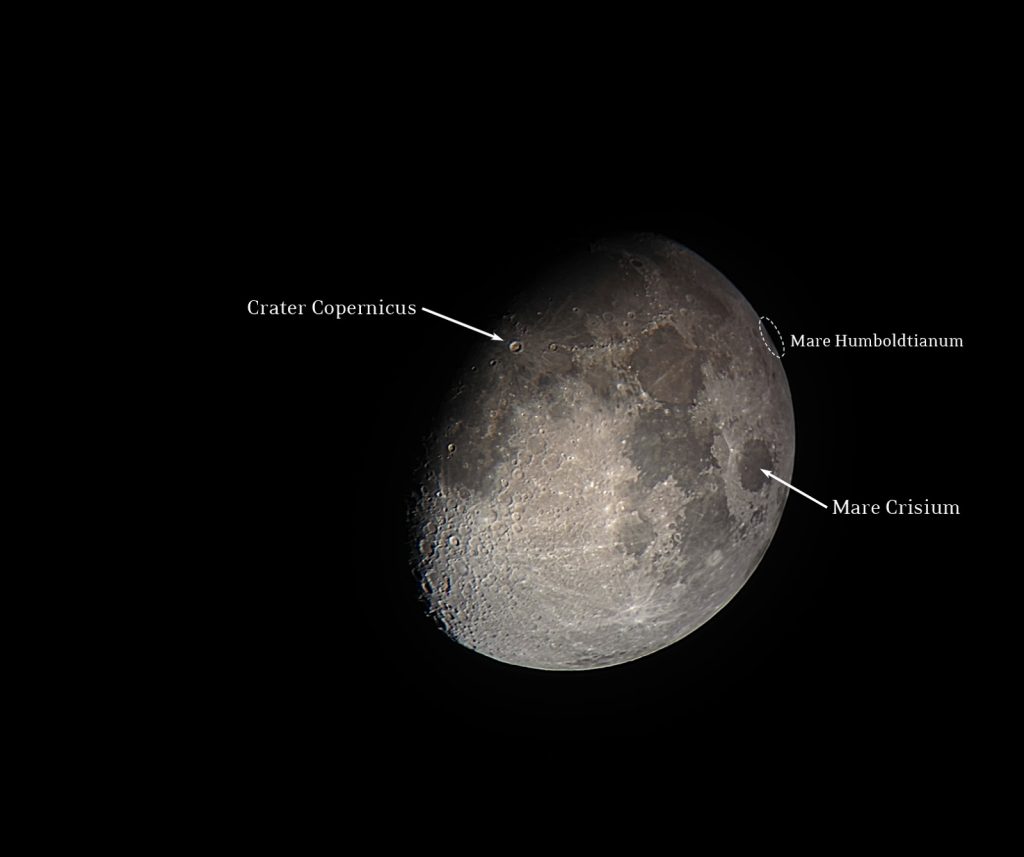
A slightly more difficult challenge for May which should be just possible to view thanks to favourable libration, is Mare Humboldtianum. Located on the northeastern limb of the Moon, this ancient impact basin is typically difficult to see fully, but libration during May tips the Moon just enough to bring more of this feature into view. The best time to catch it is a few days after Full Moon, when the Sun angle creates shadows that help define the basin’s structure.
Some further info and LROC images Mare Humboldtianum Constellation region of interest | Lunar Reconnaissance Orbiter Camera
Planets
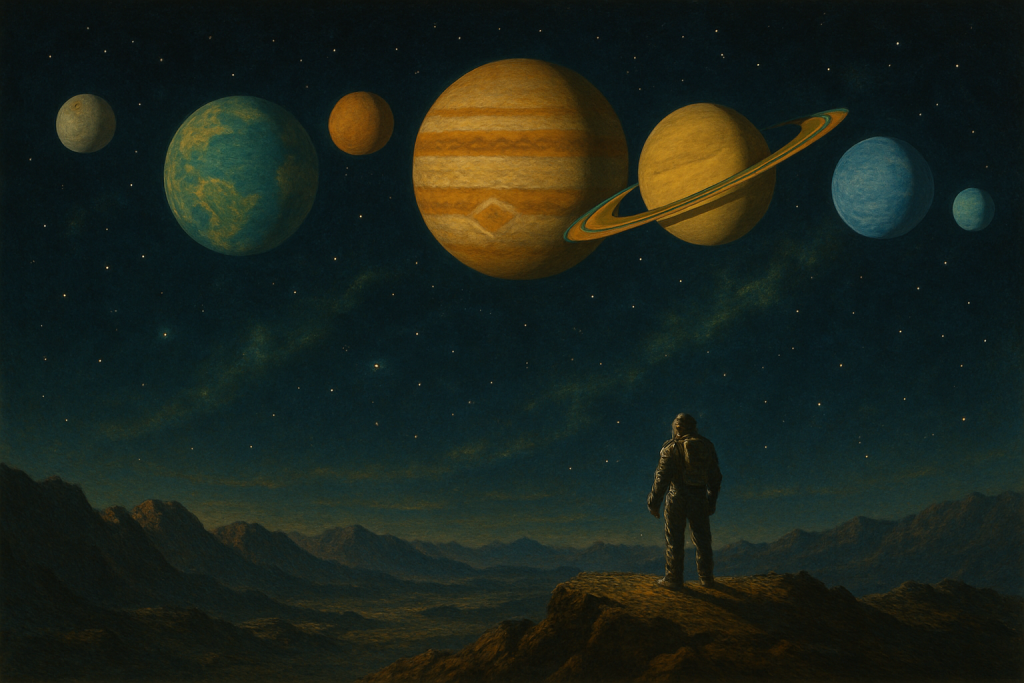
☀️ Mercury
Not really visible this month as it’s lost in the morning twilight.
🟡 Venus
Although low on the horizon Venus is a bright morning object rising before the Sun in the eastern sky. Shining at a dazzling magnitude of around −4.2, Venus is unmistakable as the brightest object in the predawn sky.
🔴 Mars
Mars is one of the best planets to view this month visible in the evening sky. It begins the month in the constellation Cancer and passes through the Beehive Cluster (M44) on May 5, offering a beautiful binocular sight. By May 26, it crosses into Leo. Although not especially bright or close to Earth this month, Mars remains a distinct golden-orange light in the western sky after dusk, gradually descending lower each night.
🟠 Jupiter
Jupiter can be found low on the western horizon this month
🪐 Saturn
Morning planet and mainly lost in the suns glare, but on the 6th May Saturn will pass an Equinox. Saturn’s rings will appear nearly edge-on from Earth because our viewing angle closely matches the line between the Sun and Saturn. Since Saturn lies over nine times farther from both the Sun and Earth than the Earth-Sun distance, we see the planet from almost the same direction in which sunlight strikes its equator.
🔵 Uranus
Not visible this month
🔷 Neptune
Not visible this month
Meteor Showers
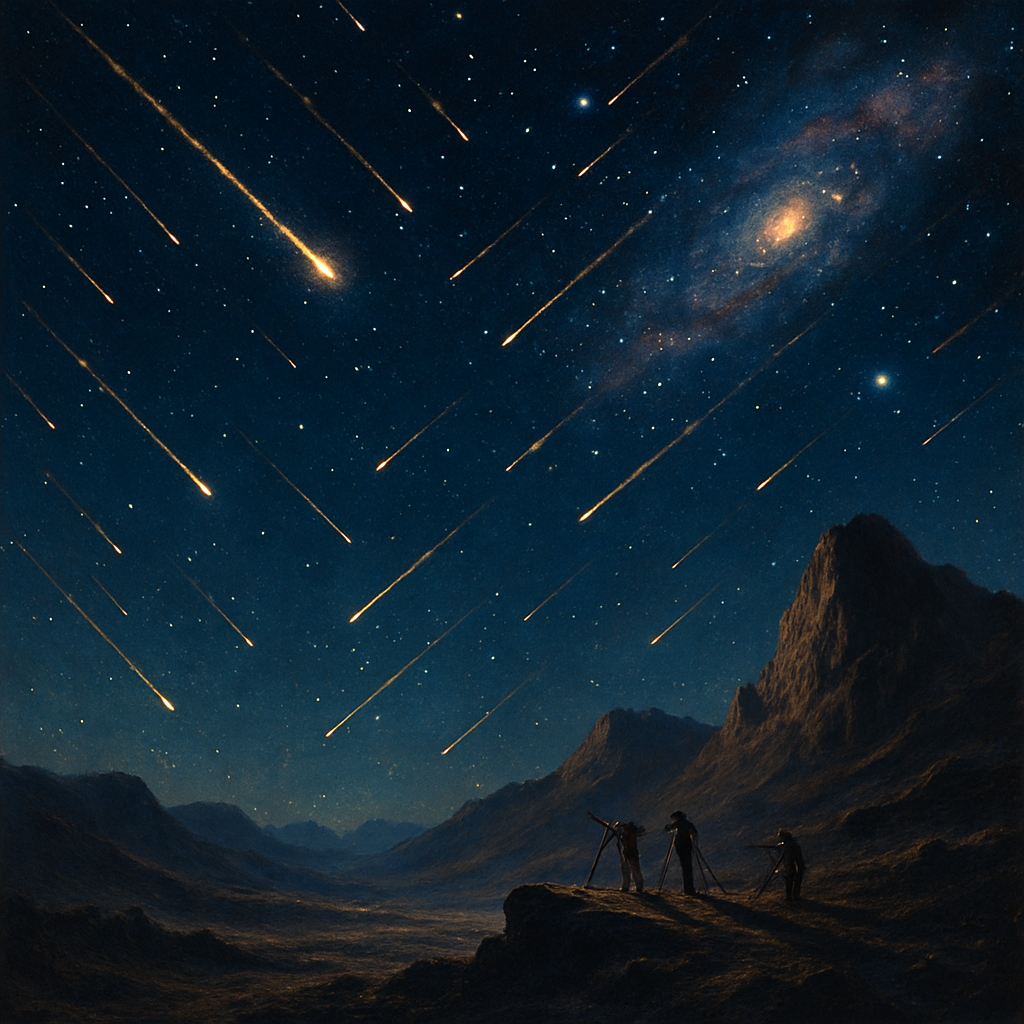
The Eta Aquarid’s
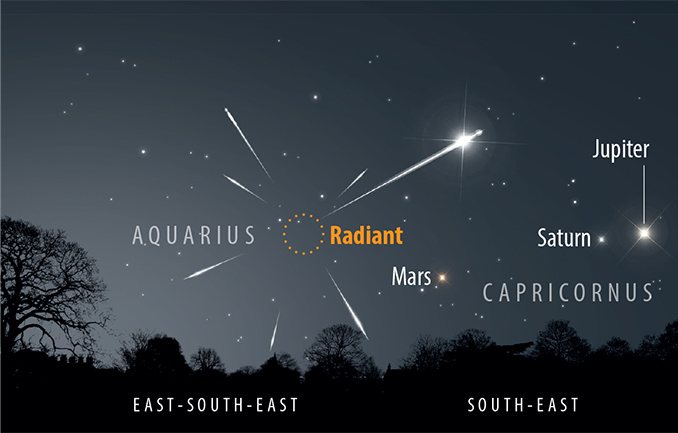
The Eta Aquarid meteor shower is an annual meteor shower that occurs from late April to mid-May. It is caused by the debris left behind by Halley’s Comet, which orbits the Sun once every 76 years. As Earth passes through the debris trail of the comet, the particles enter the Earth’s atmosphere and burn up, creating bright streaks of light known as meteors.
The Eta Aquarids are so named because the meteors appear to originate from the constellation Aquarius, which is where the radiant point of the shower is located. The shower typically peaks around May 5th and 6th, and during this time, you can expect to see up to 30-40 meteors per hour under ideal conditions.
Comets
| Comet Name | Approx. Magnitude | Best Viewing Time | Visibility Notes |
|---|---|---|---|
| C/2023 A3 (Tsuchinshan–ATLAS) | +6 to +8 | Evening twilight | Fading post-perihelion; visible low in the west-northwest. |
| 13P/Olbers | ~+9 to +10 | Late evening | Returning periodic comet; requires binoculars or telescope. |
| 12P/Pons-Brooks | ~+10 | Pre-dawn | Faint; may be visible with larger binoculars before sunrise. |
| 29P/Schwassmann-Wachmann | Variable | All night | Known for sudden outbursts; location varies, best in telescopes. |
| C/2025 F2 (SWAN) | +8 to +10 | Early May evenings | Fading rapidly; low in the northwest after sunset; challenging to observe. |
Link here for further details of each comet and how to locate it.
Visual Comets in the Future (Northern Hemisphere) (aerith.net)
Deep Sky (DSO’s)

The Beehive Cluster
A deep dive into the Beehive cluster
🌌 The Beehive Cluster (M44 / Praesepe)
Also known by its Latin name Praesepe (meaning “manger”), Messier 44 (M44) is a prominent open cluster located in the constellation Cancer, and ranks among the nearest star clusters to Earth—roughly 577 light-years away. It has been recognized since antiquity; the Greek astronomer Ptolemy described it in the 2nd century AD as a “nebulous mass in the breast of Cancer,” a reflection of its diffuse, fuzzy appearance when viewed with the naked eye under dark skies.
M44 was also one of the first celestial objects studied by Galileo Galilei, who used his early telescope to resolve more than 40 individual stars within the cluster—a remarkable achievement for the time.
Quick Facts
| 🔭 Constellation | Cancer |
| 🗺 Coordinates | RA 08h 40.4m / Dec. +19° 59′ |
| 🌌 Distance | ~577 light-years |
| ✨ Apparent Magnitude | +3.7 |
| 🧬 Cluster Type | Open |
| 🌞 Mass | 500–600 solar masses |
| 📏 Core Radius | 11.4 light-years |
| ⏳ Age | 600–700 million years |
| 🔖 Also known as | NGC 2632, Praesepe |
🧪 Structure and Stellar Population
M44 is closely related to the Hyades cluster in Taurus, as both share similar ages and proper motions—strong indicators of a shared origin. The Beehive is rich in stellar diversity, containing:
- ~680 M-type dwarfs
- ~300 F, G, and K-type Sun-like stars
- A handful of A-type stars
- 5 giant stars, including four A-type and one G0II-type
- At least 11 white dwarfs, believed to be the remnants of once massive B-type stars
Curiously, the cluster is deficient in brown dwarfs, likely because low-mass members have been stripped away from its halo by tidal forces over time.
⚖️ Dynamics and Evolution
Like many clusters, M44 exhibits mass segregation, where heavier stars drift toward the cluster core while lighter stars migrate outward. The core spans ~22.8 light-years, while its tidal radius reaches ~39 light-years, encompassing some stars that are merely passing through.
Recent research from Leicester University and Queen’s University Belfast suggests that M44 may actually be the merging remnant of two smaller clusters. This would explain its unusually high star count. If this scenario is correct, the cluster is expected to disperse within the next 10 million years as the gravitational effects of the merger destabilize its structure.
🪐 Exoplanets in the Beehive
In 2012, astronomers discovered two Hot Jupiter-type exoplanets orbiting Sun-like stars within M44: Pr0201b and Pr0211b—the first confirmed detections of such planets in an open cluster. Follow-up observations in 2016 revealed a second planet (Pr0211-c) orbiting the Pr0211 system, confirming M44 as a site of active planetary systems and strengthening the case that planet formation is common in star clusters.
🔭 Deep Sky Objects Visible in or around the Beehive Cluster (M44)
| Category | Object Name | Type | Description |
|---|---|---|---|
| 🌟 Open Cluster | M44 (Beehive) | Open cluster | ~1,000 stars, including many G, K, and M-type stars |
| 🔺 Double Stars | ε Cancri (ε Cnc) | Multiple star system | Member of the cluster, prominent in larger scopes |
| 🌐 Galaxies (background) | NGC 2637, NGC 2643 | Galaxies | Very faint, seen as distant background galaxies behind the cluster |
| 🌠 White Dwarfs & Variables | Various | Stellar remnants & variable stars | Several identified white dwarfs and suspected variable stars in the cluster |
| 🪐 Planets (transiting nearby) | Various | Exoplanets | Some field stars with detected exoplanets lie in the Beehive region (e.g. Pr0201b) |
ISS and other orbiting bits
🛰 International Space Station (ISS) Visible Passes – May
| Date | Visible | Max Height | Appears | Disappears |
|---|---|---|---|---|
| Thu May 1, 2:47 AM | 3 min | 35° | 35° above SSE | 10° above E |
| Thu May 1, 4:20 AM | 7 min | 58° | 10° above WSW | 10° above E |
| Fri May 2, 2:00 AM | 1 min | 18° | 18° above ESE | 10° above E |
| Fri May 2, 3:33 AM | 5 min | 56° | 24° above WSW | 10° above E |
| Sat May 3, 2:47 AM | 4 min | 50° | 49° above S | 10° above E |
| Sat May 3, 4:21 AM | 7 min | 53° | 10° above W | 10° above ESE |
| Sun May 4, 2:01 AM | 2 min | 29° | 29° above ESE | 10° above E |
| Sun May 4, 3:33 AM | 6 min | 57° | 16° above W | 10° above ESE |
| Mon May 5, 1:14 AM | 1 min | 14° | 14° above E | 10° above E |
| Mon May 5, 2:47 AM | 4 min | 58° | 37° above WSW | 10° above E |
| Mon May 5, 4:21 AM | 6 min | 38° | 10° above W | 10° above SE |
| Tue May 6, 2:01 AM | 3 min | 49° | 49° above SE | 10° above E |
| Tue May 6, 3:33 AM | 6 min | 46° | 10° above W | 10° above ESE |
| Wed May 7, 1:14 AM | 1 min | 21° | 21° above E | 10° above E |
| Wed May 7, 2:47 AM | 5 min | 53° | 27° above WSW | 10° above ESE |
| Wed May 7, 4:22 AM | 6 min | 24° | 10° above W | 10° above SSE |
| Thu May 8, 2:01 AM | 3 min | 57° | 57° above S | 10° above ESE |
| Thu May 8, 3:34 AM | 6 min | 31° | 10° above W | 10° above SE |
| Fri May 9, 1:15 AM | 1 min | 21° | 21° above ESE | 10° above E |
| Fri May 9, 2:48 AM | 5 min | 39° | 25° above WSW | 10° above SE |
| Fri May 9, 4:24 AM | 3 min | 13° | 10° above WSW | 10° above S |
| Fri May 9, 10:46 PM | 5 min | 27° | 10° above SSW | 17° above ESE |
| Sat May 10, 12:22 AM | 2 min | 27° | 10° above WSW | 27° above WSW |
| Sat May 10, 2:03 AM | 1 min | 20° | 20° above SE | 10° above ESE |
| Sat May 10, 3:36 AM | 4 min | 18° | 16° above WSW | 10° above SSE |
| Sat May 10, 9:58 PM | 5 min | 20° | 10° above SSW | 10° above E |
| Sat May 10, 11:34 PM | 5 min | 49° | 10° above WSW | 20° above E |
| Sun May 11, 1:10 AM | 2 min | 27° | 10° above W | 27° above WSW |
| Sun May 11, 10:46 PM | 6 min | 41° | 10° above SW | 10° above E |
| Mon May 12, 12:22 AM | 4 min | 57° | 10° above W | 50° above SE |
| Mon May 12, 9:58 PM | 6 min | 33° | 10° above SW | 10° above E |
| Mon May 12, 11:34 PM | 6 min | 58° | 10° above WSW | 19° above ESE |
| Tue May 13, 1:10 AM | 2 min | 25° | 10° above W | 25° above WSW |
Use the this NASA website for exact timings for York overpasses. York, England, United Kingdom | Sighting Opportunity | Spot The Station | NASA
Useful Resources
StarLust – A Website for People with a Passion for Astronomy, Stargazing, and Space Exploration.
http://www.n3kl.org/sun/noaa.html
http://skymaps.com/downloads.html
Astronomy Calendar of Celestial Events 2024 – Sea and Sky (seasky.org)
https://www.constellation-guide.com
IMO | International Meteor Organization
and of course the Sky at Night magazine!