A monthly look at astronomical events in the sky and on Earth
Compiled and written by Steve Sawyer

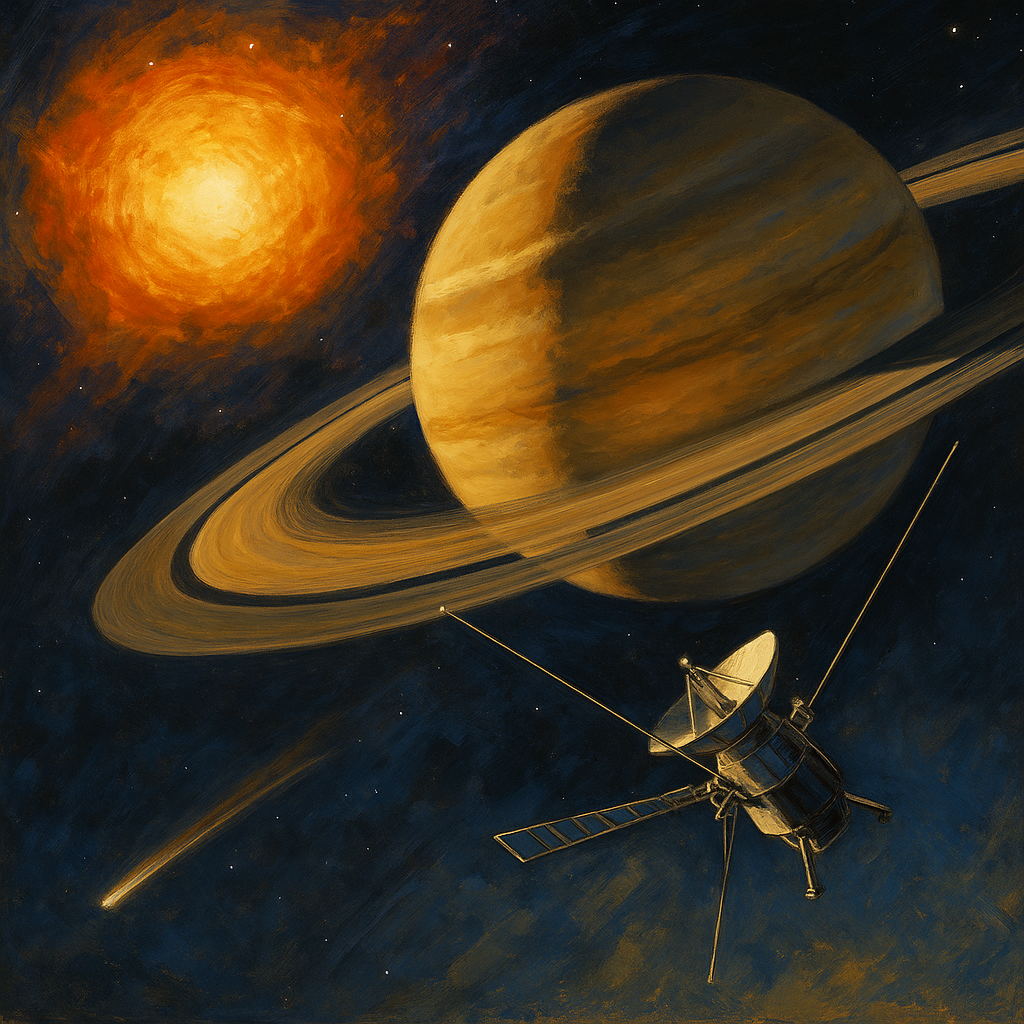
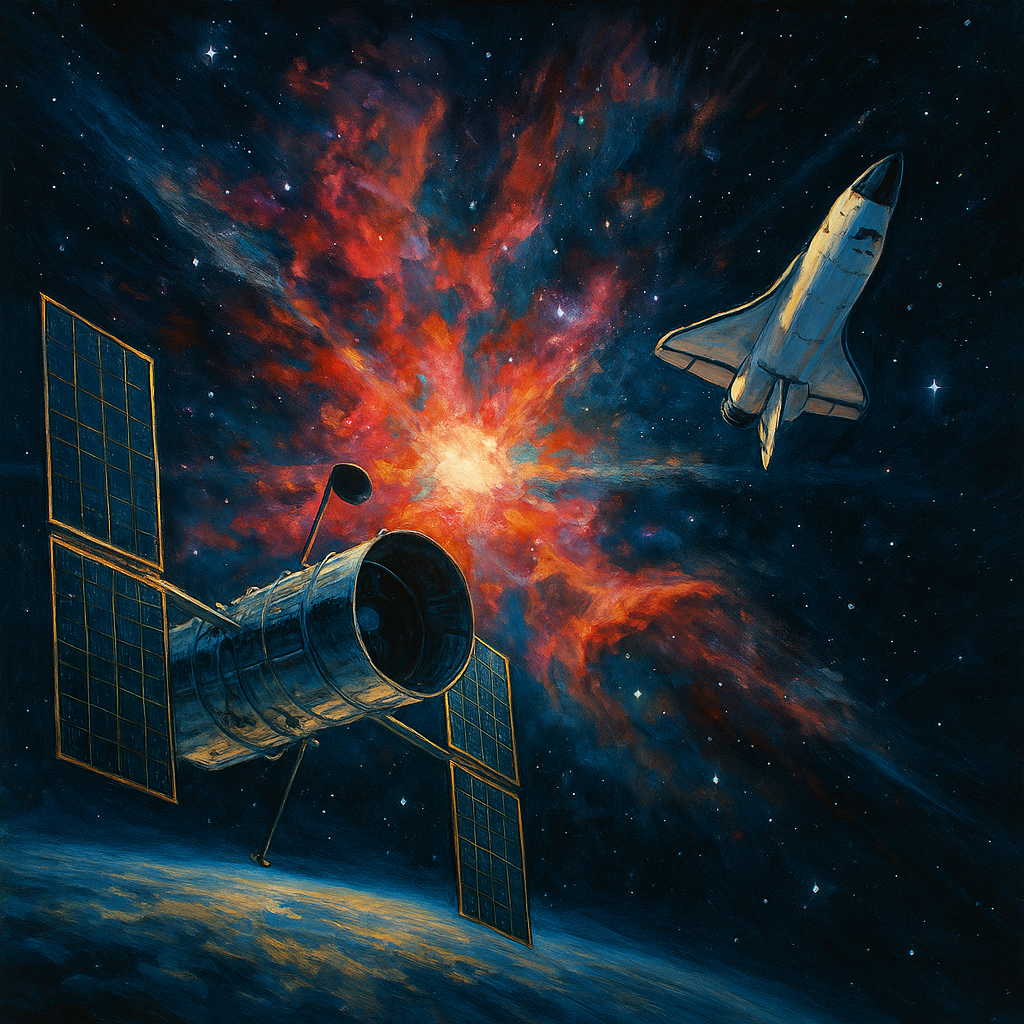
This month we’re being inspired by the art of Robert McCall 1919-2010.
McCall was a renowned American artist celebrated for his visionary space-themed artwork. He gained prominence in the 1960s as an illustrator for Life magazine and as a key artistic contributor to major films, including 2001: A Space Odyssey, Tora! Tora! Tora!, Star Trek: The Motion Picture, and The Black Hole.
Working closely with NASA, McCall visually chronicled the Space Race and designed mission patches, including for Apollo 17. His art has appeared on U.S. postage stamps and in iconic murals at institutions like the National Air and Space Museum, The Pentagon, and Disney’s Epcot, where his mural “The Prologue and The Promise” featured in the Horizons attraction.
His work left a lasting impression on both real-world space exploration and science fiction, earning recognition even within the Star Trek universe. More info here :- mccallstudios.com
Welcome to Julys What’s up!
Here’s what’s up this month! July (hopefully) brings long warm evenings which are ideal for chasing meteors, watching noctilucent clouds or evenings watching the passing satellites.
Here’s what’s up this month!
This Months and Upcoming York Astro Presentations
Upcoming events to put in your diary
| Date | Title | Speaker |
|---|---|---|
| 04/07/2025 | Galaxies: Citizens of the Universe| | Dave Armeson |
| 18/07/2025 | When Worlds Collide | Roy Gunson |
| August break and then in Autumn we start the 2025/2026 season | ||
| 05/09/2025 | The Largest Telescope on Earth: From an Inch to Forty Metres | Jurgen Schmoll |
For further details see the events page Astronomy Presentations by guest speakers | York Astro and our Facebook group (20+) The York Astronomical Society Chat Group | Facebook
So what’s on this month?
In July, the nights remain light, with continued chances to observe noctilucent clouds. As the month progresses, particularly after midnight, the major constellations become more visible. Capella skims the northern horizon, while Cassiopeia and Perseus rise in the northeast, joined by the Milky Way stretching towards Cygnus. Pegasus and Andromeda are prominent in the east, and Draco lies near the zenith.
Scorpius, with red Antares, appears low in the south, while Sagittarius and the Milky Way’s dense core become visible around midnight. The Great Rift of dark dust clouds extends from Cygnus to Sagittarius. Nearby are Sagitta and the Dumbbell Nebula (M27) in Vulpecula. Ophiuchus is near the meridian, separating the two halves of Serpens. The Summer Triangle—Vega, Deneb, and Altair—rises in the south, with Lyra and its bright star Vega near the zenith.
Sky Diary
This table captures the astronomical events for July, including phases of the moon, planetary alignments, and other notable occurrences.
| Date | Event Description |
|---|---|
| 02 | FIRST QUARTER MOON |
| 03 | Earth at aphelion: 1.01664 AU |
| 03 | Spica 0.8°N of Moon |
| 04 | Mercury at greatest elong.: 25.9°E |
| 05 | Moon at apogee: 404,627 km |
| 07 | Antares 0.4°N of Moon |
| 10 | FULL MOON |
| 13 | Venus (mag. -4.1) 3.1°N of Aldebaran |
| 14 | Mercury at aphelion |
| 16 | Saturn (mag. 0.9) 3.8°S of Moon |
| 18 | LAST QUARTER MOON |
| 20 | Pleiades 0.7°S of Moon |
| 20 | Moon at perigee: 368,047 km |
| 23 | Jupiter (mag. -1.9) 4.9°S of Moon |
| 24 | NEW MOON |
| 26 | Regulus 1.4°S of Moon |
| 28 | Mars (mag. 1.6) 1.3°N of Moon |
| 30 | α-Capricornid Meteor Shower maximum |
| 30 | Southern δ-Aquariid Meteor Shower maximum |
| 31 | Spica 1.0°N of Moon |
Sky Maps
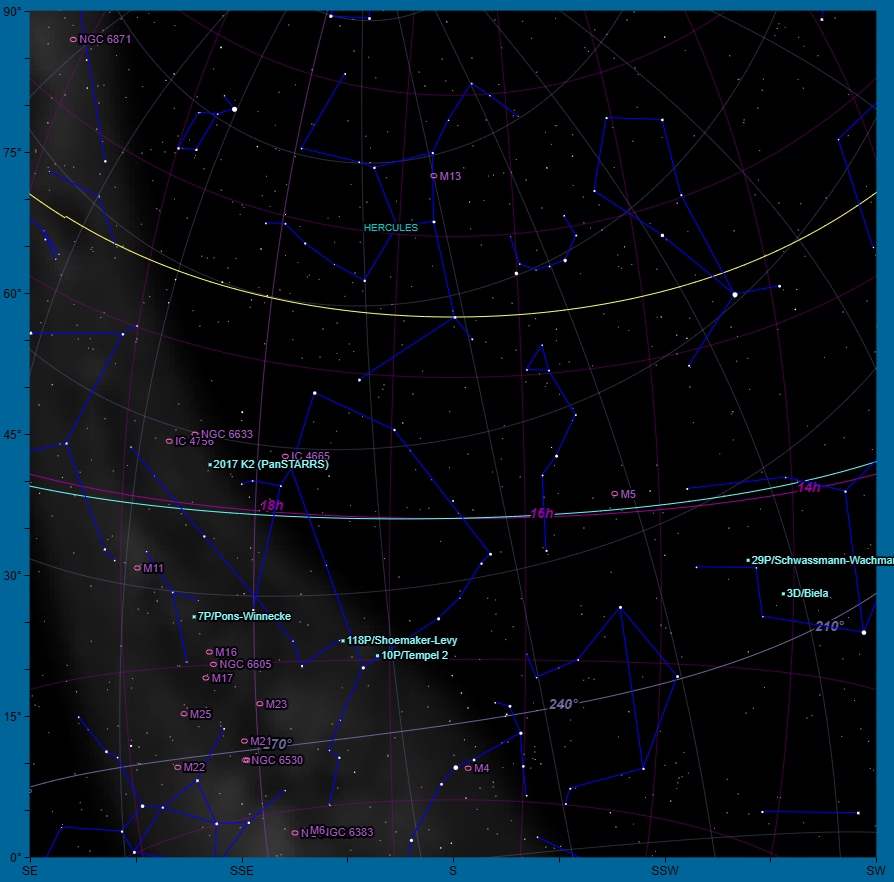
Looking South on the 15th at 22:00
Looking North on the 15th at 22:00
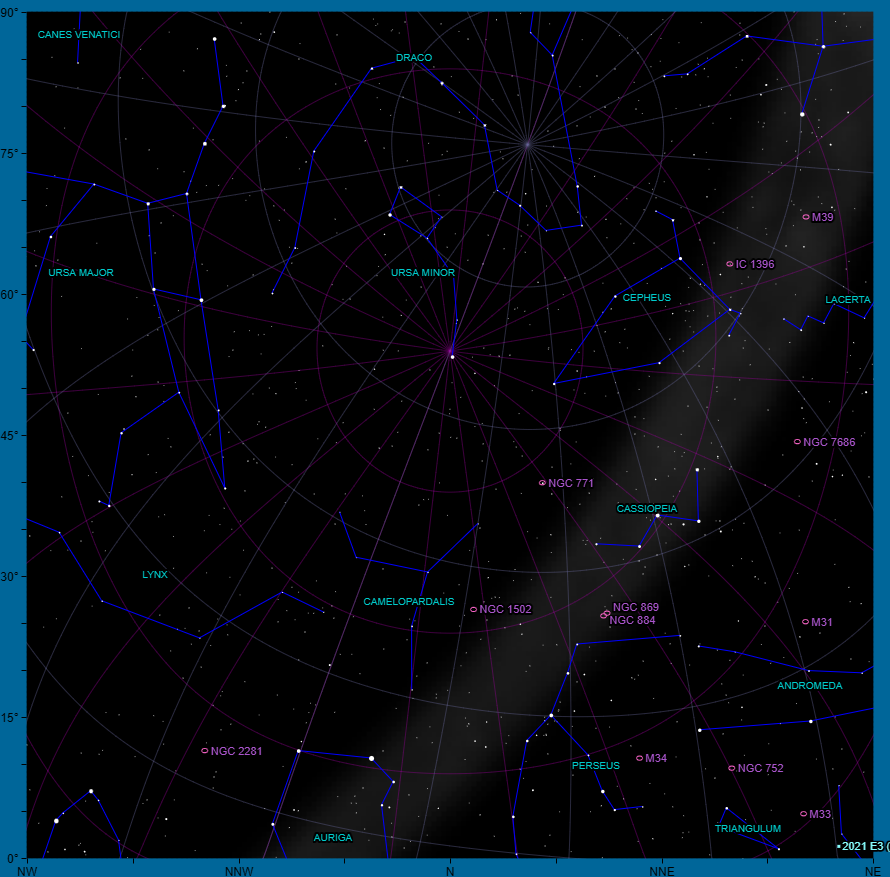
The two charts above show all DSOs of magnitude 6.0 or brighter. They are both taken from
SkyViewCafe.com and correct for the 15th of the month. For a clickable list of Messier objects with images, use the Wikipedia link.
Julys Objects
We’re still in Noctilucent cloud season, with sightings recently over central Europe, the northern UK and Ireland. The image below taken in Poland on the 24th June.
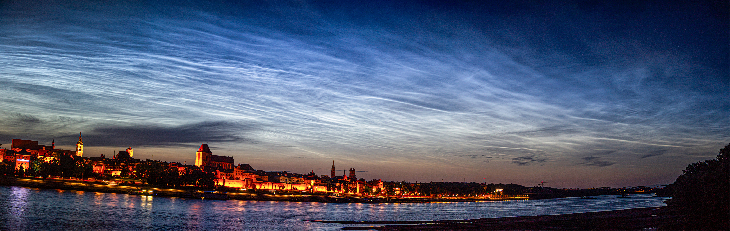
Image by Stanislaw Rokita on June 24, 2025 @ Torun, Poland
So keep an eye out!
For more information, check out Noctilucent clouds – Met Office
The Sun
🔆 July 2025 Space Weather Outlook: Solar Flares, Storms & Forecasts
Data Source: NOAA SWPC
As we step into the heart of summer, the Sun remains active, continuing a trend that began in late June. Powerful flares and high-speed solar winds have stirred up space weather, offering both challenges and excitement for skywatchers and radio observers alike.
☀️ Solar Activity Recap – Late June
June ended with a bang—solar Region 4114 unleashed two significant X-class flares: an X1.2 on June 17 and a more intense X1.9 on June 19. While no Earth-directed coronal mass ejections (CMEs) were recorded, these eruptions pushed solar activity to high levels. Minor-to-moderate radio blackouts (R1–R2 class) also occurred, reminding us that solar maximum is approaching.
At the same time, geomagnetic conditions reacted to persistent high-speed solar wind streams (CH HSS), peaking with G1 (Minor) storm conditions on June 25–26.
🔭 What to Expect in July
The outlook for July keeps the spotlight on an active Sun. While no major disruptions are expected, moderate space weather effects will persist.
Key Predictions:
- Solar Flares: Continued low-to-moderate activity with a chance of R1–R2 radio blackouts, especially before mid-July. A slight risk of stronger R3-class events remains.
- Geomagnetic Storms: Watch for minor geomagnetic disturbances around July 1–3, 5–6, and 11–12, likely driven by recurring high-speed solar wind streams.
- Radio Flux: Values rise steadily, peaking near 155 solar flux units (sfu)—a sign of elevated solar activity.
- Kp Index: Expect values mostly in the Kp 3–4 range, with occasional spikes to Kp 5, indicating unsettled geomagnetic conditions.
- Electron Flux: Elevated around June 26–28, but likely to return to moderate levels by early July.
No significant proton events or Earth-directed CMEs are forecast at this time.
🌌 Bottom Line for Observers
If you’re planning astrophotography or aurora watching, early July may offer brief windows of geomagnetic interest. Radio enthusiasts should stay alert for mild blackouts during solar flare upticks. And with solar flux trending high, expect stronger solar emissions to enhance the brightness of the Sun for H-alpha and white light viewing.
Auroa Forecasts
A bit US centred but still useful
Aurora Dashboard (Experimental) | NOAA / NWS Space Weather Prediction Center
And our own Met-office have an excellent space weather forecast page here Space Weather – Met Office
The Moon
July Lunar Calendar
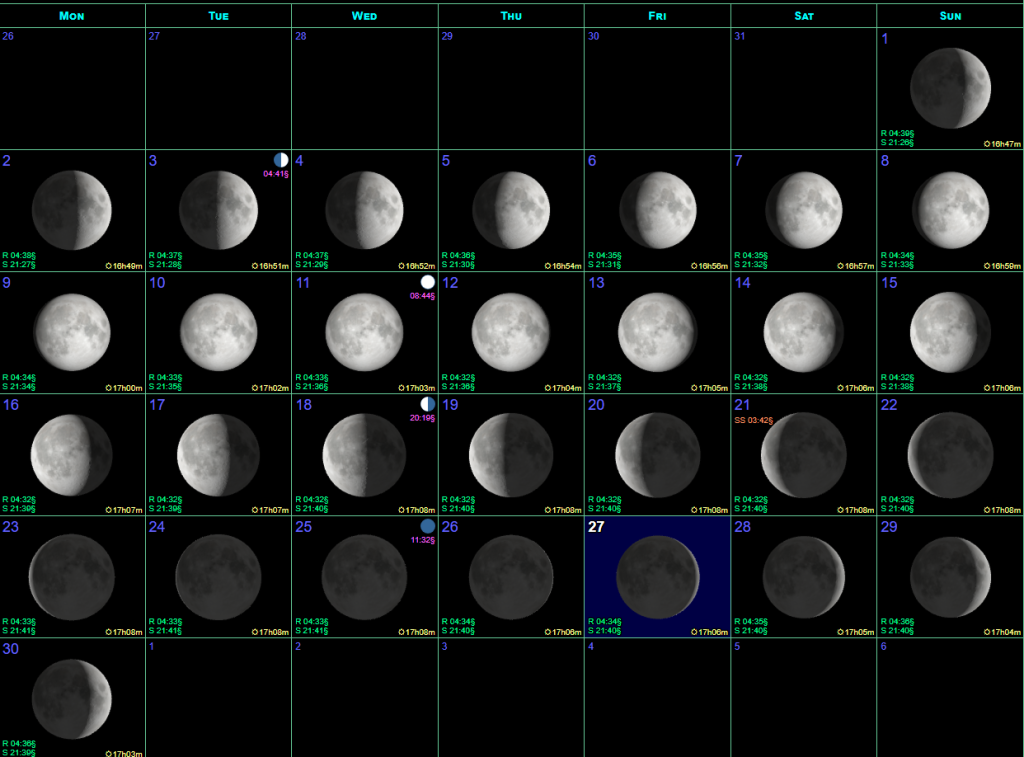
Julys moon calendar from Sky View Café (skyviewcafe.com)
A full yearly lunar calendar can be found here :-
https://www.mooninfo.org/moon-phases/2025.html
Moon Features
Here are several features to observe as the month progresses.
🌑 Around First Quarter (July 2–5):
This is an excellent time to observe features along the lunar terminator, where shadows enhance surface detail.
- Theophilus, Cyrillus, and Catharina: A striking trio of overlapping craters just west of Mare Nectaris.
- Altai Scarp: A dramatic cliff line near the trio of craters above.
- Mare Tranquillitatis & Mare Serenitatis: Look for subtle variations in mare tone and small craters like Arago and Plinius.
- Rupes Recta (Straight Wall): Best seen a day or two after First Quarter; this fault line casts a long shadow.
🌕 Around Full Moon (July 10):
The full Moon offers less shadow contrast but is great for viewing bright rays and maria.
- Tycho: Its ray system is spectacular under full illumination.
- Copernicus: Another bright-rayed crater, prominent at this phase.
- Aristarchus Plateau: The brightest region on the Moon, worth a look even without shaow relief.
- Mare Imbrium: Best for overall structure and seeing the full spread of surrounding craters like Plato and Eratosthenes.
🌗 Last Quarter (July 18–20):
Features now emerge on the opposite limb from the First Quarter views.
- Grimaldi: A dark-floored, lava-filled crater on the Moon’s western limb.
- Oceanus Procellarum: The largest lunar mare, full of rilles and subtle topography.
- Schickard: A large, ancient crater often seen under low-angle lighting.
- Reiner Gamma: A curious swirl pattern in Oceanus Procellarum, visible as albedo feature, not topography.
🌘 Waning Crescent (July 21–24):
Harder to catch, but great for seasoned observers in early morning.
- Langrenus: A large eastern limb crater with a central peak.
- Mare Crisium: Oval and isolated, excellent contrast in early morning viewing.
- Petavius: Deep crater with a notable central peak and rilles—highlights near the limb.
Planets
☀️ Mercury
An evening planet but very low and hard to see this month.
🟡 Venus
Although low on the horizon Venus is a bright morning object rising before the Sun in the eastern sky. Shining at a magnitude of around −4. Best towards the end of the month.
🔴 Mars
Not easy to see this month being lost in the evening twilight.
🟠 Jupiter
Very close to the sun and not easy to see.
🪐 Saturn
An early morning planet and the best of the bunch to view this month. Most favourable towards the end of the month.
🔵 Uranus
Lost in the early dawn twilight
🔷 Neptune
Also compromised by the morning twilight
Meteor Showers
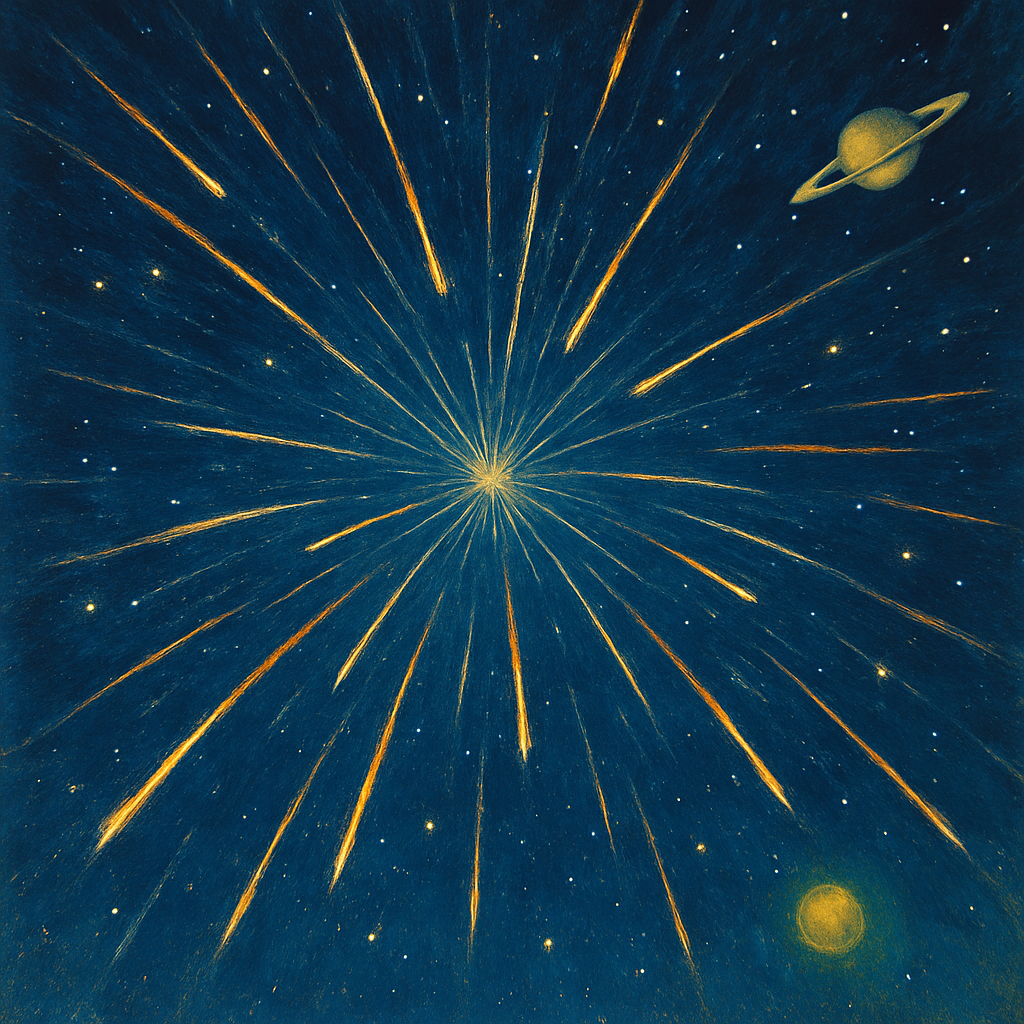
July brings an increase in meteor activity, featuring several minor showers radiating from Capricornus and Aquarius.
🌠 α‑Capricornids (July 3 – August 15; Peak: ~July 30)
- Radiant: Capricornus
- Zenithal Hourly Rate (ZHR): ~5 per hour—but notable for producing bright, slow-moving fireballs
- Parent Body: Comet 169P/NEAT
- Observation Tip: Best seen just after midnight when the radiant reaches its highest point
🌌 Southern δ‑Aquariids (July 12 – August 23; Peak: ~July 29–30)
- Radiant: Near Delta Aquarii in Aquarius
- ZHR: Around: ~15 – 20/hour
- Parent Body: Suspected comet 96P/Machholz
- Viewing Conditions: Peaks at 2 a.m., mid-sky visibility. 2025’s moon (~27% waning crescent) sets before radiant rises—ideal viewing conditions
Comets

| Comet Name | Expected Magnitude | Approx. Elevation (°) | Viewing Notes |
|---|---|---|---|
| C/2025 K1 (ATLAS) | ~13 | 59–80 | Located in Pegasus after sunset. Best seen with telescopes; rises ~22:00 LT, peaks near 73° elevation before dawn |
| C/2023 A3 (Tsuchinshan–ATLAS) | ~13–14 | 56–84 | In Vulpecula/Lyra region, bright despite faintness; use long exposures around midnight. Well-placed in early July . |
| C/2022 N2 (PanSTARRS) | ~13 | — | Observable at moderate elevation; requires telescope. Not much recent data; favorable dark-sky view. |
| 217P/LINEAR | ~13 | — | Typical periodic comet at ~13th magnitude; visible with small-to-mid-size telescopes. |
| Link here for further details of each comet and how to locate it. | |||
| Visual Comets in the Future (Northern Hemisphere) (aerith.net) |
Deep Sky (DSO’s)
The Summer Triangle
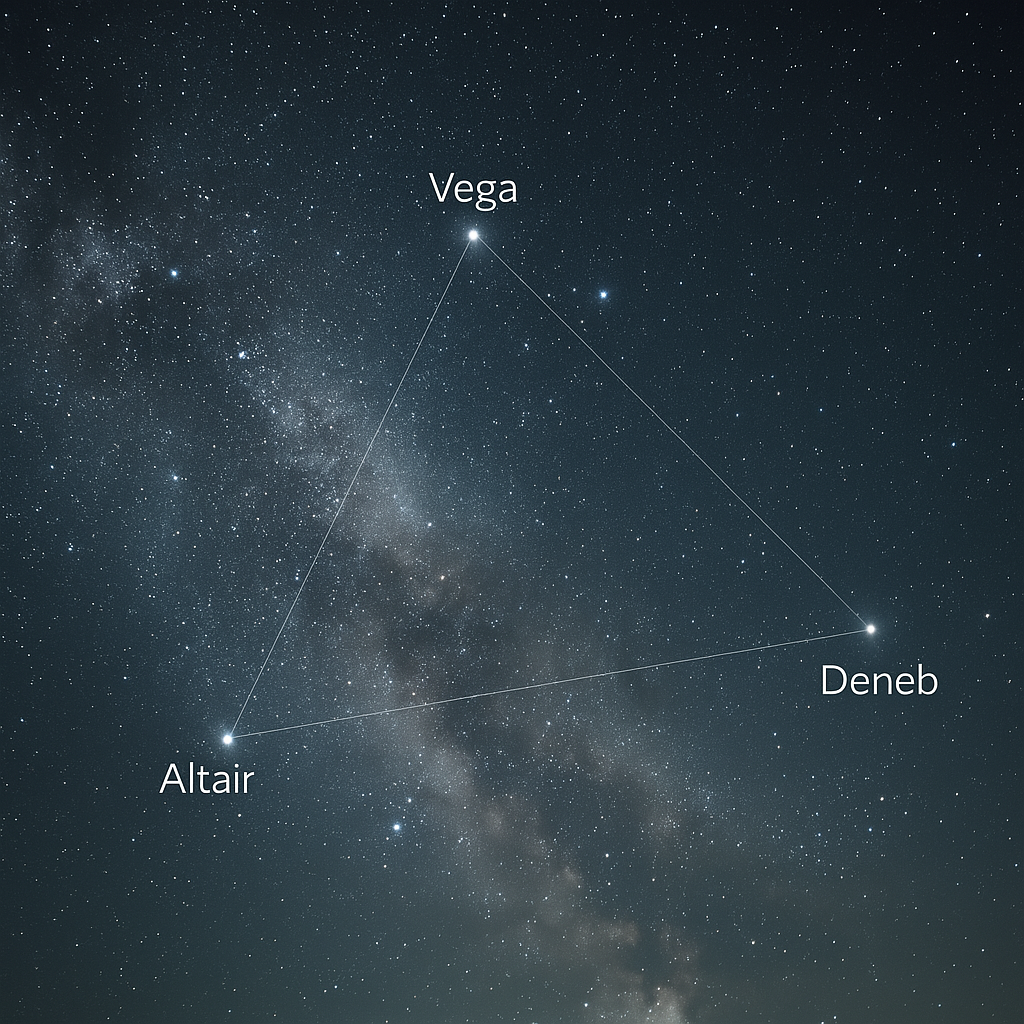
The Summer Triangle, formed by the bright stars Vega, Deneb, and Altair, dominates the northern summer sky. Each vertex lies in a rich part of the Milky Way with many interesting DSO’s and stars. Here’s a few of the notable objects that can be found near each point.
Vega
M57 The Ring Nebula
A bright planetary nebula (mag ~8.8), visible in small telescopes; lies between Beta and Gamma Lyrae.
Epsilon Lyrae The Double Double
A quadruple star system; binoculars show two stars, telescopes reveal each is a close binary.
Sheliak (Beta Lyrae) and Sulafat (Gamma Lyrae)
Bright stars flanking M57; Beta is an eclipsing binary with variability.
Deneb
North America Nebula (NGC 7000)
Emission nebula resembling the continent; best viewed with wide-field imaging near Deneb.
Pelican Nebula (IC 5070)
Next to the North America Nebula; another large emission region.
Albireo (Beta Cygni)
One of the finest color-contrast doubles: golden and blue components.
Veil Nebula (NGC 6960, 6992/5)
Supernova remnant; best seen in dark skies with an OIII filter.
M29 and M39
Modest open clusters; M29 is near Gamma Cygni (Sadr), and M39 is toward the northeast of Deneb.
Altair
NGC 6709
A rich open cluster just west of Altair; visible in binoculars.
NGC 6755 and NGC 6756
A pair of small open clusters in eastern Aquila.
Tarazed (Gamma Aquilae) and Alshain (Beta Aquilae)
Bright stars flanking Altair, forming the body of the “Eagle”.
ISS and other orbiting bits
🛰 **International Space Station (ISS) Visible Passes – July
Data sourced from Heavens-Above.
| Date | Mag. | Start | Alt | Start Direection | Mid Point | High Alt | End Direction | Time | Alt | Dir 3 |
|---|---|---|---|---|---|---|---|---|---|---|
| 30 Jun | -3.4 | 03:29:04 | 10° | WSW | 03:32:17 | 46° | SSE | 03:35:32 | 10° | E |
| 01 Jul | -1.5 | 01:08:12 | 12° | SE | 01:08:12 | 12° | SE | 01:08:57 | 10° | ESE |
| 01 Jul | -3.1 | 02:41:01 | 14° | SW | 02:43:30 | 37° | SSE | 02:46:38 | 10° | E |
| 02 Jul | -2.8 | 01:53:25 | 23° | SSW | 01:54:38 | 29° | SSE | 01:57:35 | 10° | E |
| 02 Jul | -3.7 | 03:27:43 | 10° | WSW | 03:31:00 | 57° | S | 03:34:18 | 10° | E |
| 03 Jul | -2.5 | 01:05:37 | 22° | SSE | 01:05:41 | 22° | SSE | 01:08:22 | 10° | E |
| 03 Jul | -3.6 | 02:38:42 | 10° | WSW | 02:41:58 | 51° | S | 02:45:13 | 10° | E |
| 04 Jul | -1.8 | 00:17:35 | 15° | SE | 00:17:35 | 15° | SE | 00:18:51 | 10° | ESE |
| 04 Jul | -3.4 | 01:50:23 | 15° | SW | 01:52:49 | 43° | SSE | 01:56:02 | 10° | E |
| 04 Jul | -3.7 | 03:26:00 | 10° | W | 03:29:17 | 57° | S | 03:32:35 | 10° | ESE |
| 05 Jul | -3.2 | 01:01:57 | 21° | SSW | 01:03:36 | 35° | SSE | 01:06:41 | 10° | E |
| 05 Jul | -3.8 | 02:36:43 | 10° | WSW | 02:40:01 | 58° | S | 02:43:19 | 10° | E |
| 06 Jul | -2.8 | 00:12:43 | 19° | SSW | 00:14:18 | 27° | SSE | 00:17:12 | 10° | E |
| 06 Jul | -3.7 | 01:47:21 | 10° | WSW | 01:50:38 | 56° | S | 01:53:55 | 10° | E |
| 06 Jul | -3.5 | 03:23:53 | 10° | W | 03:27:06 | 46° | SSW | 03:30:19 | 10° | ESE |
| 06 Jul | -2.4 | 23:22:25 | 10° | SSW | 23:24:57 | 20° | SSE | 23:27:29 | 10° | E |
| 07 Jul | -3.6 | 00:57:55 | 10° | WSW | 01:01:09 | 49° | SSE | 01:04:24 | 10° | E |
| 07 Jul | -3.7 | 02:34:21 | 10° | W | 02:37:37 | 54° | S | 02:40:54 | 10° | ESE |
| 07 Jul | -2.0 | 22:33:36 | 10° | S | 22:35:32 | 15° | SE | 22:37:28 | 10° | ESE |
| 08 Jul | -3.4 | 00:08:26 | 10° | SW | 00:11:36 | 41° | SSE | 00:14:45 | 10° | E |
| 08 Jul | -3.8 | 01:44:44 | 10° | W | 01:48:02 | 58° | S | 01:51:19 | 10° | ESE |
| 08 Jul | -3.1 | 03:21:23 | 10° | W | 03:24:24 | 32° | SSW | 03:27:24 | 10° | SE |
| 08 Jul | -3.1 | 23:18:56 | 10° | SW | 23:21:57 | 32° | SSE | 23:24:59 | 10° | E |
| 09 Jul | -3.8 | 00:55:01 | 10° | WSW | 00:58:19 | 58° | S | 01:01:36 | 10° | E |
| 09 Jul | -3.4 | 02:31:35 | 10° | W | 02:34:44 | 41° | SSW | 02:37:53 | 10° | SE |
| 09 Jul | -2.7 | 22:29:27 | 10° | SSW | 22:32:15 | 25° | SSE | 22:35:02 | 10° | E |
| 10 Jul | -3.7 | 00:05:15 | 10° | WSW | 00:08:31 | 54° | S | 00:11:46 | 10° | E |
| 10 Jul | -3.6 | 01:41:43 | 10° | W | 01:44:57 | 49° | SSW | 01:48:11 | 10° | ESE |
| 10 Jul | -2.4 | 03:18:36 | 10° | W | 03:21:08 | 20° | SSW | 03:23:39 | 10° | SSE |
| 10 Jul | -3.6 | 23:15:24 | 10° | WSW | 23:18:36 | 46° | SSE | 23:21:50 | 10° | E |
| 11 Jul | -3.8 | 00:51:46 | 10° | W | 00:55:02 | 55° | S | 00:58:18 | 10° | ESE |
| 11 Jul | -2.9 | 02:28:27 | 10° | W | 02:31:19 | 27° | SSW | 02:34:11 | 10° | SSE |
| 11 Jul | -3.3 | 22:25:31 | 10° | SW | 22:28:38 | 38° | SSE | 22:31:45 | 10° | E |
| 12 Jul | -3.8 | 00:01:44 | 10° | W | 00:05:01 | 58° | S | 00:08:17 | 10° | ESE |
| 12 Jul | -3.2 | 01:38:18 | 10° | W | 01:41:22 | 35° | SSW | 01:42:59 | 21° | SSE |
| 12 Jul | -3.7 | 23:11:36 | 10° | WSW | 23:14:52 | 57° | S | 23:18:09 | 10° | E |
| 13 Jul | -3.5 | 00:48:05 | 10° | W | 00:51:17 | 44° | SSW | 00:53:04 | 22° | SE |
| 13 Jul | -1.6 | 02:25:11 | 10° | WSW | 02:25:46 | 12° | WSW | 02:25:46 | 12° | WSW |
| 13 Jul | -3.6 | 22:21:24 | 10° | WSW | 22:24:39 | 51° | S | 22:27:53 | 10° | E |
| 13 Jul | -3.7 | 23:57:49 | 10° | W | 00:01:03 | 52° | S | 00:03:42 | 14° | ESE |
| 14 Jul | -2.2 | 01:34:35 | 10° | W | 01:36:25 | 20° | SW | 01:36:25 | 20° | SW |
| 14 Jul | -3.7 | 23:07:26 | 10° | W | 23:10:42 | 57° | S | 23:13:58 | 10° | ESE |
| 15 Jul | -3.0 | 00:44:02 | 10° | W | 00:47:00 | 30° | SSW | 00:47:14 | 30° | SSW |
| 15 Jul | -3.7 | 22:16:58 | 10° | WSW | 22:20:14 | 58° | S | 22:23:31 | 10° | E |
| 15 Jul | -3.2 | 23:53:28 | 10° | W | 23:56:36 | 39° | SSW | 23:58:03 | 24° | SSE |
| 16 Jul | -3.5 | 23:02:50 | 10° | W | 23:06:04 | 47° | SSW | 23:08:52 | 13° | ESE |
| 17 Jul | -2.0 | 00:39:45 | 10° | W | 00:41:35 | 18° | SW | 00:41:35 | 18° | SW |
| 17 Jul | -3.6 | 22:12:08 | 10° | W | 22:15:25 | 55° | S | 22:18:39 | 10° | ESE |
| 17 Jul | -2.6 | 23:48:48 | 10° | W | 23:51:37 | 26° | SSW | 23:52:22 | 23° | S |
| 18 Jul | -2.9 | 22:57:52 | 10° | W | 23:00:55 | 34° | SSW | 23:03:05 | 16° | SE |
| 19 Jul | -3.2 | 22:06:54 | 10° | W | 22:10:05 | 43° | SSW | 22:13:15 | 10° | ESE |
| 19 Jul | -1.9 | 23:44:01 | 10° | WSW | 23:46:05 | 16° | SW | 23:46:26 | 15° | SSW |
| 20 Jul | -2.2 | 22:52:36 | 10° | W | 22:55:14 | 22° | SSW | 22:57:03 | 15° | SSE |
| 22 Jul | -1.5 | 22:47:22 | 10° | WSW | 22:49:00 | 13° | SW | 22:50:37 | 10° | S |
Useful Resources
StarLust – A Website for People with a Passion for Astronomy, Stargazing, and Space Exploration.
http://www.n3kl.org/sun/noaa.html
http://skymaps.com/downloads.html
Astronomy Calendar of Celestial Events 2024 – Sea and Sky (seasky.org)
https://www.constellation-guide.com
IMO | International Meteor Organization
and of course the Sky at Night magazine!