A monthly look at astronomical events in the sky and on Earth
Compiled and written by Steve Sawyer
Welcome to Mays edition of What’s Up
Welcome to May’s “What’s Up”, we’re now in the final month of Spring and the night skies are becoming ever brighter making the nights shorter. Grab these warmer, clear evenings and nights (hopefully) before true astronomical darkness ends in early May.
This month we can look forward to the Eta Aquarid meteor shower that peaks in early May. This month is also a great time to view the bright Milky Way before the lighter summer nights hide it from view.
This Month’s York Astro Presentations
Upcoming events to put in your diary:
| Date | Title | Speaker |
|---|---|---|
| 01/05/2026 | Galaxies: Citizens of the Universe | Dave Armeson |
| 15/05/2026 | Life and Times of the Amateur Astronomy Centre | Andy Sieroslawski |
For further details see the events page Astronomy Presentations by guest speakers | York Astro and our Facebook group (20+) The York Astronomical Society Chat Group | Facebook.
So what’s on this month?
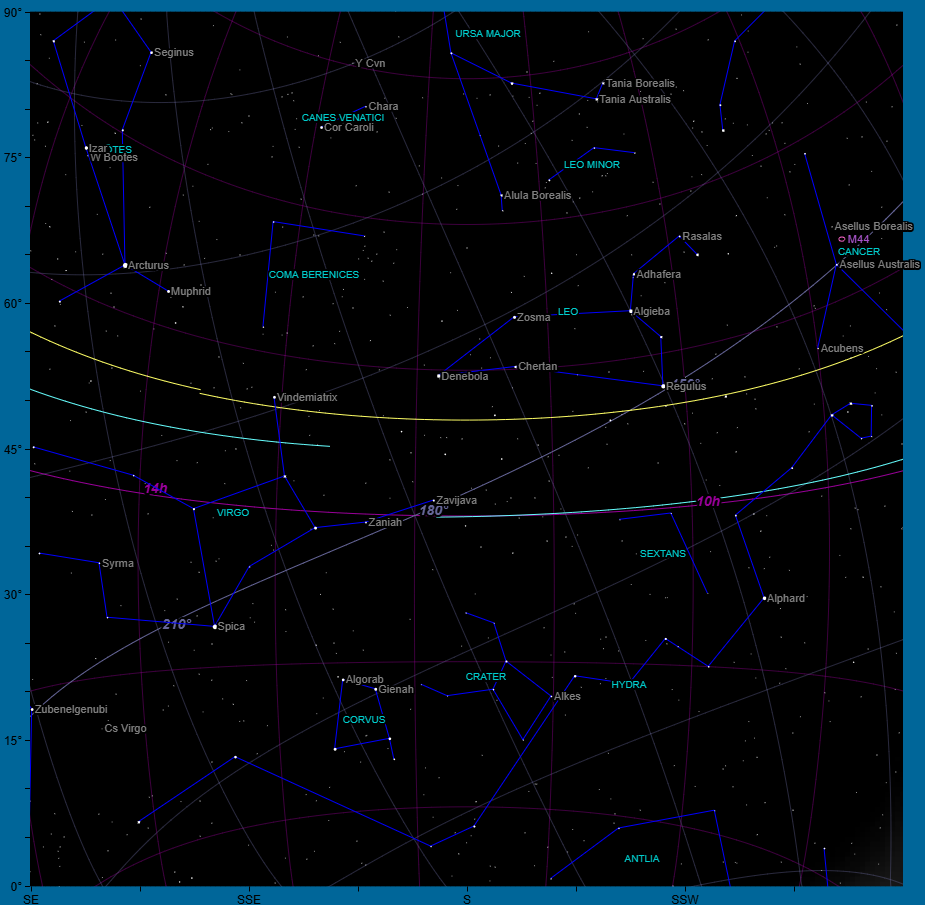
Southern Sky
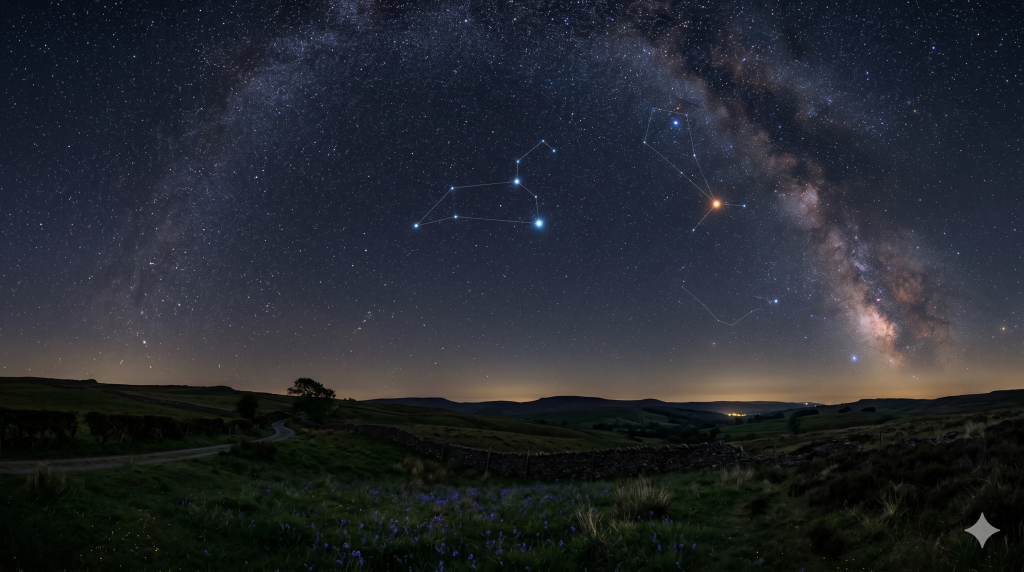
Looking south, the early summer constellations are taking over. The constellation of Virgo, home to the brilliant blue-white star Spica, lies due south. Above it sits Boötes, marked by the blazing orange star Arcturus. As Orion finally sinks in the west, Scorpius begins to rise in the southeast, bringing the red supergiant Antares into view.
NORTHERN SKY
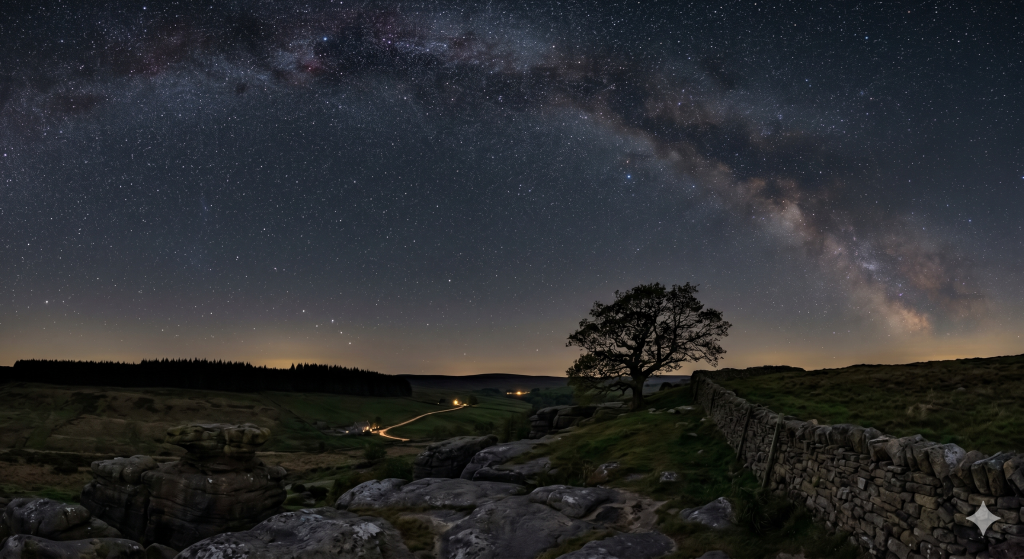
As May nights deepen, the great “W” of Cassiopeia sinks low over the northern horizon. The southern portions of Perseus and Auriga are becoming difficult to observe, though bright Capella still clears the horizon. High overhead, the familiar shape of the Plough (in Ursa Major) is close to the zenith. The winding, cosmic dragon of Draco writhes perfectly between the two bears (Ursa Major and Ursa Minor) in the northern sky.
May 2026 Calendar
| Date | Time (UT) | Event | Details |
|---|---|---|---|
| May 01 | 17:23 | Full Moon | The first of two Full Moons this month! |
| May 03/04 | Night | Moon & Antares | The Moon glides just below Antares |
| May 06 | AM | Eta Aquariid Meteors | Peak of the shower (Moonlight interference) |
| May 09 | 21:10 | Last Quarter Moon | |
| May 14 | 04:15 | Saturn Appears | Saturn reappears in the morning sky, to the lower right of the Moon |
| May 16 | 20:01 | New Moon | Darkest skies of the month |
| May 18 | Evening | Venus & Moon | The crescent Moon pairs beautifully with Venus in the NW after sunset |
| May 19 | Evening | Venus, Jupiter & Moon | The Moon lies exactly between Jupiter (left) and Venus (lower right) |
| May 20 | Evening | Jupiter & Moon | Jupiter sits just below the crescent Moon |
| May 23 | 11:11 | First Quarter Moon | |
| May 23 | 06:41 | Moon & Regulus | Regulus sits less than a tenth of a degree from the Moon |
| May 27 | 14:09 | Moon & Spica | Spica 1.9°N of the Moon |
| May 31 | 08:45 | Full Moon (Blue Moon) | The second Full Moon of the month |
This table captures the astronomical events for April, including phases of the moon, planetary alignments, and other notable occurrences.
SKY MAPS
Looking South on the 15th at 23:00
Looking North on the 15th at 23:00
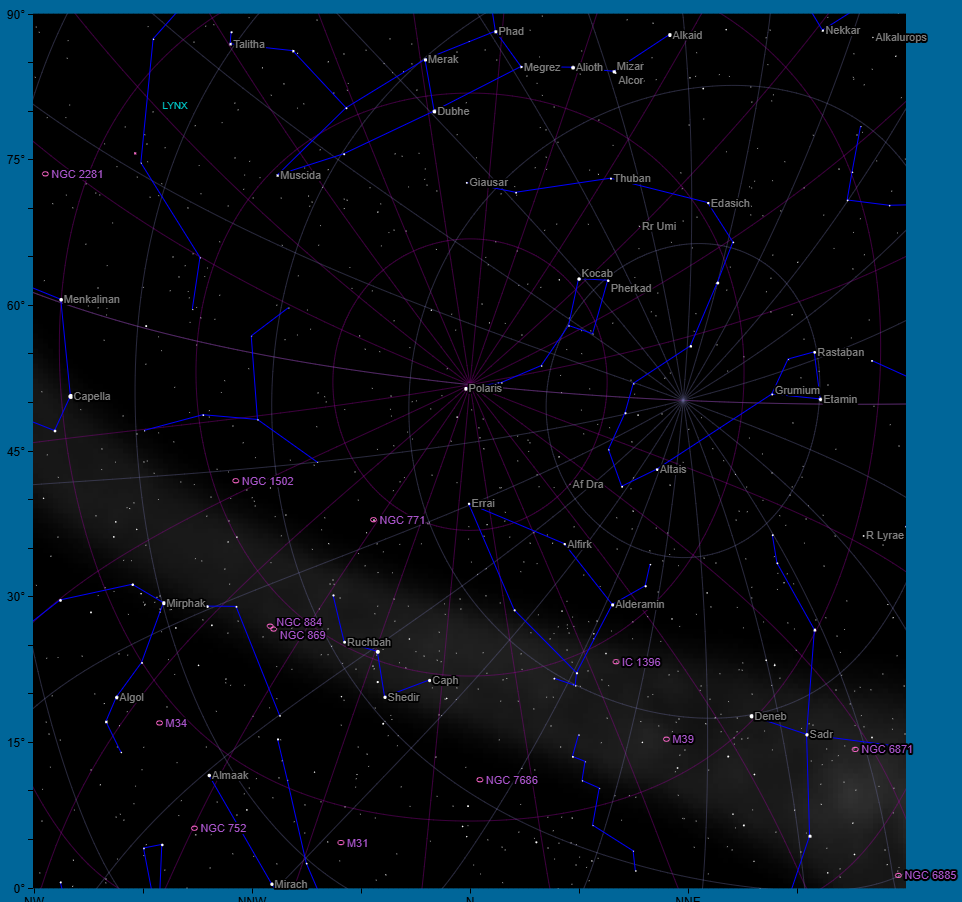
The two charts above show all DSOs of magnitude 6.0 or brighter. They are both taken from
SkyViewCafe.com and correct for the 15th of the month.
April’s Sky Guide
THE SUN
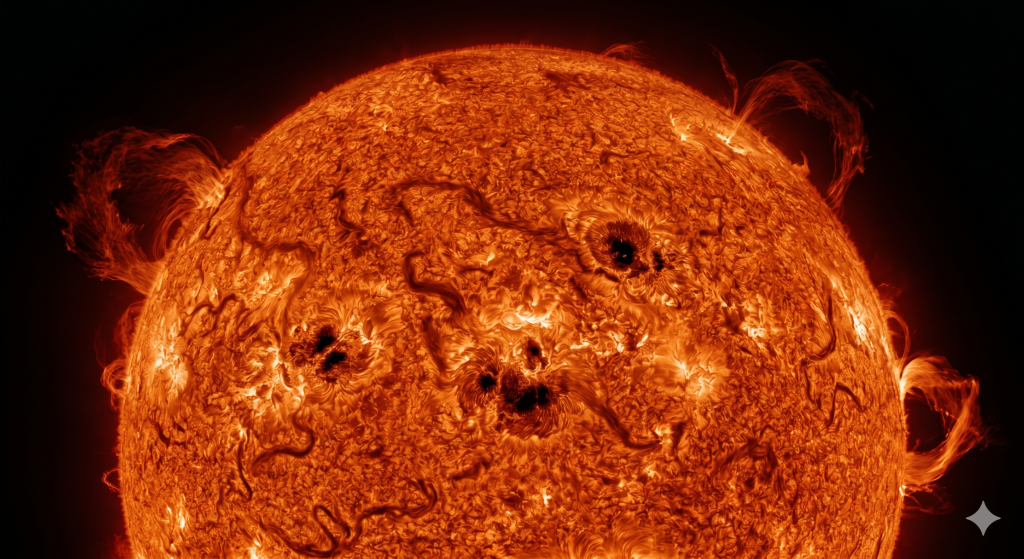
☀️ Solar Forecast – May 2026
Source: NOAA Space Weather Prediction Centre (SWPC) | Data: 27-Day Outlook (Issued 27 Apr 2026)
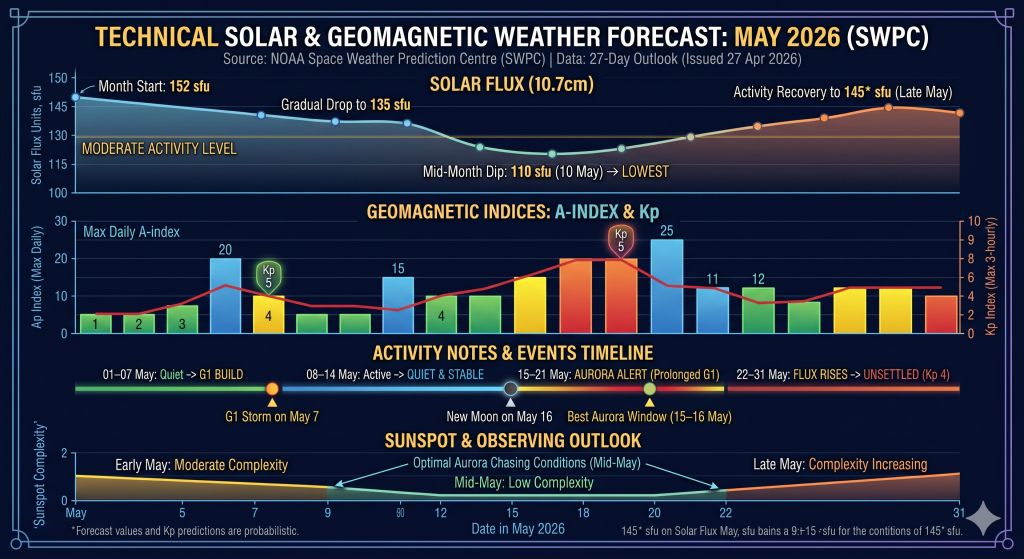
For May, the NOAA forecast indicates a dip in solar flux mid-month, but offers a couple of solid opportunities for geomagnetic storms and potential aurora sightings. The max forecasted level is of KP5. For York this is too low to be visible by eye (normally). But with a clear Northern horizon it may be possible to capture the aurora on camera. Obviously the further North you are the better chance you’ll have!
🌌 Aurora Watch: Key Storm Windows
The Kp Index measures global geomagnetic activity. For May, NOAA forecasts two distinct periods where the index is expected to reach Kp 5 (a G1 Minor Geomagnetic Storm).
- May 7: Kp 5 (G1 Minor Storm). A sudden spike in activity creates a good window for high-latitude observers early in the month.
- May 15 – 16: Kp 5 (G1 Minor Storm). This is the most prolonged storm window of the month, with the A-index peaking at 25 on the 15th. This represents the best mid-month opportunity for aurora chasers across the UK, particularly under the dark skies of the New Moon on May 16!
☀️ Solar Activity: Sunspot & Radio Flux Trends
For those using solar telescopes or safe filters, the 10.7cm Radio Flux (a proxy for sunspot complexity) shows fluctuating levels this month:
- Early May (1 – 8 May): The month starts with moderate flux at 152 sfu, gradually dropping to 135 sfu.
- Mid-May (9 – 15 May): The radio flux dips to a monthly low of 110 sfu around May 10 and remains quiet for several days. As we have seen in previous months, this dip in solar emissions curiously precedes the highest geomagnetic disturbances of the month.
- Late May (16 – 23 May): Activity climbs steadily again alongside the geomagnetic storms, recovering to 145 sfu by May 22–23.
📊 Summary Table
| Date | Max Solar Flux (10.7 cm) | Max Geomagnetic A Index | Max Kp | Activity Notes |
|---|---|---|---|---|
| May 01–07 | 152 | 20 | 5 | Quiet start, building to a G1 Storm on May 7. |
| May 08–14 | 135 | 15 | 4 | Active on May 8, then dropping to very quiet, stable conditions. |
| May 15–21 | 140 | 25 | 5 | Aurora Alert! G1 storms expected on May 15 and 16. |
| May 22–31 | 145* | 12 | 4 | Flux rising again; unsettled conditions (Kp 4) returning. |
(Note: Forecast data currently extends to May 23)
📊 Forecast Visualisation
A generated chart of Mays solar forecast
Aurora Forecasts
A bit US centred but still useful: Aurora Dashboard (Experimental) | NOAA / NWS Space Weather Prediction Center And our own Met-office have an excellent space weather forecast page here: Space Weather – Met Office
The Moon

May’s Lunar Calendar
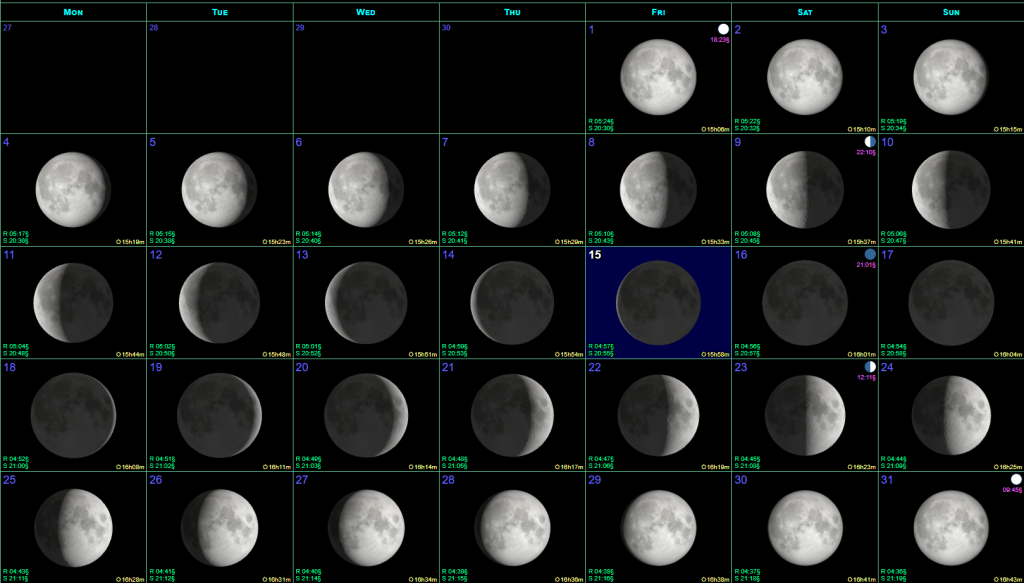
Mays moon calendar from Sky View Café (skyviewcafe.com).
Moon Feature
This April the crew of Artemis II (Commander Reid Wiseman, Victor Glover, Christina Koch, and Jeremy Hansen) did more than just break the record for the farthest human spaceflight (reaching 252,756 miles from Earth). They transitioned from passengers to lunar geographers. During their high-speed flyby, the crew provisionally named two impact sites that are now essential targets for any serious backyard astronomer: Carroll and Integrity
Both craters are located on the Moon’s western limb, a challenging “twilight zone” where the nearside meets the farside.
- Carroll Crater (The Personal Tribute): Named for Carroll Taylor Wiseman, the late wife of the Mission Commander.
- Morphology: It is a simple crater, approximately 3.5 miles (5.6 km) wide. Its high albedo (reflectivity) suggests it is a geologically “young” impact, having not yet been darkened by billions of years of space weathering.
- Coordinates: Situated northwest of the Glushko crater (7.8^{\circ} N, 90.7^{\circ} W). Because it sits right at the 90^{\circ} W longitudinal line, it is at the absolute limit of visibility.
- Integrity Crater (The Mission Landmark): Named for the crew’s callsign for the Orion capsule.
- Context: Located northwest of the Orientale Basin, a massive “bullseye” impact structure 600 miles wide. Integrity sits in the rugged highlands surrounding the basin, an area of extreme geological complexity.
How to View Them: The Secret of Libration
Because these craters sit on the very edge of the Moon, they are not always visible. To see them, you must wait for a phenomenon called lunar libration.
Although the Moon is tidally locked to Earth, it “wobbles” over its 27-day orbit. This creates a “peek-a-boo” effect, allowing us to see up to 59% of the lunar surface over time. To catch Carroll and Integrity, you need a favourable Western Libration—when the Moon’s western edge is tilted toward Earth.
Observing Tips for May 2026:
- Check the Longitude: Look for dates when the Moon’s libration in longitude is strongly negative (around -6^{\circ} to -8^{\circ}). This “pulls” the western limb into better view from Earth.
- Timing the Terminator: The best time to see crater detail is when the lunar terminator (the line between day and night) is nearby, as long shadows reveal depth. For these craters, this typically occurs a few days after the Full Moon.
- Software Assistance: Use a tool like the Virtual Moon Atlas to track real-time libration. Look for the bright ray system of Glushko; if you can see Glushko clearly, Carroll is just a short hop to the northwest.
Planets

⚪ Mercury
Mercury spends the first half of May lost in the Sun’s glare, reaching superior conjunction on May 14. However, it swings into the evening sky late in the month. From May 20 onwards, it joins Venus in the northwest after sunset, well down to the lower right. By the end of May, it shines at a bright magnitude -0.6 and sets around 11 pm.
🟡 Venus
Venus is an absolute treat this month. It is the brilliant Evening Star, blazing at magnitude –3.9 in a dark sky. By the end of May, it won’t set until midnight! On the evenings of May 18 and 19, it forms a dazzling, highly photogenic gathering with a crescent Moon and Jupiter.
🔴 Mars
Mars is currently a very difficult morning object for UK observers. Spending the month tracking from Pisces into Aries, it shines around magnitude +1.2. However, it remains mired in the bright dawn twilight before sunrise, making it a very tough catch.
🟠 Jupiter
Jupiter blazes at magnitude –1.9 in the constellation Gemini, positioned to the lower left of the twin stars Castor and Pollux. It sets around 1 am. Don’t miss the beautiful convergence on May 19, when the Moon sits exactly between Jupiter and Venus in the evening sky!
🪐 Saturn
After being lost to the solar glare, Saturn begins to emerge into the dawn sky in Pisces by mid-May. It shines at magnitude +0.9. By the end of the month, the ringed planet will be rising around 3 am.
🔵 Uranus
Uranus reaches solar conjunction on May 22, meaning it is entirely lost in the Sun’s glare this month and cannot be observed.
🔷 Neptune
Neptune lies in Pisces, rising in the early morning hours. At a faint magnitude +7.8, it requires a telescope and a dark, moonless night to be spotted.
METEOR SHOWERS

he Eta Aquariids (Peak: May 6)
The Eta Aquariids are debris left behind by the famous Halley’s Comet. These meteors are incredibly fast, smashing into our atmosphere at around 210,000 km/h, and roughly a quarter of them leave persistent, glowing trains that can last for several seconds!
The Catch for 2026: The shower peaks on the morning of May 6, offering a maximum rate of roughly 40 meteors per hour. Unfortunately, this peak coincides perfectly with a very bright waning gibbous Moon (following the May 1 Full Moon). The moonlight will wash out the fainter meteors, but it is still worth heading out in the early hours before dawn to try and catch a few of the brightest fireballs cutting through the lunar glare.
COMETS

May brings a couple of reliable telescopic targets for early risers and dedicated imagers.
| Comet Name | Predicted Magnitude | Visibility Period (Approx.) | Notes |
|---|---|---|---|
| 88P/Howell | 9 | Morning | A short-period Jupiter-family comet. Best seen low in the southeast before dawn. |
| 10P/Tempel 2 | 10 | Morning | Approaching its summer perihelion, this comet is brightening. Visible in the morning sky. |
| C/2024 E1 (Wierzchos) | 12 | Evening | Fading considerably now, but still trackable for imagers in the evening sky. |
| C/2025 A6 (Lemmon) | 12 | Morning | A faint telescopic object, but one to watch as it may brighten significantly by autumn. |
| 29P/Schwassmann-Wachmann 1 | 13 (Variable) | Most of the night | The unpredictable centaur. Always worth checking for sudden, massive outbursts. |
Data sourced from Seiichi Yoshida’s Visual Comets in the Future.
DEEP SKY (DSOs)
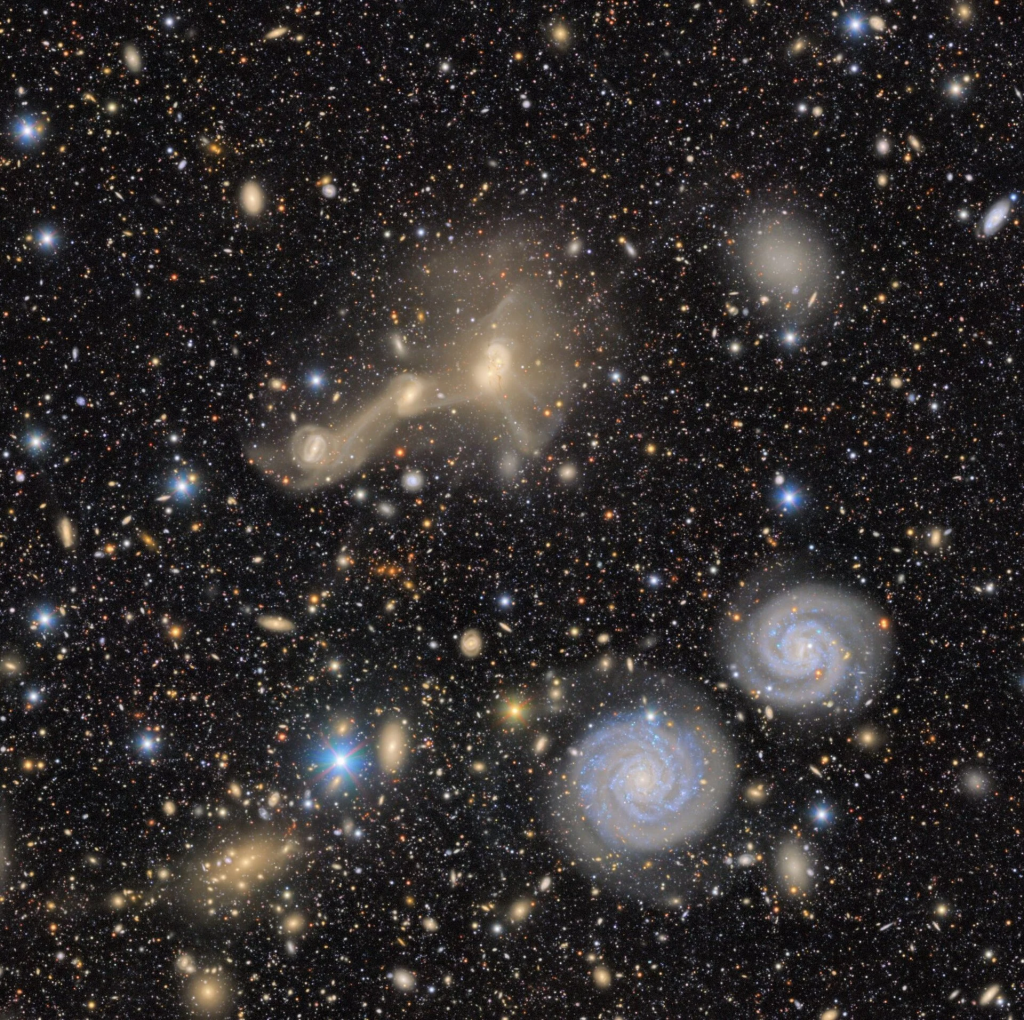
A Vera Rubin Observatory view of a portion of the Virgo Cluster. Galaxies are crammed together so close that that their gravitational pull tears them apart,as we see in the two galaxies near the center of the image. That leaves behind some galaxies without as many stars as they started with, but with “overmassive” black holes. Image credit: RubinObs/NOIRLab/SLAC/NSF/DOE/AURA
Deep Dive: The Realm of the Galaxies (The Virgo Cluster)
With the Milky Way mostly out of the way during spring, our view into deep space is unobscured, making May the perfect time to explore the Virgo Cluster.
Located roughly 54 million light-years away, this massive cluster contains an astonishing 2,000 individual galaxies. Its immense gravity holds many neighbouring galaxy groups in thrall, forming the centre of the Virgo Supercluster (of which our own Milky Way is just a minor suburb on the outskirts!).
- The King of the Cluster (M87): Sweeping the ‘Y’ shape of the constellation Virgo with a telescope will bring you to the heart of the cluster. The undisputed king here is Messier 87 (M87), a giant elliptical galaxy. M87 is a true monster, containing trillions of stars and a central supermassive black hole weighing 6.5 billion times the mass of our Sun.
- How to Observe: While you won’t see the black hole, a moderate-to-large telescope under dark, moonless skies (aim for the New Moon around May 16) will reveal M87 as a bright, fuzzy ball of light. If you have a large aperture scope and excellent seeing, you might even glimpse the dozens of fainter companion galaxies swarming in the same field of view.
ISS
🚀 ISS Overpasses
| Date | Mag | Start (Time / Alt / Az) | Max Point (Time / Alt / Az) | End (Time / Alt / Az) |
|---|---|---|---|---|
| 4 May | -2.2 | 18:39:28 (10° SSE) | 18:41:42 (17° SE) | 18:42:08 (16° ESE) |
| 5 May | -2.0 | 19:27:42 (10° WSW) | 19:30:45 (33° NW) | 19:32:46 (17° N) |
| 6 May | -3.8 | 18:39:52 (10° SW) | 18:43:12 (85° NW) | 18:46:32 (10° NE) |
| 8 May | -1.0 | 05:28:58 (10° N) | 05:31:46 (24° NE) | 05:34:35 (10° ESE) |
| 8 May | -0.5 | 18:42:35 (10° W) | 18:44:37 (15° NW) | 18:46:38 (10° NNW) |
| 9 May | -0.2 | 04:42:58 (10° NNE) | 04:44:09 (11° NE) | 04:45:20 (10° ENE) |
| 10 May | -3.6 | 05:29:49 (10° NW) | 05:33:07 (53° SW) | 05:36:25 (10° SSE) |
| 11 May | -3.2 | 04:42:10 (10° NNW) | 04:45:29 (58° NE) | 04:48:48 (10° SE) |
| 12 May | -1.2 | 03:58:37 (22° ENE) | 03:58:37 (22° ENE) | 04:00:37 (10° ESE) |
| 13 May | -1.5 | 04:48:56 (13° S) | 04:48:56 (13° S) | 04:49:28 (10° S) |
(Note: As satellite passes depend heavily on your specific location and the exact date, please use dedicated tracker apps or websites like Heavens-Above closer to the time for accurate May 2026 ISS overpass schedules.)
USEFUL RESOURCES
- StarLust – A Website for People with a Passion for Astronomy, Stargazing, and Space Exploration.
- https://www.spacedaily.com/
- http://www.n3kl.org/sun/noaa.html
- http://skymaps.com/downloads.html
- Astronomy Calendar of Celestial Events – Sea and Sky (seasky.org)
- http://www.deepskywatch.com/deepsky-guide.html
- https://www.constellation-guide.com/
- IMO | International Meteor Organization
- https://in-the-sky.org/
- And of course, the Sky at Night magazine!