
A monthly look at astronomical events in the sky and on Earth
Compiled and written by Steve Sawyer

Welcome to July’s edition of What’s Up
Welcome to July! For observers in northern latitudes, the short summer nights mean that true darkness is still quite elusive, with twilight persisting for much of the night. However, this keeps our chances alive for spotting the beautiful, electric-blue glow of noctilucent (“night-shining”) clouds low on the northern horizon.
So whilst waiting for noctilucent clouds It’s always fun on summer evenings to satellite spot. Especially reclined in a garden chair with a cold beer!
Try to count how many overpasses you can spot in 30 mins or so.
This month also brings a fantastic planetary encounter in the early morning sky, as Mars and Uranus pass incredibly close to one another, and the evening skies are graced by Venus, reigning as the undisputed Queen of the summer nights.
This Month’s York Astro Presentations
Upcoming events to put in your diary:
| Date | Title | Speaker |
|---|---|---|
| 03/07/2026 | Atmospheres of our Solar System (The First in a Four Part Trilogy) | Paul Money |
| 17/07/2026 | James Webb II | Dave Armeson |
Note we don’t have any presentations in August. But keep an eye on the website or Facebook group as there are often Persoid events and this year there is a partial eclipse on the 12th August.
For further details see the events page on the main website Astronomy Presentations by guest speakers. for those that dare to venture in to the wilds of social media we have a Facebook group : Search for The York Astronomical Society Chat Group.
So what’s on this month?
Here are this months events and guides. If you have children don’t forget the Young Astronomers section!
Northern & Southern Sky

The Northern Highlights
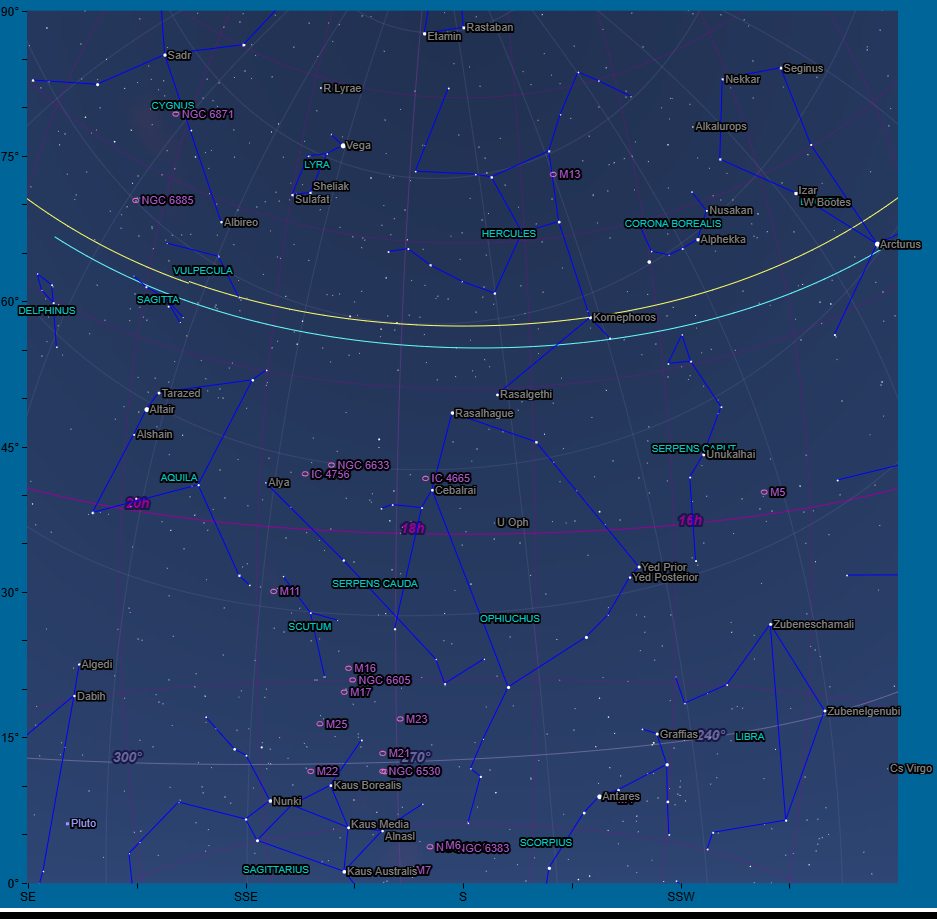
Looking north, the brilliant star Vega in Lyra shines high overhead near the zenith. The sprawling constellation of Hercules sits nearby. In the north-western sky, you can find the distinctive semi-circle of Corona Borealis and Boötes, marked by the blazing orange tinted star Arcturus
The band of the Milky Way runs from north to south on the eastern side of the meridian, carrying the constellation of Cygnus high into the sky. Albireo, the star marking the Swan’s beak, is a must-see through a telescope it is a stunning optical double star featuring a bright orange giant and a blue-white companion .

The Southern Highlights
Although part of it remains hidden from our latitude, this is perhaps the best time of year to view Scorpius, with its deep red supergiant star Antares** glowing just above the southern horizon.
To the east of Scorpius lies Sagittarius. This constellation is famous for the distinctive asterism of the “Teapot”. The incredibly dense star clouds at the centre of the Milky Way appear as glowing “steam” rising from the teapot’s spout. The Great Dark Rift—dense clouds of dust that obscure starlight—runs directly down the Milky Way from Cygnus into Sagittarius .
July 2026 Calendar
| Date | Time (UT) | Event | Details |
|---|---|---|---|
| Jul 04 | 03:00 | Mars & Uranus | Mars passes incredibly close to Uranus (just 9 arcminutes away!) [8]. |
| Jul 06 | 17:30 | Earth at Aphelion | The Earth is furthest from the Sun, at 152 million km |
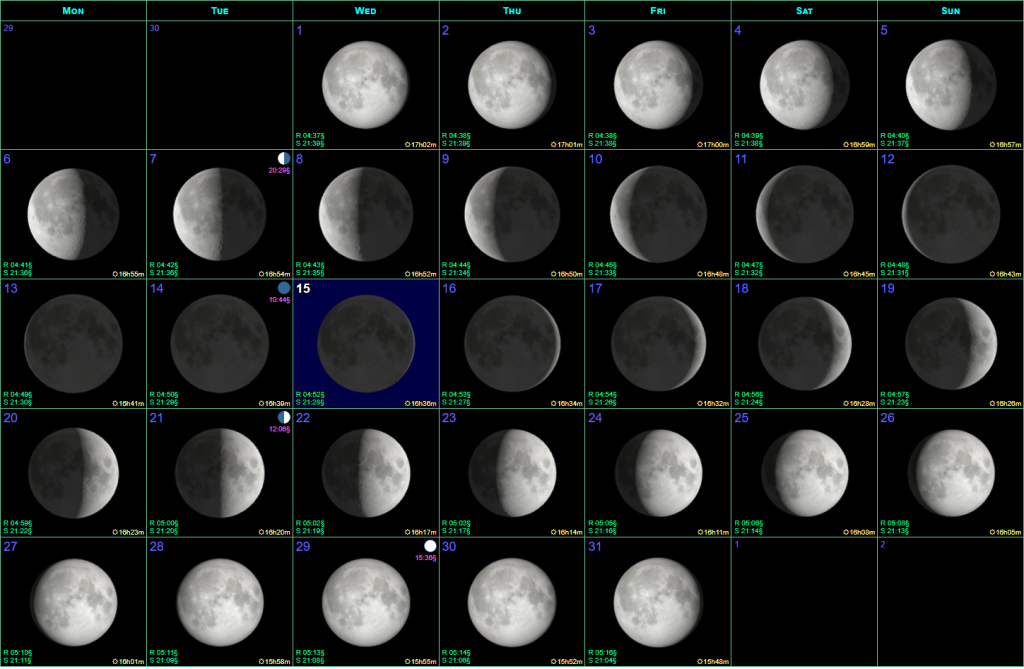
| Jul 07 | 19:29 | Last Quarter Moon | |
| Jul 07/08 | AM | Moon & Saturn | Saturn lies near the Moon in the early hours |
| Jul 09 | Evening | Venus & Regulus | Venus passes less than a degree from Regulus |
| Jul 10 | 22:54 | Moon & Pleiades | The Moon sits just 1.1° south of the Pleiades cluster |
| Jul 11 | AM | Moon & Mars | The Moon rises beside the Pleiades, with Mars to the lower left. |
| Jul 14 | 09:43 | New Moon | |
| Jul 17 | Evening | Moon & Venus | The crescent Moon forms a lovely duo with Venus low in the west. |
| Jul 21 | 11:06 | First Quarter Moon | |
| Jul 24 | 21:00 | Moon & Antares | The Moon glides under Antares low in the southern sky. |
| Jul 29 | 14:36 | Full Moon | |
| Jul 30 | Night | Meteor Showers | Peaks of the Alpha-Capricornid and Southern Delta-Aquariid showers (Moonlight interference) . |
This table captures the astronomical events for July, including phases of the moon, planetary alignments, and other notable occurrences.
Sky Maps
Looking South on the 15th at 23:00, as you can probably tell it’s not very dark!
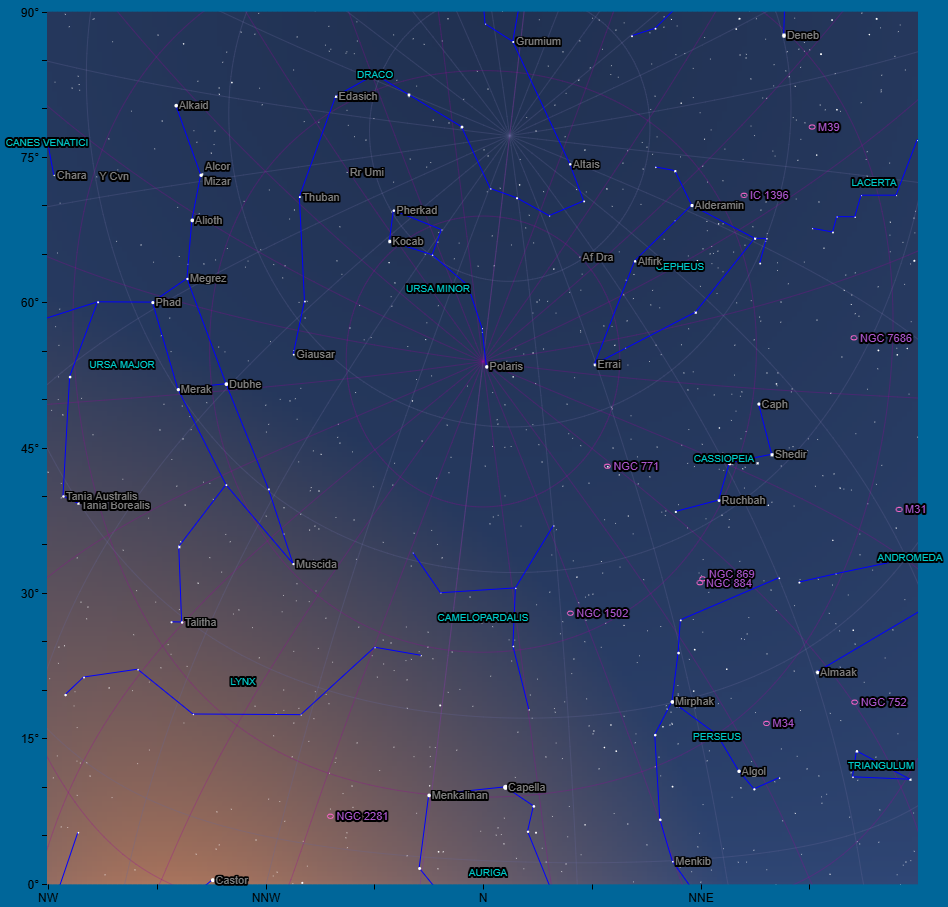
Looking North on the 15th at 23:00
July’s Sky Guide

The Sun
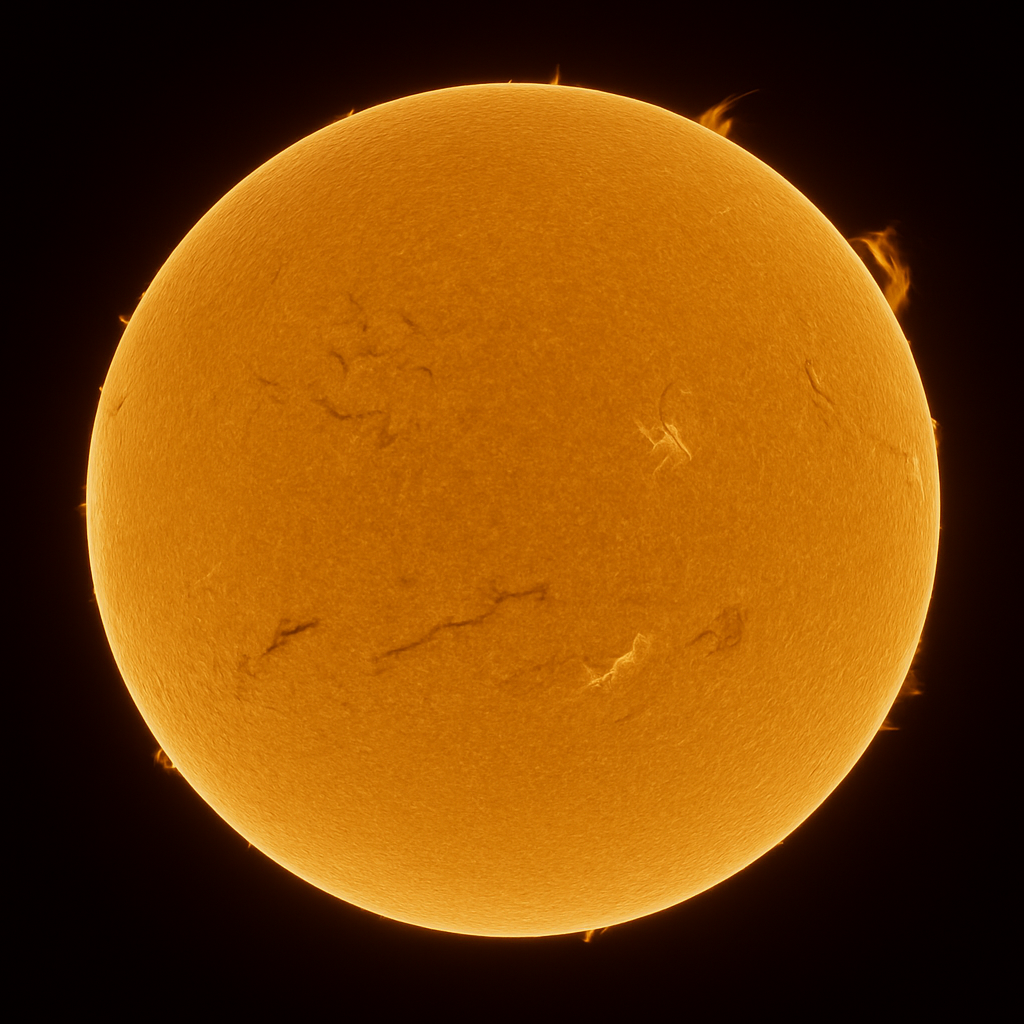
☀️ Solar Forecast – July 2026
As we step into July 2026, the Sun continues to display significant activity, consistent with an active period in our current solar cycle.
Based on the latest 27-day Space Weather Outlook issued by the NOAA Space Weather Prediction Centre (SWPC) on 29 June 2026, here is what to expect for the month ahead.
Understanding the Indices
To make sense of the forecast, we look at two primary indicators:
- 10.7 cm Radio Flux: This is a measure of solar radio emissions, which serves as an excellent proxy for overall solar activity. Higher values generally correspond to more sunspots and higher solar activity.
- Planetary K-index (Kp): This index measures the geomagnetic activity on Earth. It ranges from 0 to 9, where lower numbers signify “quiet” conditions, and values of 5 or higher indicate a geomagnetic storm. A higher Kp index increases the likelihood of auroral displays at lower latitudes.
The Month Ahead at a Glance
July begins with relatively high activity, with the Kp index reaching 4 around July 1st, before settling down. Throughout the middle of the month, we anticipate a more “quiet” period. However, as we look toward the end of July, the forecast indicates another rise in geomagnetic activity.
This guide doesn’t include the recent X1 flare that happened on the 30th June. This CME is expected to arrive on the 2nd of July, so keep a look out using the resources listed at the end of this section.
| Period | Expected Activity | Notes |
|---|---|---|
| July 1–7 | Quiet to Active | Starts with a Kp of 4 on July 1st, then drops to stable levels (Kp 2). |
| July 8–9 | Active | A brief increase to Kp 4 is expected. |
| July 10–21 | Quiet | Generally low geomagnetic activity (Kp 2–3). |
| July 22–25 | Active to Storm Level | Increased activity with a forecasted Kp of 5 on July 22nd, tapering to Kp 3 by July 25th. |
What This Means for You
While these forecasts provide a helpful guide, it is important to remember that space weather is dynamic and can change rapidly.
- For Aurora Hunters: The forecasted Kp index of 5 on July 22nd is categorized as a “Minor Storm” (G1 on the NOAA G-scale). Under these conditions, aurorae may be visible at higher latitudes. Keep a close watch on real-time data if you are hoping to catch a display.
- Stay Informed: Because the Sun’s activity is unpredictable, we recommend checking real-time space weather resources frequently if you are planning an evening of dedicated observation.
Aurora Forecasts
US centred but still useful.
Aurora Dashboard (Experimental) | NOAA / NWS Space Weather Prediction Center
And our own Met-office have an excellent space weather forecast page here Space Weather – Met Office
The Moon

The crescent Moon forms a lovely duo with Venus low in the west on the 17th. I want to be here!
July’s Lunar Calendar
Moon Feature

Lunar Feature of the Month: The Nectaris Trio Best Viewed: Around July 21 (First Quarter Moon)
If you follow the terminator (the line between lunar day and night) around the time of the First Quarter Moon, you will see a dark mare region called Mare Nectaris (the “Sea of Nectar”). Curving beautifully around its eastern shore is a prominent, spectacular trio of craters: Theophilus, Cyrillus, and Catharina.
This trio is one of the best places on the Moon to see how cosmic impacts overlap over time. Theophilus, the northernmost of the three, is a stunning crater with a prominent central mountain peak. If you look closely, you can see that Theophilus actually overlaps the northwestern edge of Cyrillus, proving to astronomers that Theophilus is the younger, fresher crater. Just to the south of Cyrillus lies Catharina, which appears much more battered, worn-down, and ancient. Looking at these three side-by-side provides a perfect snapshot of lunar history!
Planets

⚪ Mercury
Mercury is too close to the Sun to be observed in July .
🟡 Venus
Venus is the absolute Queen of the evening sky, blazing brilliantly at magnitude –4.2 over in the west and setting about 11 pm . On July 9, the Evening Star passes right above the star Regulus . The crescent Moon forms a highly photogenic pairing with Venus on the evening of July 17 .
🔴 Mars
Mars rises around 2 am in the constellation Taurus, shining at magnitude +1.3 . During July, it tracks past the Pleiades and Aldebaran . Set your alarms for the morning of July 4, when Mars passes just 9 arcminutes away from Uranus, an excellent chance to view the reddest and greenest planets in the same telescope field of view !
🟠 Jupiter
At the start of July, Jupiter sits well down to the lower right of Venus in the evening twilight . Shining at magnitude –1.8, it sets around 10:30 pm, but after a few days, it sinks out of sight into the Sun’s glow entirely .
🪐 Saturn
Saturn commands the early morning hours. Shining at magnitude +0.8 in Pisces, it rises just after midnight . The Moon passes nearby on July 7 and 8 .
🔵 Uranus
Uranus lies in Taurus, near the Pleiades, rising around 1:30 am. At magnitude +5.8, it is a binocular object. Don’t miss its incredibly close encounter with Mars on the morning of July 4th!
🔷 Neptune
Neptune sits about 10 degrees to the right of Saturn in Pisces, rising around 1 am . Glowing faintly at magnitude +7.7, it requires binoculars or a telescope to spot .
Meteor Showers

The Summer Showers
July brings three meteor showers, though the light summer nights and moonlight will present a significant challenge this year.
- The Alpha-Capricornids (Peak: July 30): Active from early July to mid-August, this shower only produces about 5 meteors per hour, but it is famous for producing very bright, slow-moving fireballs !
- The Southern Delta-Aquariids (Peak: July 30): This is the most prominent shower of the month, potentially offering up to 25 meteors per hour.
- The Catch for 2026: Unfortunately, the peak of both of these showers coincides with a bright, Full Moon on July 29 . The moonlight will wash out all but the brightest fireballs .
Comets

Here are the best telescopic comet targets for July 2026.
| Comet Name | Predicted Magnitude | Visibility Period (Approx.) | Notes |
|---|---|---|---|
| 10P/Tempel 2 | 8 | Morning / Midnight | Brightening nicely to magnitude 8! Visible high in the sky through the early morning hours [12]. |
| 88P/Howell | 11 | Midnight / Morning | Hovering around magnitude 11 to 12 as it moves through the night sky [12]. |
| 78P/Gehrels 2 | 12 | Midnight | A faint telescopic target [12]. |
| C/2024 J3 (ATLAS) | 12 | Most of the night | Faint telescopic object requiring long exposures [12]. |
| 169P/NEAT | 13 | Midnight | Very faint target at magnitude 13 [12]. |
Data sourced from Seiichi Yoshida’s Visual Comets in the Future.
Deep Sky (DSOs)

Deep Dive: The Teapot’s Steam (Sagittarius)
To the ancient Greeks, the star pattern of Sagittarius represented a centaur archer, but to modern eyes, its brightest stars form the unmistakable shape of a Teapot. As you look toward Sagittarius, you are looking directly toward the dense, star-packed centre of our Milky Way galaxy.
This region is incredibly rich in nebulae and star clusters. Rising from the “spout” of the teapot is the visual representation of cosmic steam:
- The Lagoon Nebula (M8): Located just above the spout, this wonderful region of starbirth is visible to the naked eye on a really dark night and looks stunning in binoculars or a telescope. It is a massive cloud of hydrogen gas located 5,000 light-years away.
- The Trifid Nebula (M20): Sitting right next door to the Lagoon Nebula is the Trifid Nebula. Requiring a telescope to spot, this nebula is famously divided into three lobes by dark, swirling dust lanes.
- The Omega Nebula & M22: If you scan higher up with binoculars, you will find the Omega Nebula (another star-forming region) and Messier 22, a brilliant globular cluster containing almost a million stars located 11,000 light-years away.
🔭 Junior Stargazers: July’s Cosmic Wonders!
A special guide for our young astronomers. Grab your coat, step outside, and look up!

Welcome to the night sky! The warm summer nights of July are the absolute best time to start stargazing. You don’t need a telescope, just your eyes, a bit of imagination, and maybe a blanket to lie back on!
Here are the coolest things to look out for in the sky this July:
☕ The Cosmic Teapot
Did you know there is a giant teapot in space? Look towards the south and see if you can connect the stars to draw a teapot shape. This is the constellation Sagittarius! Even cooler, if you look on a really dark night, you will see a glowing, hazy cloud of light rising right out of the teapot’s spout like steam. That “steam” is actually the centre of our very own Milky Way galaxy, packed with millions of stars!
🌟 The Evening Star
If you look towards the west just after the Sun goes down, you will see an incredibly bright “star.” This is actually the planet Venus! It is so bright that it is called the Evening Star. On the night of July 17th, look for a beautiful, thin crescent Moon sitting right next to it.
🔴 Mars meets Uranus (July 4th)
Early in the morning on July 4th, the red planet Mars is going to fly incredibly close to the green planet Uranus. If you have a pair of binoculars, you might be able to see them both in the exact same view—the reddest planet and the greenest planet right next to each other!
☀️ The Furthest Day (July 6th)
Here is a crazy space fact: on July 6th, the Earth will be at “Aphelion.” That is a fancy science word that means we are at the furthest point from the Sun in our entire orbit! But wait… if we are furthest from the Sun, why is it so hot in July? It’s because the Earth is tilted! Right now, the top half of the Earth (where we live) is leaning straight into the warm sunlight, giving us summer, even though the whole planet is further away!
🚀 ISS Overpasses
| Date | Max Brightness (Mag) | Start Time (UT) | Max Altitude & Direction | End Time & Direction |
|---|---|---|---|---|
| 3 Jul | –1.0 | 19:52:16 | 13° above SW | 19:52:42 at SW |
| 4 Jul | –3.7 | 19:04:23 | 54° above SE | 19:10:57 at NE |
| 5 Jul | –0.2 | 19:55:16 | 11° above NW | 19:57:24 at NW |
| 6 Jul | –1.2 | 19:05:37 | 24° above NW | 19:11:10 at N |
| 9 Jul | –1.7 | 05:05:29 | 32° above NE | 05:11:34 at ESE |
| 10 Jul | –0.5 | 04:18:36 | 15° above NE | 04:22:30 at E |
| 11 Jul | –3.3 | 05:05:58 | 39° above SW | 05:12:18 at SSE |
| 12 Jul | –1.1 | 04:24:02 | 13° above SE | 04:24:30 at SE |
Observing Tip for the ISS: Notice the spectacular pass on 4 July at 19:04 UT. Reaching a maximum magnitude of –3.7, it will climb very high into the southeastern sky (54° altitude), making it brilliantly visible across the UK even before full twilight sets in. The passes split from late evening to early morning around 7–9 July as the station’s orbital plane shifts relative to our twilight zone.
(Note: As satellite passes depend heavily on your specific location and the exact date, please use dedicated tracker apps or websites like Heavens-Above closer to the time for accurate July 2026 ISS overpass schedules.)
Useful Resources
- StarLust – A Website for People with a Passion for Astronomy, Stargazing, and Space Exploration.
- https://www.spacedaily.com/
- http://www.n3kl.org/sun/noaa.html
- http://skymaps.com/downloads.html
- Astronomy Calendar of Celestial Events – Sea and Sky (seasky.org)
- http://www.deepskywatch.com/deepsky-guide.html
- https://www.constellation-guide.com/
- IMO | International Meteor Organization
- https://in-the-sky.org/
- And of course, the Sky at Night magazine!
Great work again Steve