A monthly look at astronomical events in the sky and on Earth
Compiled and written by Steve Sawyer
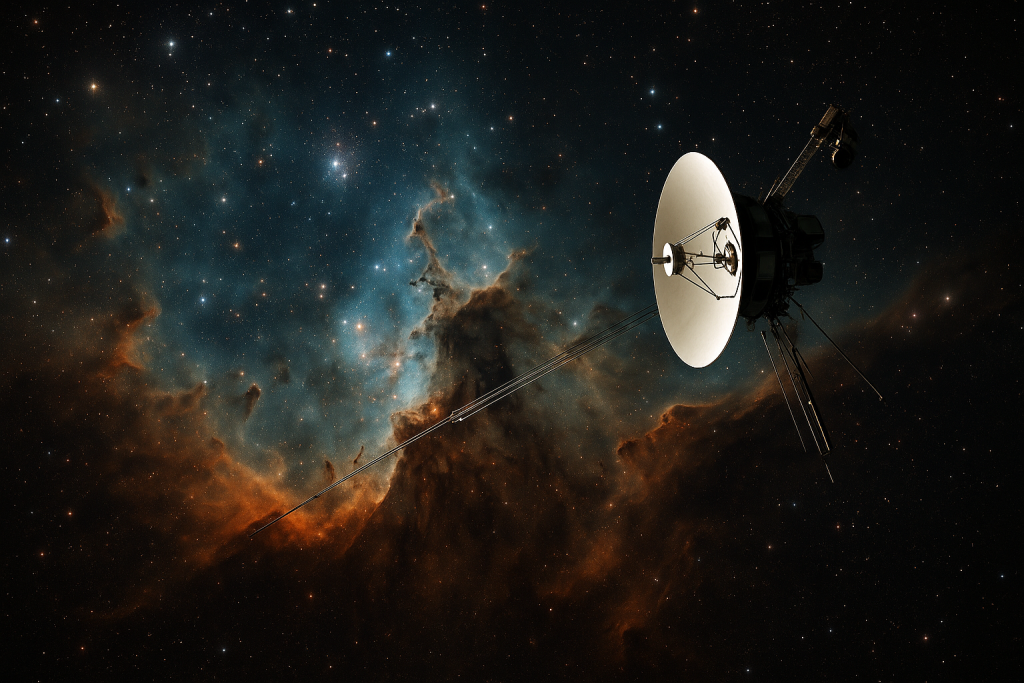
This month, we’re drawing inspiration from the legendary British space artist David A. Hardy, born in 1936. Hardy has enjoyed a long and pioneering career, creating awe-inspiring depictions of the cosmos. His first published work appeared in 1952, and over the decades, his illustrations have graced the pages of numerous magazines and books including several collaborations with Sir Patrick Moore.
Originally working in watercolours and gouache, Hardy later expanded his repertoire to include acrylics, oils, pastels, photography, and since 1991, digital art using Photoshop on a Mac. His ability to evolve with the times while maintaining his unique artistic vision makes him a true icon of astronomical illustration. (Ref: astroart.org)
👉 Watch a YouTube gallery of his work: https://youtu.be/Fnq1D6Z94L0
Welcome to August’s What’s up!
Here’s what’s up this month! August brings the return of astronomical darkness for a few hours alongside warm evenings. August also brings the annual Perseid meteor shower which is well worth watching.
Here’s what’s up this month!
This Months and Upcoming York Astro Presentations
Upcoming events to put in your diary
| Date | Title | Speaker |
|---|---|---|
| August break and then in Autumn we start the 2025/2026 season | ||
| 05/09/2025 | The Largest Telescope on Earth: From an Inch to Forty Metres | Jurgen Schmoll |
For further details see the events page Astronomy Presentations by guest speakers | York Astro and our Facebook group (20+) The York Astronomical Society Chat Group | Facebook
So what’s on this month?
Ursa Major sits upright in the northwest (though its dim southern stars fade), with Boötes standing tall in the west as Arcturus sinks toward the horizon. Corona Borealis and Hercules gleam overhead, while Capella crowns the northeast and Auriga still hugs the horizon. Perseus is climbing into view—followed later by the Pleiades—while the faint Camelopardalis drifts between Perseus and Polaris.
Cassiopeia and Cepheus lie deep in the Milky Way band near the zenith. Pegasus and Andromeda soar above the eastern horizon, with Pisces edging up below them. Deneb and Vega—two vertices of the Summer Triangle—are almost overhead.
From Cygnus near the zenith, the Milky Way arches southward through Aquila (with Altair) down to Sagittarius’s “Teapot.” Nestled in the star clouds are the little constellations Vulpecula, Sagitta, Delphinus and Scutum (home to the binocular-friendly “Wild Duck” cluster M11), with Capricornus and Aquarius rising to the southeast.
Sky Diary
This table captures the astronomical events for July, including phases of the moon, planetary alignments, and other notable occurrences.
| Date | Event |
|---|---|
| 01 | 12:41 – First Quarter Moon |
| 01 | 20:37 – Moon at apogee (404 164 km) |
| 04 | 01:40 – Antares 0.6° N of Moon |
| 09 | 07:55 – Full Moon |
| 10 | 23:58 – Minor planet (89) Julia at opposition (mag 8.5) |
| 12 | 07:00 – Venus (mag –4.0) 0.9° S of Jupiter |
| 12 | 15:05 – Saturn (mag 0.7) 4.0° S of Moon |
| 12 | — – Perseid Meteor Shower maximum |
| 14 | 18:01 – Moon at perigee (369 287 km) |
| 16 | 05:12 – Last Quarter Moon |
| 16 | 16:09 – Pleiades 0.9° S of Moon |
| 19 | 10:00 – Mercury at greatest elongation (18.6° W) |
| 19 | 21:05 – Jupiter (mag –2.0) 4.8° S of Moon |
| 20 | 12:07 – Pollux 2.4° N of Moon |
| 21 | 16:14 – Mercury (mag –0.3) 3.7° S of Moon |
| 23 | 06:06 – New Moon |
| 26 | 13:53 – Minor planet (6) Hebe at opposition (mag 7.5) |
| 26 | 16:41 – Mars (mag 1.6) 2.8° N of Moon |
| 27 | 12:00 – Mercury at perihelion |
| 27 | 13:57 – Spica 1.1° N of Moon |
| 29 | 15:34 – Moon at apogee (404 552 km) |
| 31 | 06:25 – First Quarter Moon |
| 31 | 09:55 – Antares 0.7° N of Moon |
| 31 | — – α-Aurigid Meteor Shower maximum |
Sky Maps
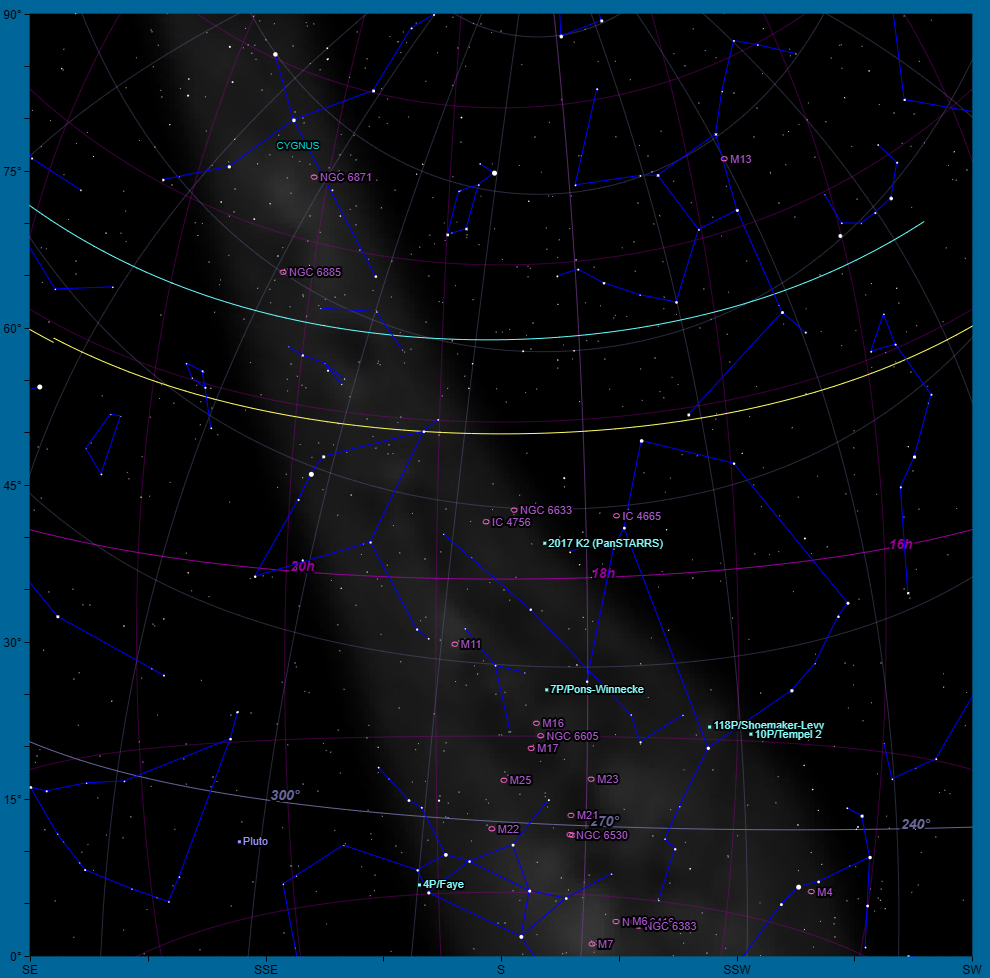
Looking South on the 15th at 22:00
Looking North on the 15th at 22:00
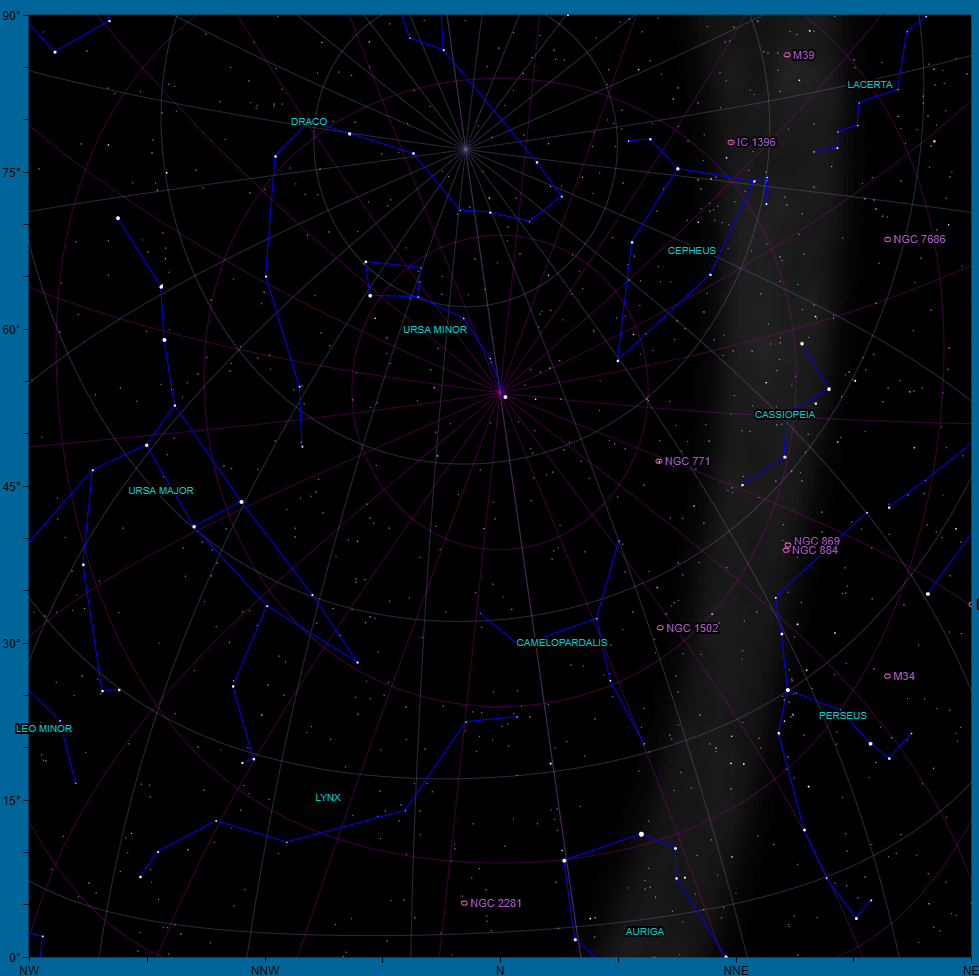
The two charts above show all DSOs of magnitude 6.0 or brighter. They are both taken from
SkyViewCafe.com and correct for the 15th of the month. For a clickable list of Messier objects with images, use the Wikipedia link.
Augusts Objects
The Sun
🔆 August 2025 Space Weather Outlook: Storm Surges and Solar Fireworks
Data Source: NOAA SWPC – Issued July 28, 2025
Radio Flux, Kp Index & Geomagnetic Predictions
As August begins, the Sun continues its assertive rise toward solar maximum. After a relatively quiet start to the month, mid-August promises a notable surge in geomagnetic and solar activity, driven by elevated solar flux and intensified high-speed solar wind streams.
☀️ Solar Activity Recap – Late July
The closing days of July were marked by moderate solar activity, with radio flux values hovering around 140–145 sfu. Geomagnetic conditions remained largely unsettled (Kp 3), with no major storms or CMEs reported.
🔭 What to Expect in August
Prepare for a mid-month spike in both solar and geomagnetic activity, with a window of heightened storm potential between August 7–14 and another brief disturbance around August 18–20.
Key Predictions:
- Solar Flares: Moderate flare activity expected through the month. Elevated radio flux values peaking at 160 sfu suggest an increased chance of M-class flares, with a slight risk of R1–R2 radio blackouts from August 7–14.
- Geomagnetic Storms:
- Minor (G1-class) geomagnetic storms are likely on August 7, 9, 11, 13, and 19, with Kp index reaching 5.
- Active conditions (Kp 4) dominate August 4, 8, 10, 12, 14, 18, and 20.
- Quieter intervals bookend these disturbances, particularly August 2–3 and August 16–17.
- Radio Flux (10.7 cm):
Peaks near 160 sfu between August 7–14, reflecting strong sunspot activity and heightened UV/X-ray output. - Kp Index:
Expect mostly Kp 3–5, with short-lived quiet spells (Kp 2) early in the month and again after August 23. - Electron Flux:
Likely elevated during and after geomagnetic peaks, especially following the August 9–13 disturbance window.
No major solar proton events or Earth-directed CMEs are forecast at this time—but vigilance is wise as solar activity intensifies.
🌌 Bottom Line for Observers
- Aurora watchers in mid- and high-latitudes: Watch August 7–14 and *August 19 your best chances for visible aurora, especially if local skies cooperate.
- Radio operators: Prepare for possible HF disruptions and degraded shortwave propagation, especially during peak flare and geomagnetic windows.
- Solar observers: Expect enhanced sunspot and plage visibility in white light and H-alpha due to elevated flux and active regions.
August’s space weather may not break records, but it’s a significant step up from earlier summer patterns—and a reminder that solar maximum is near.
Auroa Forecasts
A bit US centred but still useful
Aurora Dashboard (Experimental) | NOAA / NWS Space Weather Prediction Center
And our own Met-office have an excellent space weather forecast page here Space Weather – Met Office
The Moon
August Lunar Calendar
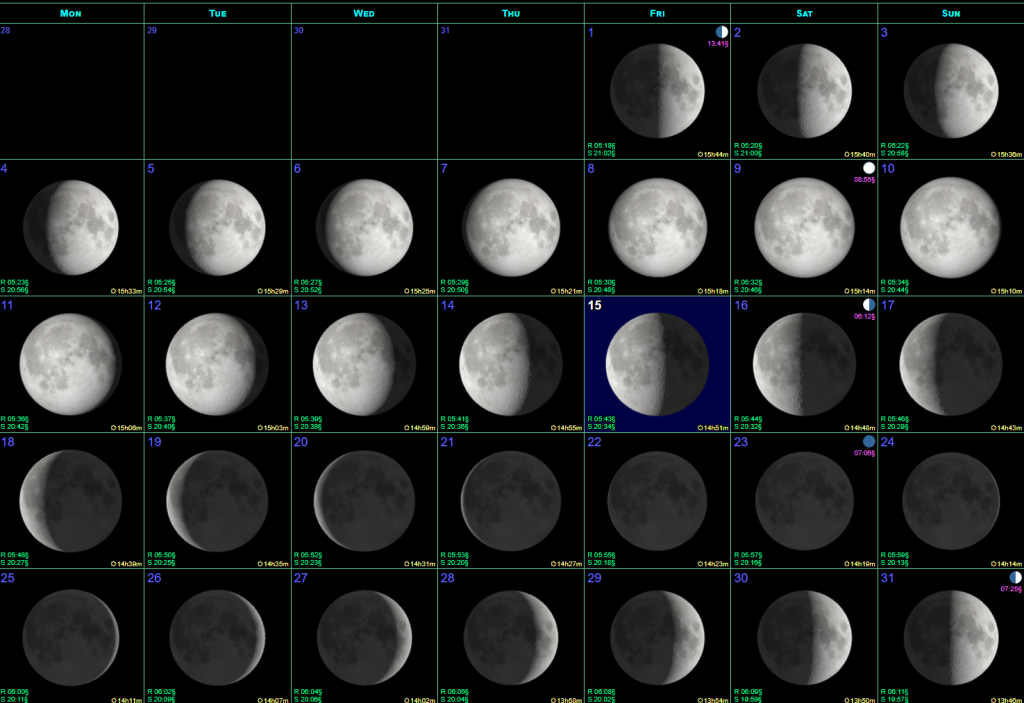
/Augusts moon calendar from Sky View Café (skyviewcafe.com)
A full yearly lunar calendar can be found here :-
https://www.mooninfo.org/moon-phases/2025.html
Moon Features
Here are several features to observe as the month progresses.
🌕 August 2025: Lunar Features to Explore
Here’s what to watch for this month as the Moon cycles through its phases. Try using binoculars or a small telescope during twilight or early evening when the Moon is high and shadows are sharp.
🌓 First Quarter Moon (August 4):
Best contrast for rugged terrain along the terminator.
- Lunar Apennines & Montes Caucasus: A dramatic mountain range along the southeastern edge of Mare Imbrium. Excellent near First Quarter for observing rugged peaks and valleys.
- Sinus Iridum (Bay of Rainbows): A graceful arc north of Mare Imbrium, formed by an ancient impact basin. Look for its curved “shoreline” and Jura Mountains.
- Rima Hyginus: A rille (trench-like feature) near the crater Hyginus in central Mare Vaporum—appears like a crack in the lunar crust.
- Triesnecker Rilles: Just west of Sinus Medii, this region displays a complex network of rilles and is best viewed a day after First Quarter.
🌕 Full Moon (August 10):
Shadow relief is minimal, but bright rays and mare patterns stand out.
- Kepler: A bright-rayed crater west of Copernicus, very prominent at full Moon.
- Aristarchus & Vallis Schröteri: Although relief is washed out, the Aristarchus Plateau and nearby sinuous valley are bright and worth examining.
- Mare Nubium & Mare Cognitum: Less well-known maria, but beautifully highlighted under full illumination.
🌗 Last Quarter Moon (August 18):
Time to explore the western limb and older highlands.
- Hainzel and Mee: Overlapping craters in the Moon’s southwestern quadrant. Their complex structure is ideal under low-angle light.
- Byrgius A: A small but striking crater with an unusually prominent ray system near the western limb.
- Wargentin: A unique crater that appears filled to the rim with lava—forming a flat-topped plateau.
- Vallis Alpes (Alpine Valley): North of Plato, this long, narrow valley cuts through the lunar Alps and is best seen in low sun.
🌘 Waning Crescent (August 24–26):
Early risers can catch faint shadowing near the limb.
- Endymion: A large, ancient crater on the northeastern limb with a dark, smooth floor.
- Cleomedes & Geminus: Paired craters northeast of Mare Crisium; their floors and central peaks stand out nicely under grazing sunlight.
- Hercules & Atlas: A striking duo in the Moon’s northeast, appearing side-by-side with sharply defined rims and floor details.
Planets
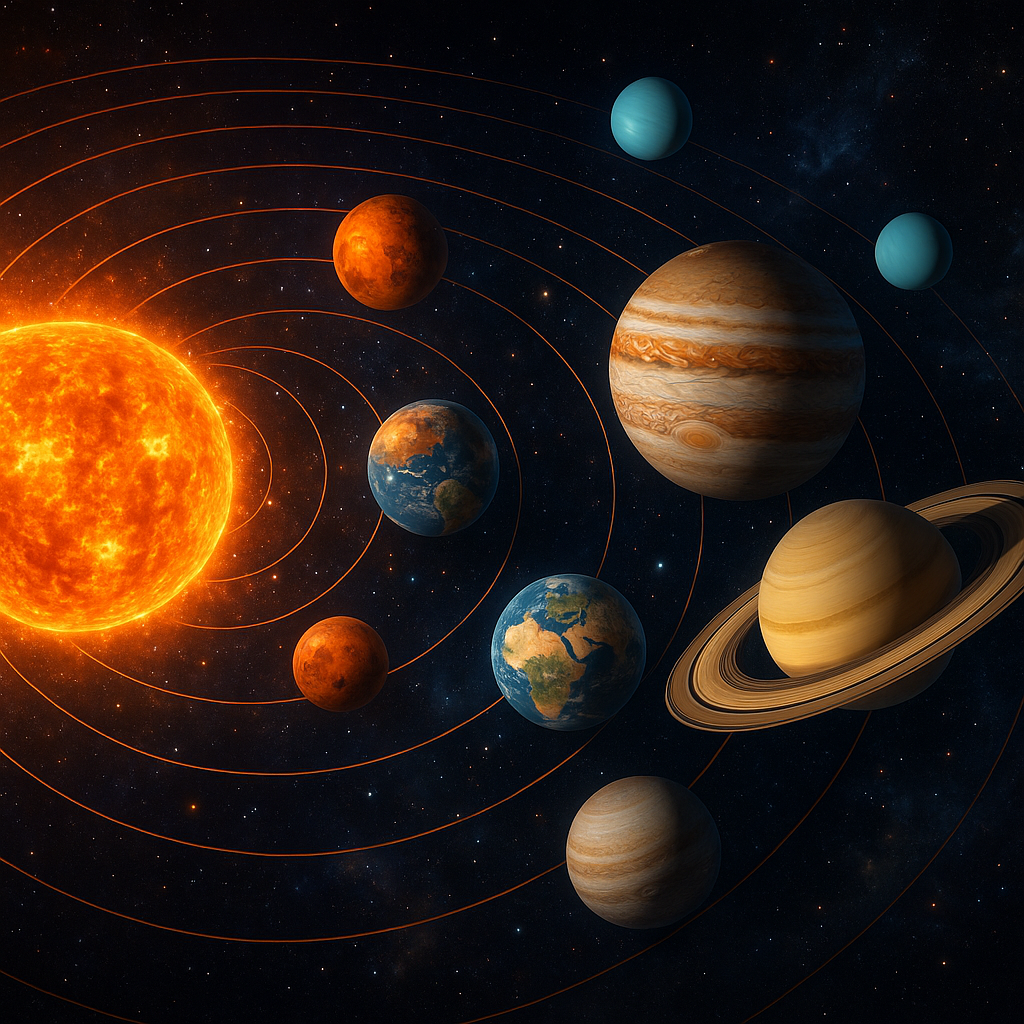
☀️ Mercury
Best seen: Until 19 August, low in the east-northeast about 40 minutes before sunrise.
It reaches greatest western elongation on the 19th, shining at mag. –0.2, but is difficult to spot due to proximity to the Sun. On the 31st, Mercury rises just 13 minutes before sunrise, fading to mag. –1.1.
🟡 Venus
Best seen: Until 12 August, before dawn in the east-northeast.
Venus shines brilliantly at mag. –4.0, reaching its highest morning altitude and passing just 0.5° from Jupiter on 12 August. By month’s end, it dips lower in the sky and fades slightly to mag. –3.8.
🔴 Mars
Visible low in the eastern dawn sky, Mars remains a morning object, shining at mag. +1.6.
It becomes increasingly difficult to spot in twilight as it hugs the horizon.
🟠 Jupiter
Rising before dawn in Gemini, Jupiter is a bright presence at mag. –1.9 to –2.0.
Don’t miss its conjunction with Venus on 12 August, when they appear less than a degree apart.
🪐 Saturn
Best viewed: Late August, especially around 31 August at 04:20 BST.
Saturn is now well placed in the south, shining at mag. +0.6, with its globe tilted edge-on to Earth. Excellent for telescopic viewing as it reaches opposition.
🔵 Uranus
Visible in the early morning sky in Taurus, near the Pleiades.
By 31 August, Uranus reaches a handy position 4.5° southeast of Alcyone, shining at mag. +5.7—a perfect small telescope target.
🔷 Neptune
Best seen: Before dawn, in Pisces, near Saturn.
At mag. +7.7, Neptune is visible through binoculars or a telescope, culminating at opposition on 31 August.
Meteor Showers
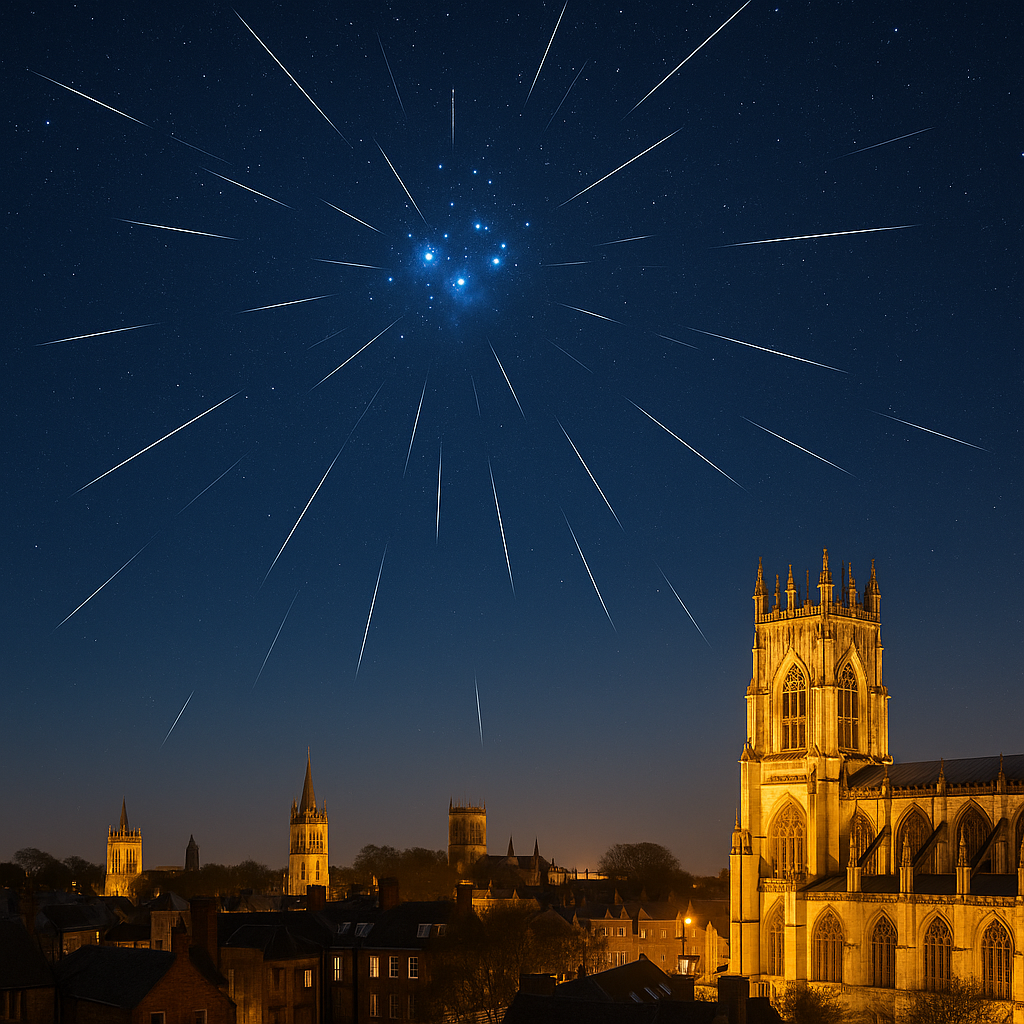
Perseids
The Perseid shower is ongoing and peaks on the 12th-13th August. This annual meteor shower is one of the most anticipated and reliable displays in the night sky and this year takes place without the Moon causing interference.
The Perseids meteor shower appears to radiate from the constellation Perseus, which rises in the northeastern part of the sky during the peak hours. While you can spot Perseid meteors anywhere in the sky, their trails will generally trace back to the radiant point in Perseus.
Meteors can be unpredictable, and the number of visible meteors per hour can vary throughout the night. Be patient and give yourself plenty of time to observe. Your eyes need around 20-30 minutes to fully adjust to the darkness, allowing you to see fainter meteors.
KAPPA CYGNIDS
Another meteor shower this month are the Kappa Cygnigs which are a lesser-known meteor shower that occurs annually in August. While it is not as well-known or as active as some of the major meteor showers it’s still worth looking out for.
The Kappa Cygnid meteor shower is associated with the debris left behind by Comet 169P/NEAT and it’s radiant point is located in the constellation Cygnus, near the star Kappa Cygni
Comets
| Comet | Approx. Mag | Viewing Details & Notes |
|---|---|---|
| C/2025 K1 (ATLAS) | 13‑15 | Visible with 200 mm+ telescope in Pegasus near mid‑August; may brighten further toward mag 13 by month’s end. Optimal from Southern Hemisphere during pre‑dawn hours. (Time and Date, TheSkyLive, Chron) |
| C/2024 E1 (Wierzchos) | ~14 | Located in Hercules, about mag 13.9–14–15, requires long-exposure imaging or 10×50 binoculars. Too faint for naked-eye; low in north–northwest sky. (astro.vanbuitenen.nl, heavens-above.com, Time and Date) |
| C/2021 G2 (ATLAS) | ~14.4 | Situated in Libra, last observed at mag 14–14.5, very faint; visible only with medium-large telescopes or imaging. Coma ~1′, faint tail ~2′. (TheSkyLive, TheSkyLive, Sky & Telescope, heavens-above.com) |
| 240P/NEAT | ~14–14.5 | In constellation Eridanus, fading slowly but “brighter than expected” at mag 14.3 (July). Use star charts for tracking; visible in telescopes. (aerith.net, TheSkyLive, astro.vanbuitenen.nl) |
| C/2022 N2 (PANSTARRS) | ~14.9 | Near perihelion 31 Jul, in Aries rising pre-dawn; mag 15 range, visible only with ≥500 mm telescopes. Rarely observed by amateurs. (TheSkyLive, TheSkyLive, astro.vanbuitenen.nl) |
Link here for further details of each comet and how to locate it.
Visual Comets in the Future (Northern Hemisphere) (aerith.net)
Deep Sky (DSO’s)
A few more challenging objects for you to image this month
| Object | Type | Constellation | Notes |
|---|---|---|---|
| Sh 2-86 (Sharpless 86) | Emission Nebula | Vulpecula | Often overshadowed by M27, this is a richly structured H II region associated with the open cluster NGC 6823. Great for narrowband imaging (H-alpha/SII/OIII). |
| NGC 6823 | Open Cluster | Vulpecula | At the heart of Sh 2-86, this young stellar cluster lights up the surrounding nebulosity. Frame both together for dramatic contrast.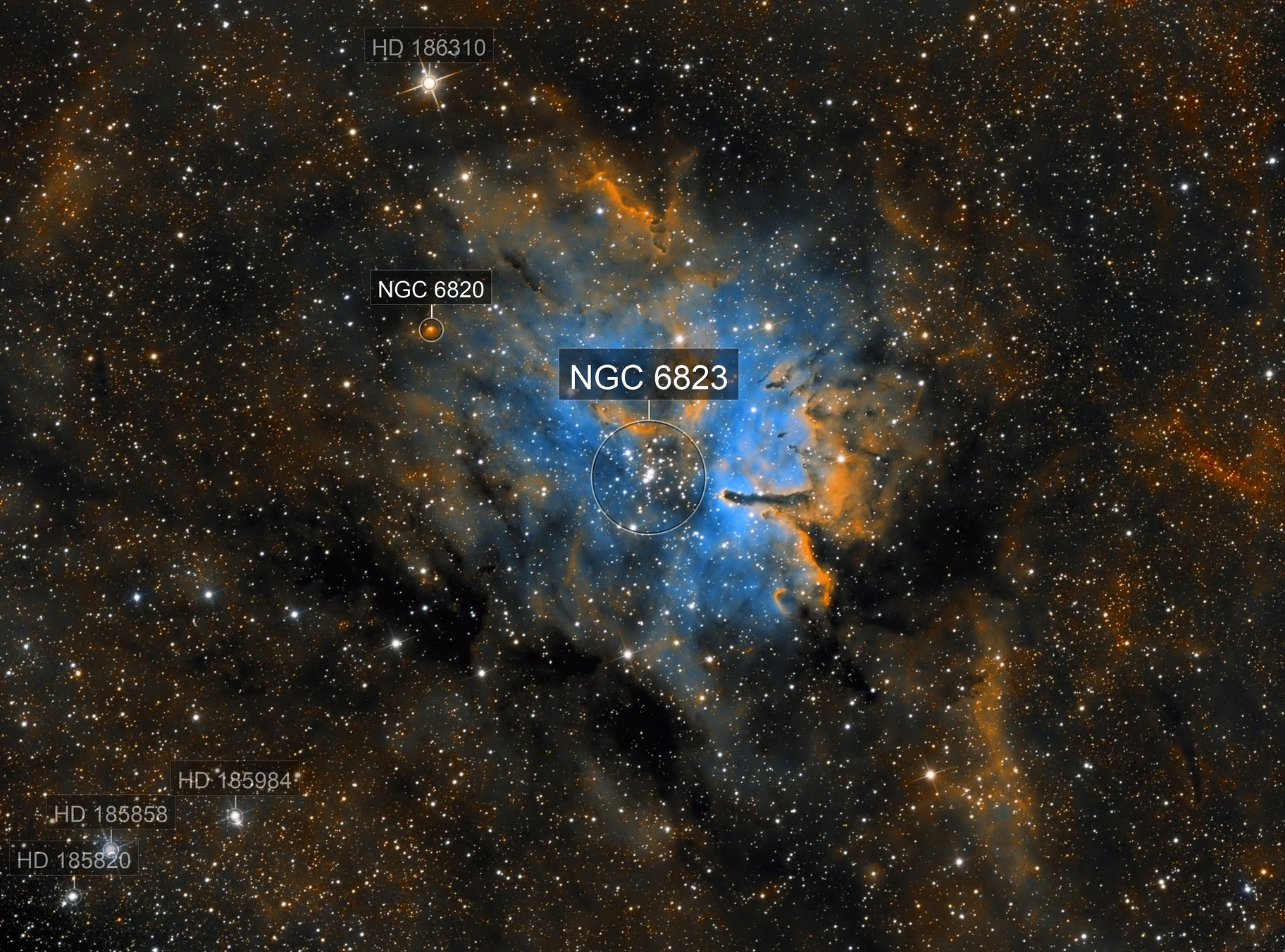 |
| NGC 6781 | Planetary Nebula | Aquila | A faint but rewarding “halo-like” nebula, resembling a ghostly ring—sometimes called a “mini Dumbbell.” Ideal for long exposures. |
| Collinder 399 (Coathanger Asterism) | Asterism | Vulpecula | Technically not a true cluster, but a favorite wide-field object with binoculars and small refractors. Shows well in low focal lengths. |
| NGC 6905 (Blue Flash Nebula) | Planetary Nebula | Delphinus | A compact planetary nebula that rewards high magnification. Faint but colorful—use OIII filters to bring out structure. |
| IC 1295 | Planetary Nebula | Scutum | Often missed due to proximity to the Wild Duck Cluster (M11), this faint planetary has a soft, ghostly glow—great in long narrowband stacks.ESO’s VLT images the planetary nebula IC 1295 | ESO |
| Barnard 142 & 143 (“E” Nebula) | Dark Nebula | Aquila | Two dust clouds shaped like the letter E, silhouetted against the Milky Way. Stunning in wide-field shots using broadband filters. |
| Sh 2-64 | Emission Nebula | Scutum | A rarely imaged nebula near the southern Milky Way star fields. Requires deep integration and H-alpha sensitivity. |
ISS and other orbiting bits
For York observers: the ISS will deliver several bright evening flyovers in early August. On 5 August at 19:13 BST, the station reaches a peak magnitude of −3.4—making for a spectacular trail across the southwestern sky at an elevation of nearly 60°. Other notable opportunities include 3 and 4 August, with passes of ~23° and ~19° elevation respectively. Use NASA’s Spot‑the‑Station or Heavens‑Above for full‑month coverage and exact approach bearings.
🚀 ISS Overpasses Early August 2025
| Date | Time (BST) | Mag | Appears From | Max Elevation | Disappears Toward |
|---|---|---|---|---|---|
| 2 Aug | 20:02 | −0.8 | NNW (10°) | 13° NNW | ~20:03 |
| 3 Aug | 19:15 | −2.3 | North (10°) | 23° NE | ~19:17 |
| 4 Aug | 20:02 | −1.1 | WNW (10°) | 19° West | ~20:04 |
| 5 Aug | 19:13 | −3.4 | NW (10°) | 59° SW | ~19:18 (~SSE) |
| 7 Aug | 19:14 | −0.9 | West (10°) | 12° SW | ~19:17 (~SSW) |
| 8 Aug | 05:13 (6 Aug) | −0.9 | SSE (10°) | 14° SE | ~05:16 (~E) |
Useful Resources
StarLust – A Website for People with a Passion for Astronomy, Stargazing, and Space Exploration.
http://www.n3kl.org/sun/noaa.html
http://skymaps.com/downloads.html
Astronomy Calendar of Celestial Events 2024 – Sea and Sky (seasky.org)
https://www.constellation-guide.com
IMO | International Meteor Organization
and of course the Sky at Night magazine!
Hi Steve. You might add https://www.youtube.com/@astrumspace/videos to your list of Resources. Lots of very good short You Tube videos. Cheers. MW2
👍