
A monthly look at astronomical events in the sky and on Earth
Compiled and written by Steve Sawyer
Welcome to the December edition of “What’s Up”!
As the nights draw in and the air turns crisp, we reach the finale of another incredible year of astronomy. It feels like no time at all since we started 2025, yet here we are, wrapping up and looking back on twelve months of celestial highlights.
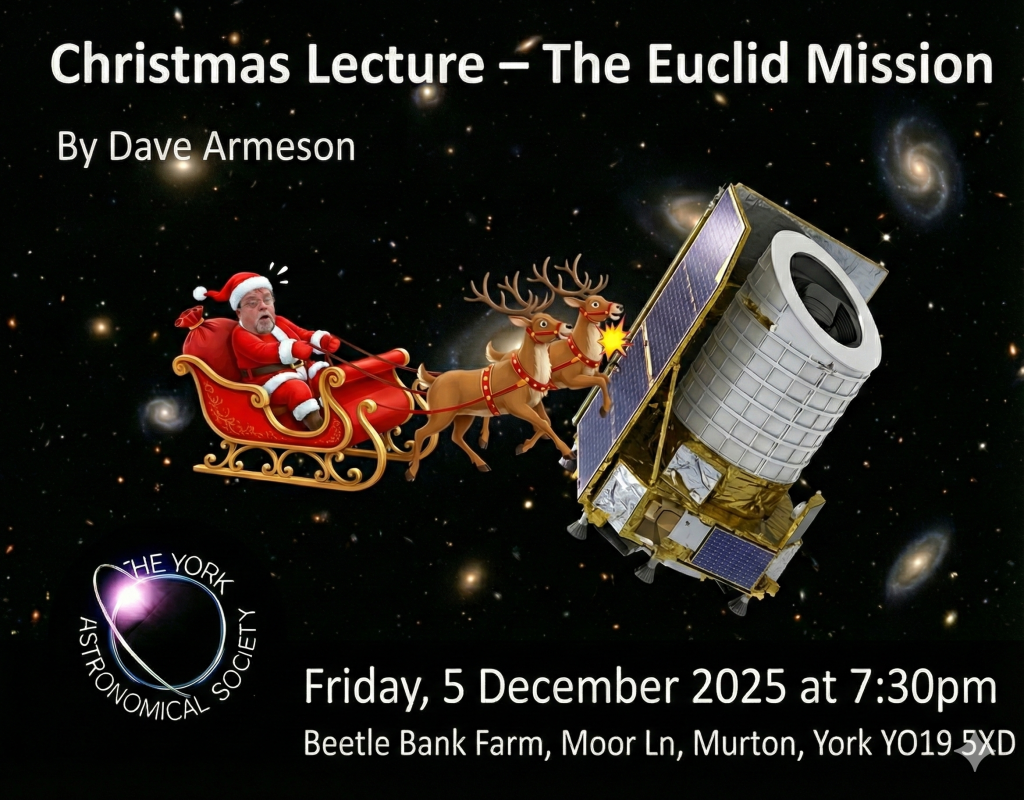
December brings us the longest nights of the year—perfect for observing—and a special festive treat for our members: Dave Armeson will be delivering the Christmas Lecture on the 5th of December, taking us on a deep dive into The Euclid Mission. Grab a mince pie, wrap up warm, and let’s see what the winter sky has in store!
This Months and Upcoming York Astro Presentations
Upcoming events to put in your diary
| Date | Title | Speaker |
|---|---|---|
| 05/12/2025 | Christmas Lecture – The Euclid Mission | Dave Armeson |
| 19/12/2025 | Festive Meal, Observing and Quiz Evening | YAS Members |
| 02/01/2026 | Members Evening – Short Talks | YAS Members |
For further details see the events page Astronomy Presentations by guest speakers | York Astro and our Facebook group (20+) The York Astronomical Society Chat Group | Facebook
So what’s on this month?
Northern Sky
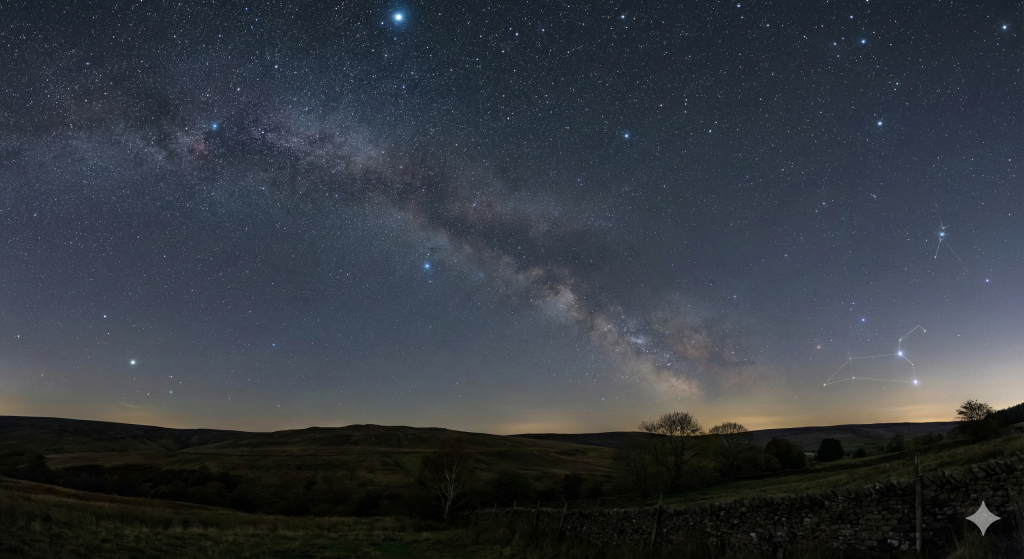
An artistic view of the Northern night sky
Ursa Major has now swung around and is beginning to climb in the eastern sky. The fainter stars towards the southern end of the constellation are now fully visible. Meanwhile, Ursa Minor hangs below Polaris in the north. Just above it lies the faint outline of Camelopardalis, with Lynx — another subtle circumpolar constellation — positioned to the east.
Over in the northwest, Vega (Alpha Lyrae) is hugging the horizon, while Deneb (Alpha Cygni) and most of Cygnus remain visible a bit farther west. In the east, Regulus (Alpha Leonis) and the constellation of Leo are just beginning to lift above the horizon. Cancer stands high in the eastern sky, with Gemini sitting even higher still.
At the zenith, Perseus holds centre stage, with Auriga and Capella nestled between it and Gemini. With this part of the sky now standing high overhead, it’s a fine opportunity to explore the dimmer star fields of the Milky Way stretching from Cassiopeia in the west, across to Gemini and Orion in the east.
Southern Sky
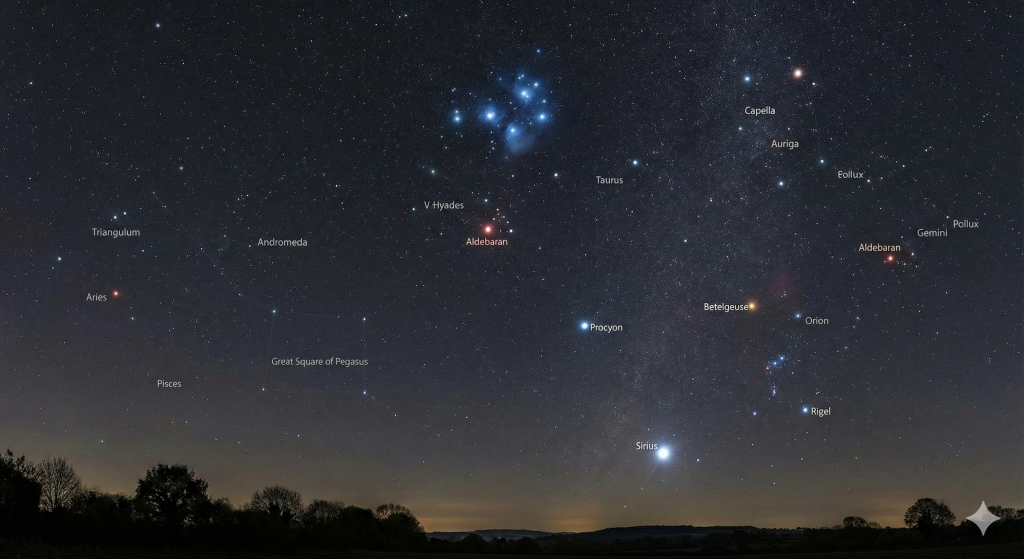
An artistic view of the southern night sky
Pleiades is due south around 22:00, with the Hyades, Aldebaran and the rest of Taurus to the east. Auriga with Capella and Gemini with Castor and Pollux are well placed, and Orion is now a dominant feature of the winter sky, flanked by Canis Minor (Procyon) and Canis Major (Sirius, the brightest star). The small constellation Lepus sits just south of Orion. In the west, Aquarius has gone and Cetus is sinking, but Pisces, Aries, Triangulum and Andromeda remain easy to see above, while the Great Square of Pegasus drops toward the horizon, looking more like a large diamond than a square.
Sky Diary December 2025
| date | time | event | details |
|---|---|---|---|
| 04 | 02:54 | moon–pleiades close approach | the moon passes 0.8° south of the pleiades |
| 04 | 11:06 | moon at perigee | the moon reaches perigee (closest to earth) at 356,962 km |
| 04 | 23:14 | full moon | |
| 07 | 15:48 | jupiter near the moon | jupiter (mag. −2.6) lies 3.7° south of the moon |
| 07 | 16:21 | pollux near the moon | pollux lies 2.9° north of the moon |
| 07 | 21:00 | greatest elongation of mercury | mercury at greatest western elongation, 20.7° from the sun |
| 10 | 06:32 | regulus near the moon | regulus lies 0.8° south of the moon |
| 11 | 20:52 | last quarter moon | |
| 14 | — | geminid meteor shower maximum | geminid meteor shower at maximum |
| 14 | 16:27 | spica near the moon | spica lies 1.4° north of the moon |
| 17 | 06:09 | moon at apogee | the moon reaches apogee (furthest from earth) at 406,324 km |
| 18 | 12:29 | antares near the moon | antares lies 0.4° north of the moon |
| 20 | 01:43 | new moon | |
| 21 | 15:03 | winter solstice | |
| 22 | — | ursid meteor shower maximum | ursid meteor shower at maximum |
| 27 | 03:24 | saturn near the moon | saturn (mag. 1.0) lies 4.0° south of the moon |
| 27 | 19:10 | first quarter moon | |
| 31 | 13:21 | moon–pleiades close approach | the moon passes 0.9° south of the pleiades |
This table captures the astronomical events for December, including phases of the moon, planetary alignments, and other notable occurrences.
Sky Maps
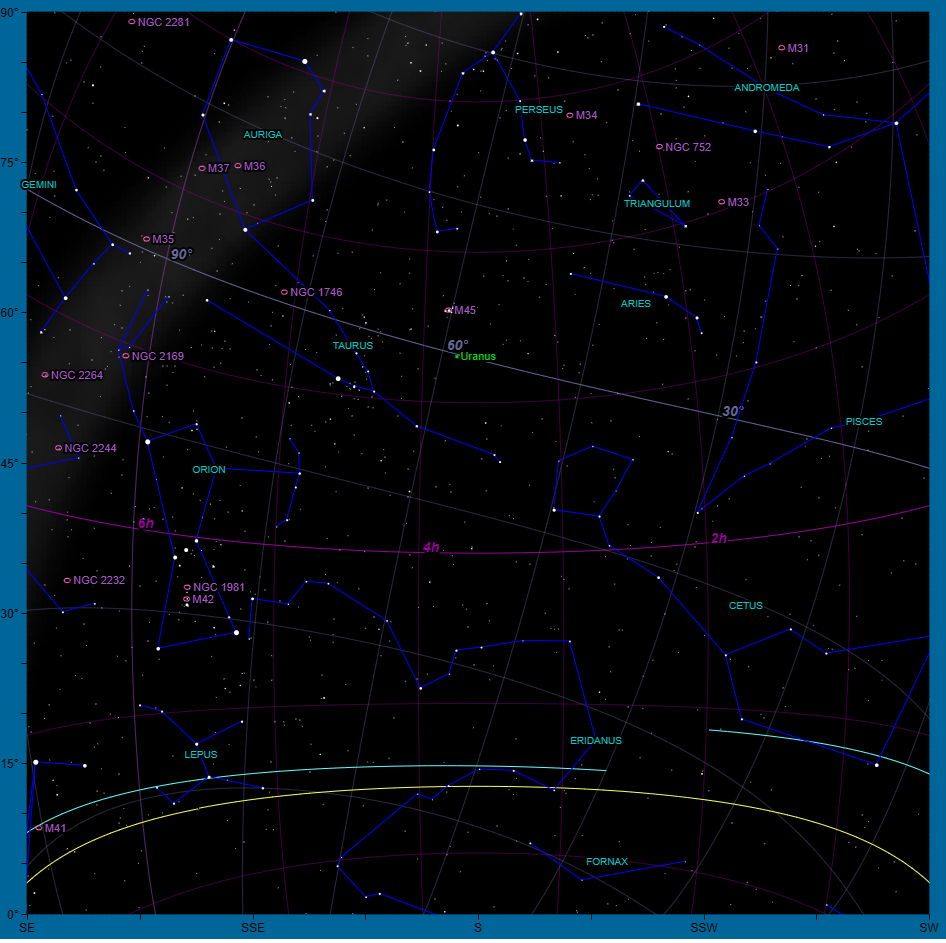
Looking South on the 15th at 22:00
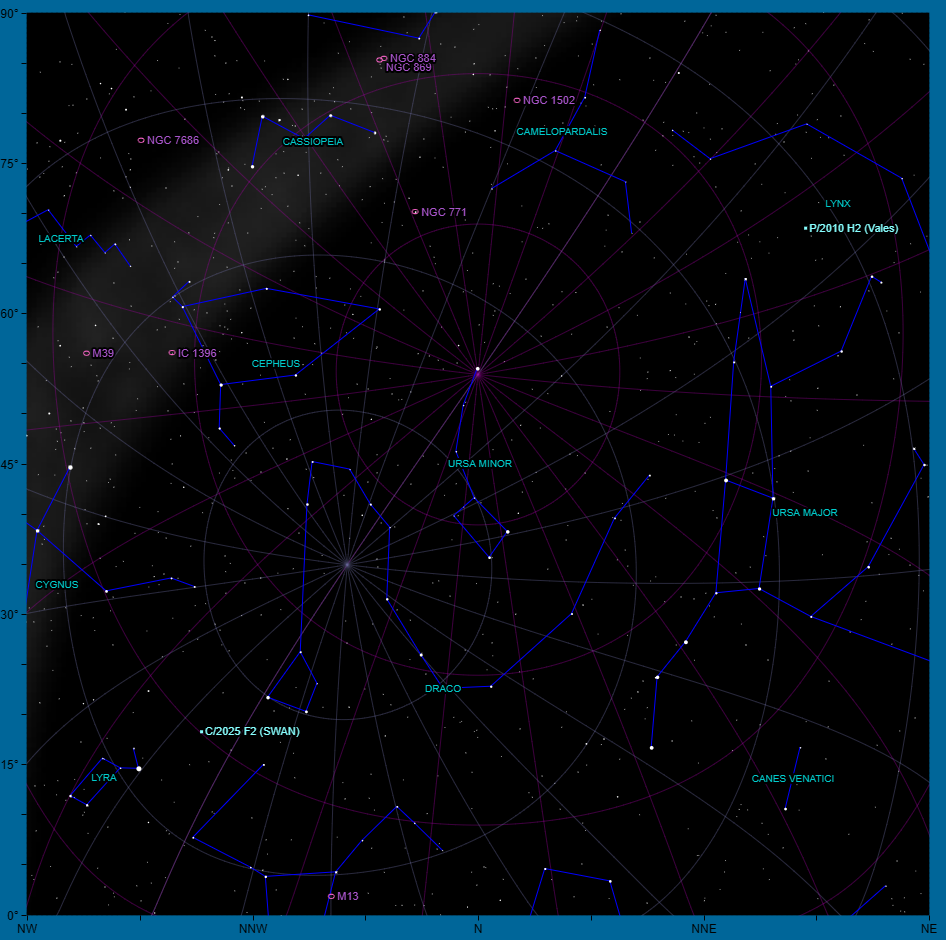
Looking North on the 15th at 22:00
Decembers Feature
2025 has been a landmark year for astronomy, characterized by the “first light” of next-generation observatories and groundbreaking data releases that have reshaped our understanding of the cosmos.
Here is a summary of the major astronomical discoveries and milestones from this year:
1. Euclid’s “Dark Universe” Map (March 2025)
Launched previously, the Euclid space telescope delivered its first massive batch of science data in March, marking a major leap in cosmology.
- The Data: The release included a catalogue of over 380,000 galaxies and the discovery of 500 new strong gravitational lenses—doubling the number known to humanity in a single release.
- The Discovery: Euclid identified thousands of dwarf galaxies, which are crucial building blocks of larger galaxies like our Milky Way. It also provided unprecedented 3D maps of dark matter distribution, helping scientists refine the “galactic tuning fork” diagram of galaxy evolution.
2. The Einstein Probe’s “Lobster Eye” Vision
The Einstein Probe (launched Jan 2024) proved its worth this year by detecting transient events that other telescopes missed.
- Ancient Explosion: In March, it detected EP240315a, a long-duration X-ray burst from the early universe (12.5 billion years ago). This event, likely a massive gamma-ray burst, challenges our models of stellar collapse in the infant cosmos.
- Stellar Cannibalism: It also captured a rare X-ray flash from a “behemoth” binary system in the Small Magellanic Cloud, involving a massive star and a white dwarf—a phase of stellar evolution rarely observed.
3. Vera C. Rubin Observatory “First Look” (June 2025)
After years of anticipation, the Vera C. Rubin Observatory in Chile released its “First Look” images on June 23, 2025.
- Using the world’s largest digital camera (3,200 megapixels), it began its 10-year survey to film the “Greatest Movie of All Time.” The initial images revealed faint details of the southern sky that will help catalogue billions of stars and galaxies.
4. Exoplanet Breakthroughs
Nearby Super-Earth
Astronomers confirmed a “nearby” Super-Earth snappily named GJ 251 c which is only 18–20 light-years away. And can be found in the habitable zone of an M-dwarf star, making it a prime target for biosignature searches.
Tatooine” System
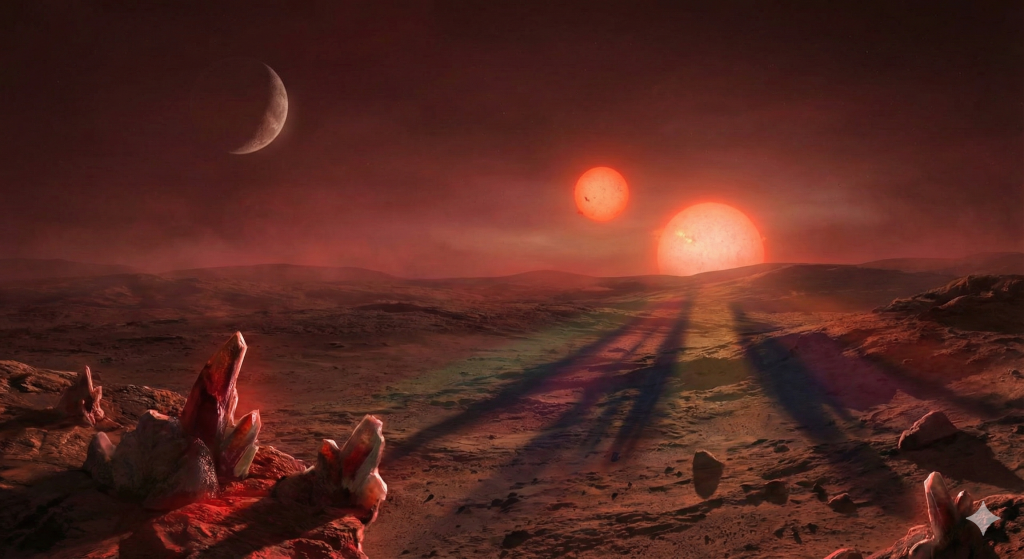
A compact system, TOI-2267, was found to host three Earth-sized planets orbiting two stars, proving that stable, orderly planetary systems can form in chaotic binary environments.
TOI-2267 is a compact binary system located roughly 72–190 light-years from Earth that has redefined our understanding of planetary formation. It consists of two small red dwarf stars (types M5V and M6V) orbiting each other with a separation of only about 8 Astronomical Units (AU).
Key Characteristics
- Unique Planetary Configuration: The system hosts three Earth-sized planets with a rare arrangement: two planets orbit one star, while the third orbits its companion.
- First of Its Kind: This is the first known compact binary system where planets have been observed transiting both stars, meaning planets pass in front of each star relative to our view.
- “Double-Sunrise” Environment: Because the stars are so close, an observer on one of these planets would see two suns in the sky, experiencing double sunrises and sunsets.
Scientific Significance
- Defying Models: The existence of these planets challenges current theories, which suggest that the complex gravitational forces (tidal influence) in such a tight binary system should prevent planets from forming or remaining stable.
- Compact Nature: The stars orbit each other tightly, creating a chaotic environment that was previously thought to be hostile to planetary stability.
This discovery suggests that nature can form stable planetary systems in much more complex and extreme gravitational environments than previously believed.
5. Solar System Highlights
- Interstellar Visitor: A third confirmed interstellar object, 3I/ATLAS (referenced in your November notes as 3I/2025 N1), made its closest approach to the Sun, sparking a global observation campaign.
- Solar Poles: In March, ESA’s Solar Orbiter captured the first-ever direct images of the Sun’s south pole, a region key to understanding the solar magnetic cycle.
- Artemis II Readiness: While the launch is targeted for early 2026, NASA fully “stacked” the Artemis II Moon rocket in November 2025, marking the final prep stage for the first crewed lunar mission in over 50 years.
NASA’s Moon rocket assembled as first available launched date for Artemis 2 approaches
Now onto Decembers guide
Decembers Sky Guide
The Sun
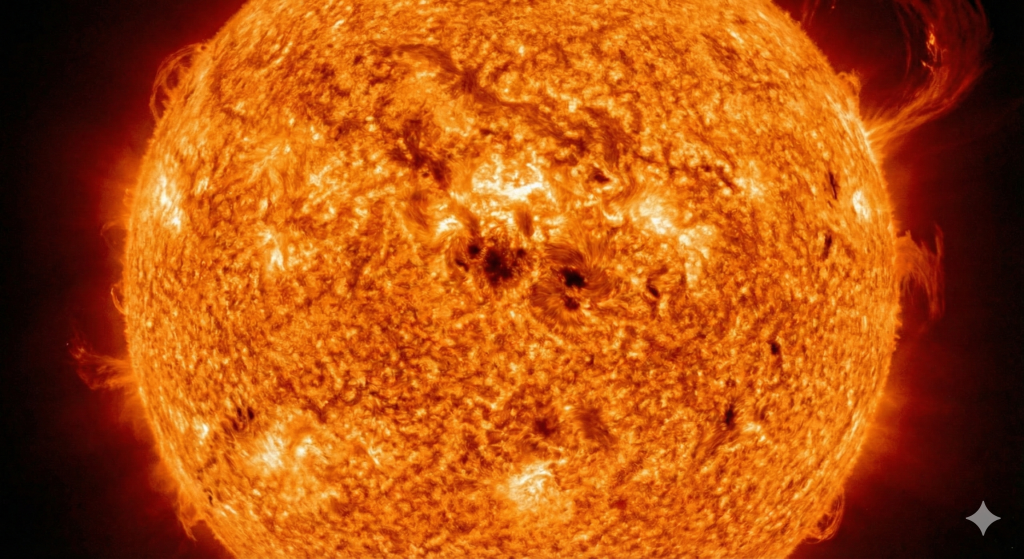
☀️ Solar Forecast – December 2025
Source: NOAA Space Weather Prediction Centre (SWPC) | Data: 27-Day Outlook (Issued Nov 24, 2025)
December promises to be a dynamic month for solar observers. The Sun is forecast to be particularly active during the first week, offering excellent targets for telescope users, while aurora chasers should mark two specific windows on their calendars where geomagnetic unrest is most likely.
🌌 Aurora Watch: Two Key Windows
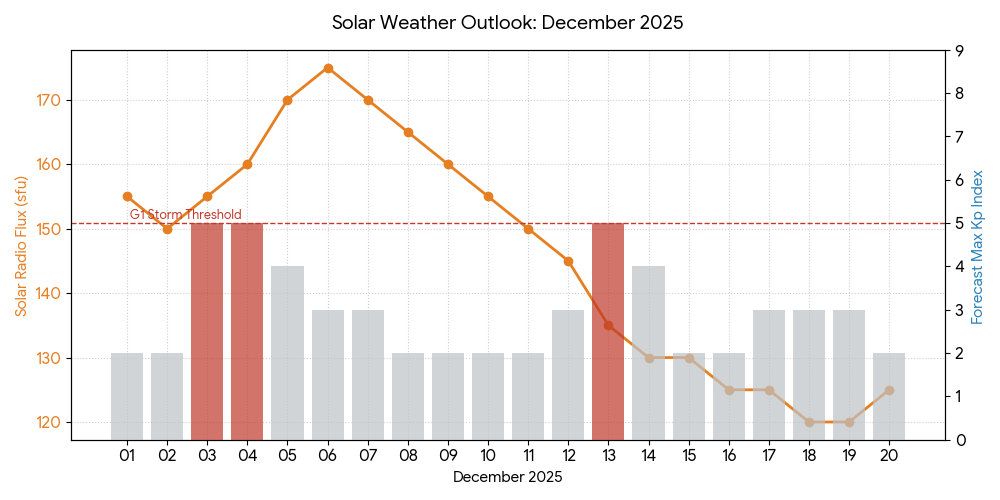
The Kp Index measures global geomagnetic activity. For December, NOAA forecasts two periods where the index is expected to reach Kp 5, the threshold for a G1 (Minor) Geomagnetic Storm.
1. Early Month: December 3 – 4
- Forecast: Kp 5 (Minor Storm)
- Details: This is the most significant predicted event of the first half of the month. High-latitude observers (Scotland, Scandinavia, Canada) should monitor real-time data closely these evenings. If the interplanetary magnetic field (IMF) tilts south, displays could dip into northern England and the northern US tier.
2. Mid-Month: December 13
- Forecast: Kp 5 (Minor Storm)
- Details: A brief return to storm conditions is expected mid-month. This falls close to the Geminid meteor shower peak (Dec 13/14), potentially offering a spectacular “two-for-one” show of meteors and aurora if skies are clear.
☀️ Solar Activity: A Peak in the First Week
For those with solar telescopes or safe filters, the 10.7cm Radio Flux—a proxy for sunspot number—indicates a surge in activity early in the month.
- The Trend: Activity climbs steadily from Dec 1, peaking on December 6 with a flux of 175 sfu.
- What to Look For: This high flux suggests the solar disk will likely host complex, active sunspot regions during the first week of December. It is an ideal time for imaging or sketching sunspots.
- The Decline: Activity is forecast to taper off gently after the 7th, dropping to moderate levels (120–130 sfu) by mid-month.
📊 December Visual Forecast
The chart below highlights the correlation between the storm threshold (red line) and the predicted Kp peaks.
Auroa Forecasts
A bit US centred but still useful
Aurora Dashboard (Experimental) | NOAA / NWS Space Weather Prediction Center
And our own Met-office have an excellent space weather forecast page here Space Weather – Met Office
The Moon
December Lunar Calendar
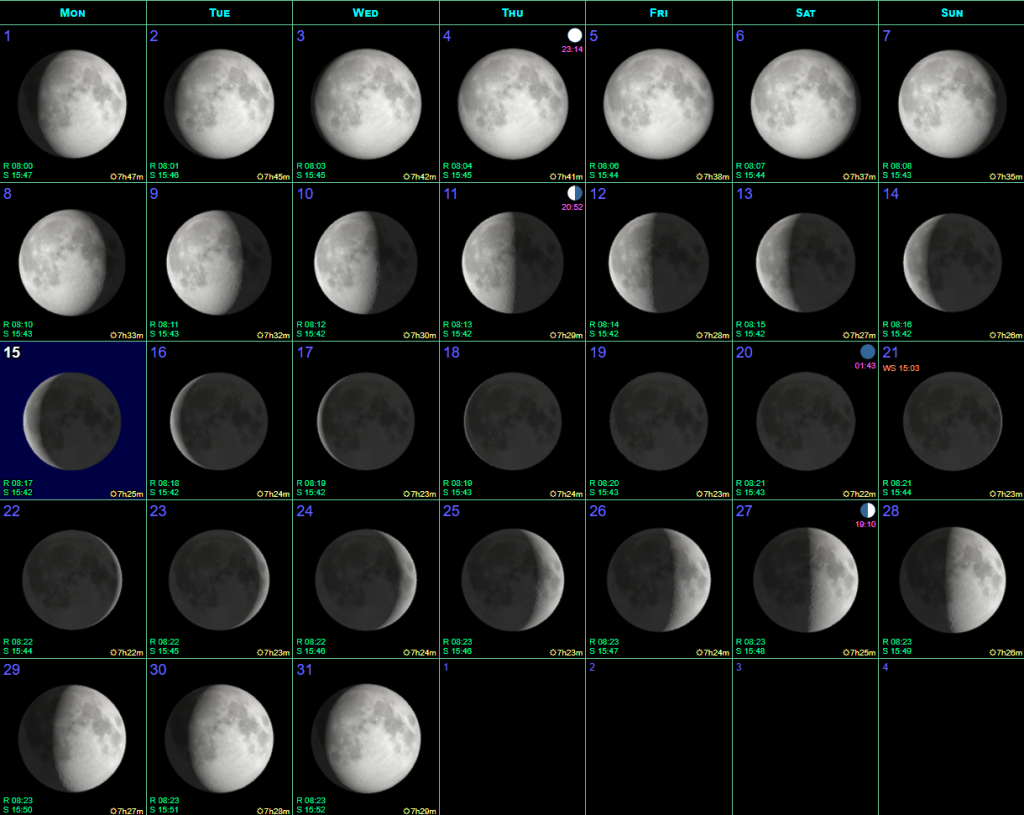
Decembers moon calendar from Sky View Café (skyviewcafe.com)
A full yearly lunar calendar can be found here :-
https://www.mooninfo.org/moon-phases/2025.html
Moon Feature
Two events to look out for. The latter being an easy and worthwhile activity for new telescope owners.
Lunar Occultation
Early risers on the morning of December 10 are in for a treat as the Waning Gibbous Moon performs a lunar occultation of Regulus (Alpha Leonis), the bright heart of the constellation Leo. The event begins at approximately 07:16 GMT, when the star vanishes behind the Moon’s bright sunlit limb. This will be a challenging observation that requires high magnification to combat the lunar glare.
However, the true highlight arrives around 08:18 GMT during the reappearance; here, the magnitude +1.4 star will suddenly “pop” back into existence from behind the Moon’s unlit, dark limb.
This should be a startling sight, and while binoculars will show the pair’s close approach, a small telescope is highly recommended to fully appreciate the drama of this event.
Lunar Feature of the Month: The Spine of the Moon (Montes Apenninus)
Best Viewed: December 27 – 28 (First Quarter)
For our December focus, we turn our telescopes to the most spectacular mountain range on the lunar surface: the Montes Apenninus. Forming the southeastern rugged border of the vast Mare Imbrium (Sea of Rains), this range stretches over 600 km and offers a breathtaking sight that rivals any terrestrial mountain view.
Why Look Now? With the Moon reaching First Quarter on December 27, the solar terminator (the line between day and night) will fall directly across this region. The low-angle sunlight will cast long, jagged shadows from the peaks across the adjacent lava plains, throwing the range’s relief into sharp, dramatic contrast.
What to Spot:
- The Peaks: Look for Mons Hadley, rising over 4,000 meters. This is famously the landing site of Apollo 15 in 1971. While you can’t see the Lunar Module, knowing humans drove a rover in the valley below adds a profound sense of scale.
- The Chain: Follow the “spine” as it curves from the prominent crater Eratosthenes (at the southern tip) up towards the gap near the Caucasus mountains.
- The Texture: Notice the difference between the steep face dropping into Mare Imbrium and the more gradual, chaotic slopes on the “back” side of the range.
Planets
☀️ Mercury
The innermost planet puts on a fine show in the morning sky during the first week of the month. It reaches Greatest Western Elongation (its furthest point west of the Sun) on December 7/8. Look for it low in the east before sunrise; it will be brightening as the month progresses
🟡 Venus
A morning planet that is very close to the sun in the sky and thus very hard to see.
🔴 Mars
Too clos to the sun to be seen this month
🟠 Jupiter
The gas giant is in the constellation Gemini and is visible from early evening until dawn. It is brightening steadily (magnitude -2.5 to -2.7) as it heads toward opposition next month.
- What to see: It forms a striking triangle with the “Twin” stars, Castor and Pollux.
- Telescope Tip: On December 31, Jupiter’s retrograde motion carries it just over 1 degree north of the planetary nebula NGC 2392 (the Eskimo Nebula), offering a fantastic photo opportunity or wide-field telescopic view
🪐 Saturn
Found in Aquarius, Saturn is well-placed in the evening sky but sets around midnight. It reaches East Quadrature (90 degrees from the Sun) on December 17, meaning shadows cast by the planet onto its rings will be prominent, giving the system a wonderful 3D appearance in telescopes
🔵 Uranus
Fresh off its November opposition, Uranus is visible nearly all night in Taurus. It shines at magnitude +5.6, making it a binocular object.
🔷 Neptune
Neptune: Located in Pisces, this faint, magnitude +7.8 ice giant ends its retrograde (backward) motion on December 10, appearing stationary against the background stars before resuming its eastward drift. You will need a telescope to spot it near Saturn.
Meteor Showers
We have two meteors showers this month
The Geminids: The Winter Highlight
- Activity Period: December 4–20.
- Peak Date: Night of December 13–14, 2025.
- Radiant: The constellation Gemini (near the bright star Castor).
The Geminids are widely regarded as one of the strongest and most active showers of the year. Under ideal conditions, the Zenith Hourly Rate (ZHR) the number of meteors a single observer might see in an hour under perfect skies—can reach 100 to 120.
The “Rock” Comet: Unlike most meteor showers, which originate from icy comets, the Geminids are debris from 3200 Phaethon, an asteroid. Because they originate from rocky material rather than fluffy cometary dust, Geminid meteors are denser; they tend to move slower and can last longer as they burn up in the atmosphere compared to other showers.
2025 Prospects: Conditions for the Geminids in 2025 are reasonably favourable. The peak occurs when the Moon is a waning crescent (Last Quarter is on December 11), meaning the moonlight will not be overwhelming, allowing observers to see a good number of meteors.
The Ursids: A Solstice Treat
- Activity Period: December 17–26.
- Peak Date: Night of December 22–23, 2025.
- Radiant: The constellation Ursa Minor (The Little Bear), near the star Beta Ursae Minoris (Kochab).
Following the Geminids, the Ursids provide a final show for the year. This shower is associated with the debris from Comet 8P/Tuttle. While generally a minor shower with a ZHR of about 10 meteors per hour, it has been known to occasionally surge to rates of 25 per hour.
2025 Prospects: The Ursids peak right around the Winter Solstice. In 2025, conditions are excellent. The Moon will be a thin waxing crescent that sets early in the evening, leaving the sky dark for the majority of the night.
Comets
| Comet Name | Predicted Magnitude | Visibility Period (Approx.) | Notes |
|---|---|---|---|
| 24P/Schaumasse | 8.2 | Throughout December | Brightest of the month. Morning object in Leo/Coma Berenices. |
| 210P/Christensen | 9.3 | Early December | Fading, but still a decent binocular/small telescope target. |
| C/2025 T1 (ATLAS) | 9.4 | Throughout December | Evening object in Hercules. Brightening. |
| 3I/2025 N1 (ATLAS) | 10.7 | Throughout December | Interstellar object. Faint but scientifically significant. |
| C/2025 R2 (SWAN) | 11.2 | Early December | Fading rapidly. Diffuse. |
| C/2024 E1 (Wierzchos) | 11.4 | Early December | Low in evening twilight. Fading. |
| C/2025 K1 (ATLAS) | 11.5 | Throughout December | Circumpolar in Camelopardalis. Breaking up! |
| C/2025 V1 (Borisov) | 12.1 | Mid-Late December | New visitor. Telescopic only. |
| 88P/Howell | 12.3 | Late December | Faint periodic comet returning. |
| 240P/NEAT | 12.7 | Throughout December | Very faint, telescopic object. |
| 29P/Schwassmann-Wachmann | 13.1 | Irregular | Known for sudden, massive outbursts. Keep watching! |
| 235P/LINEAR | 13.3 | Late December | Faint, requires large aperture. |
| C/2022 N2 (PanSTARRS) | 13.8 | Throughout December | Fading. Persistent faint telescopic target. |
24P/Schaumasse
Taking centre stage this month is 24P/Schaumasse, currently the most rewarding target for observers. Hovering around magnitude 8, it has brightened enough to be visible in large binoculars or small telescopes under dark skies. It is currently moving through the constellations of Leo and Coma Berenices, making it a prime target for after-midnight and pre-dawn observing. It is heading towards a close approach with Earth in early January, so expect it to remain a steady highlight throughout the holidays.
C/2025 T1 (ATLAS)
While 24P dominates the morning, C/2025 T1 (ATLAS) is the best target for evening observers. Predicted to be around magnitude 9.4, it is currently located in the constellation Hercules. This comet is brightening as it approaches the Sun, so keep an eye on it in the western sky after sunset. It offers a nice contrast to the morning comets and is well-placed for those who prefer not to stay up all night.
C/2025 K1 (ATLAS)
This comet has become a fascinating object for astrophotographers and those with larger telescopes. While it has faded to around magnitude 11.5, reports indicate the nucleus has fragmented, with three distinct parts now visible in deep imaging. It is currently circumpolar (visible all night) in the constellation Camelopardalis, high in the northern sky. Don’t just look for a fuzzball; look for a comet falling apart before our eyes!
29P/Schwassmann-Wachmann 1
Never ignore 29P. Technically listed at a faint magnitude 13.1, this “Centaur” object (orbiting between Jupiter and Saturn) is famous for its cryovolcanic outbursts. It can brighten by several magnitudes in a matter of hours, suddenly becoming visible in small telescopes. It is currently located in Leo, near the “front foot” of the lion. Monitor it closely; if you catch an outburst, it appears as a rapidly expanding, star-like point that fuzzes out over subsequent nights.
3I/2025 N1 (ATLAS)
Still holding steady at around magnitude 10.7, this object remains a priority for scientific observation. As a candidate interstellar object, its hyperbolic trajectory confirms it originated outside our solar system. It is currently moving through the northern sky. While it may not be the brightest object, the knowledge that you are looking at a visitor from another star system makes it worth the hunt with a medium-sized telescope.
210P/Christensen & C/2025 R2 (SWAN)
Both of these comets are fading as we close out the year. 210P/Christensen (mag 9.3) is still respectable but dropping in brightness. C/2025 R2 (SWAN) has faded significantly to mag 11.2 and is becoming more diffuse. Catch them early in the month before they become difficult targets for visual observers.
New Arrivals: C/2025 V1 (Borisov) & 88P/Howell
December welcomes a few fainter friends. C/2025 V1 (Borisov) is a newly discovered visitor hovering around magnitude 12, while the periodic comet 88P/Howell returns at a similar brightness. Both are strictly targets for larger telescopes or imaging rigs this month.
Link here for further details of each comet and how to locate it.
Visual Comets in the Future (Northern Hemisphere) (aerith.net)
Deep Sky (DSO’s)
As there may be a few new astronomers at this time of the year with shiny new scopes we’ll start with a few easy to find objects.
- M45: The Pleiades (The Seven Sisters)
- Location: Taurus
- Description: A stunning open star cluster that looks like a miniature dipper. It is bright enough to be seen with the naked eye even in light-polluted cities.
- How to find: Look high in the south; it lies to the northwest of the bright orange star Aldebaran.
- Viewing Tip: Binoculars are actually the best instrument for this large cluster, as they frame the bright blue stars and the “chain” of fainter stars beautifully.
- M42: The Orion Nebula
- Location: Orion
- Description: A stellar nursery where new stars are being born. It appears as a fuzzy “star” in the middle of Orion’s Sword.
- How to find: Locate the three distinct stars of Orion’s Belt. Look below the belt for a fainter vertical line of three stars (the Sword); the nebula is the middle “star”.
- Viewing Tip: Even a small telescope will reveal the “Trapezium”—four young, hot stars at the nebula’s heart that illuminate the surrounding gas.
- The Hyades
- Location: Taurus
- Description: A large, V-shaped open cluster that forms the face of the Bull. The bright orange star Aldebaran lies in the line of sight but is not physically part of the cluster.
- How to find: Follow the line of Orion’s Belt upwards to the right (northwest) to find the bright V-shape.
- Viewing Tip: This cluster is so large that it is best viewed with binoculars or the naked eye; telescopes often have too much magnification to fit the whole “V” in the view.
- The Double Cluster (NGC 869 & NGC 884)
- Location: Perseus
- Description: Two rich open clusters lying side-by-side. They are visible to the naked eye as a large fuzzy patch in the Milky Way.
- How to find: Located between the “W” of Cassiopeia and the main body of Perseus high in the northern sky.
- Viewing Tip: A small telescope at low power creates a spectacular “diamonds on velvet” effect with these twin jewelled clusters.
Challenging Targets (Telescope & Dark Skies Required)
These objects are fainter, smaller, or require specific techniques like “averted vision” to see well.
- M1: The Crab Nebula
- Location: Taurus
- Description: The remnant of a supernova explosion observed by Chinese astronomers in 1054 AD. It appears as a faint, oval patch of grey light.
- Difficulty: Despite being a famous Messier object, it has low surface brightness and can be a “ghost” in light-polluted skies.
- How to find: It lies just near the star Zeta Tauri (the tip of the Bull’s southern horn).
- Viewing Tip: You will need a dark sky. Don’t expect to see the filament structures seen in photos; visually, it looks like a smudge of cotton wool.
- M33: The Triangulum Galaxy
- Location: Triangulum
- Description: A spiral galaxy and the third-largest member of our Local Group (after Andromeda and the Milky Way).
- Difficulty: Although it has a relatively bright integrated magnitude, its light is spread over a large area (low surface brightness), making it very difficult to see if there is any light pollution.
- How to find: Located just below the Andromeda Galaxy (M31), near the star Mothallah in the small constellation Triangulum.
- Viewing Tip: Use low magnification. Surprisingly, giant binoculars (like 15x70s) under a truly dark sky often provide a better view than a high-power telescope.
- NGC 891: The “Silver Sliver” Galaxy
- Location: Andromeda
- Description: A beautiful edge-on spiral galaxy that looks like a thin needle or sliver of light.
- Difficulty: It is faint (mag 10.0) and requires a telescope of at least 4-6 inches aperture to see well, and 8-10 inches to resolve the dark dust lane cutting through its center.
- Viewing Tip: Use “averted vision” (looking slightly to the side of the object) to help your eye detect the faint contrast of the dust lane against the galaxy’s core.
- M78
- Location: Orion
- Description: A reflection nebula, meaning it shines by reflecting the light of nearby stars (unlike M42, which emits its own light).
- Difficulty: It is smaller and fainter than the Great Orion Nebula. It appears as two dim stars wrapped in a ghostly haze.
- How to find: Located roughly 2 degrees northeast of Alnitak (the left-most star in Orion’s Belt).
ISS and other orbiting bits
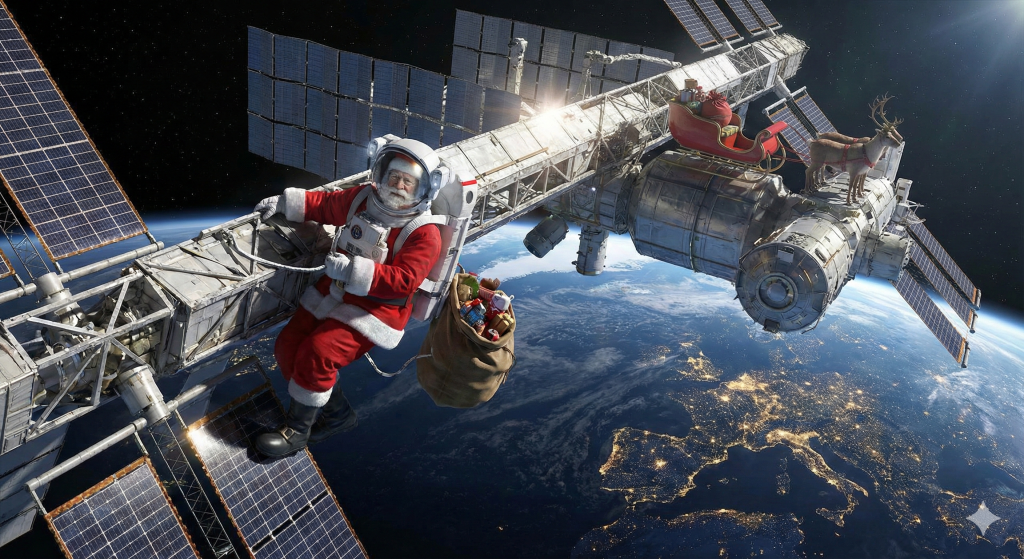
🚀 ISS Overpasses
| Date | Mag | Start Time | Start Alt | Start Az | Max Time | Max Alt | Max Az | End Time | End Alt | End Az | Visibility |
|---|---|---|---|---|---|---|---|---|---|---|---|
| 01 Dec | -0.8 | 17:22:56 | 10° | WSW | 17:25:06 | 16° | SW | 17:27:15 | 10° | S | Visible |
| 02 Dec | -1.0 | 16:34:59 | 10° | W | 16:37:38 | 21° | SSW | 16:40:18 | 10° | SSE | Visible |
| 04 Dec | -0.2 | 16:37:27 | 10° | WSW | 16:38:40 | 12° | SW | 16:39:52 | 10° | SSW | Visible |
| 12 Dec | -0.4 | 07:03:12 | 10° | S | 07:04:46 | 13° | SE | 07:06:22 | 10° | ESE | Visible |
| 14 Dec | -1.2 | 07:02:41 | 10° | SSW | 07:05:26 | 23° | SSE | 07:08:11 | 10° | E | Visible |
| 15 Dec | -0.9 | 06:15:25 | 10° | S | 06:17:44 | 17° | SE | 06:20:03 | 10° | ESE | Visible |
| 16 Dec | -0.7 | 05:28:31 | 10° | SSE | 05:30:02 | 13° | SE | 05:31:34 | 10° | ESE | Visible |
| 16 Dec | -2.3 | 07:03:00 | 10° | SW | 07:06:09 | 37° | SSE | 07:09:19 | 10° | E | Visible |
| 17 Dec | -2.0 | 06:15:31 | 11° | SW | 06:18:20 | 30° | SSE | 06:21:20 | 10° | E | Visible |
| 18 Dec | -1.7 | 05:29:58 | 22° | SSE | 05:30:32 | 23° | SSE | 05:33:16 | 10° | E | Visible |
| 18 Dec | -3.0 | 07:03:35 | 10° | WSW | 07:06:54 | 52° | S | 07:10:11 | 10° | E | Visible |
| 19 Dec | -0.6 | 04:44:15 | 13° | ESE | 04:44:15 | 13° | ESE | 04:45:02 | 10° | ESE | Visible |
| 19 Dec | -2.8 | 06:17:12 | 22° | SW | 06:18:59 | 45° | SSE | 06:22:14 | 10° | E | Visible |
| 20 Dec | -2.4 | 05:31:21 | 36° | SSE | 05:31:21 | 36° | SSE | 05:34:14 | 10° | E | Visible |
| 20 Dec | -3.3 | 07:04:17 | 10° | W | 07:07:36 | 59° | S | 07:10:57 | 10° | E | Visible |
| 21 Dec | -0.6 | 04:45:23 | 15° | E | 04:45:23 | 15° | E | 04:46:10 | 10° | E | Visible |
| 21 Dec | -3.3 | 06:18:19 | 31° | WSW | 06:19:38 | 57° | S | 06:22:58 | 10° | E | Visible |
| 22 Dec | -2.7 | 05:32:17 | 44° | SE | 05:32:17 | 44° | SE | 05:34:58 | 10° | E | Visible |
| 22 Dec | -3.2 | 07:05:13 | 12° | W | 07:08:14 | 52° | S | 07:11:32 | 10° | ESE | Visible |
| 23 Dec | -0.6 | 04:46:11 | 15° | E | 04:46:11 | 15° | E | 04:46:55 | 10° | E | Visible |
| 23 Dec | -3.4 | 06:19:07 | 35° | WSW | 06:20:15 | 57° | S | 06:23:34 | 10° | ESE | Visible |
| 24 Dec | -2.7 | 05:32:59 | 44° | SE | 05:32:59 | 44° | SE | 05:35:33 | 10° | E | Visible |
| 24 Dec | -2.7 | 07:05:54 | 12° | W | 07:08:45 | 38° | SSW | 07:11:53 | 10° | SE | Visible |
| 25 Dec | -0.6 | 04:46:49 | 15° | E | 04:46:49 | 15° | E | 04:47:30 | 10° | E | Visible |
| 25 Dec | -3.1 | 06:19:44 | 34° | WSW | 06:20:44 | 46° | SSW | 06:23:59 | 10° | ESE | Visible |
| 26 Dec | -2.6 | 05:33:33 | 40° | SE | 05:33:33 | 40° | SE | 05:36:00 | 10° | ESE | Visible |
| 26 Dec | -2.0 | 07:06:28 | 11° | W | 07:09:04 | 23° | SSW | 07:11:49 | 10° | SSE | Visible |
| 27 Dec | -0.6 | 04:47:22 | 14° | ESE | 04:47:22 | 14° | ESE | 04:47:57 | 10° | ESE | Visible |
| 27 Dec | -2.5 | 06:20:17 | 27° | SW | 06:21:05 | 30° | SSW | 06:24:05 | 10° | SE | Visible |
| 28 Dec | -2.1 | 05:34:06 | 29° | SSE | 05:34:06 | 29° | SSE | 05:36:12 | 10° | SE | Visible |
| 28 Dec | -1.3 | 07:07:30 | 10° | WSW | 07:09:10 | 13° | SW | 07:10:48 | 10° | S | Visible |
| 29 Dec | -0.5 | 04:47:56 | 12° | ESE | 04:47:56 | 12° | ESE | 04:48:13 | 10° | ESE | Visible |
| 29 Dec | -1.9 | 06:20:52 | 18° | SW | 06:21:13 | 18° | SSW | 06:23:36 | 10° | SSE | Visible |
| 30 Dec | -1.4 | 05:34:43 | 18° | S | 05:34:43 | 18° | S | 05:36:00 | 10° | SSE | Visible |
Useful Resources
StarLust – A Website for People with a Passion for Astronomy, Stargazing, and Space Exploration.
http://www.n3kl.org/sun/noaa.html
http://skymaps.com/downloads.html
Astronomy Calendar of Celestial Events 2024 – Sea and Sky (seasky.org)
https://www.constellation-guide.com
IMO | International Meteor Organization
and of course the Sky at Night magazine!
Really good again Steve. Thanks for letting me share.