
A monthly look at astronomical events in the sky and on Earth
Compiled and written by Steve Sawyer

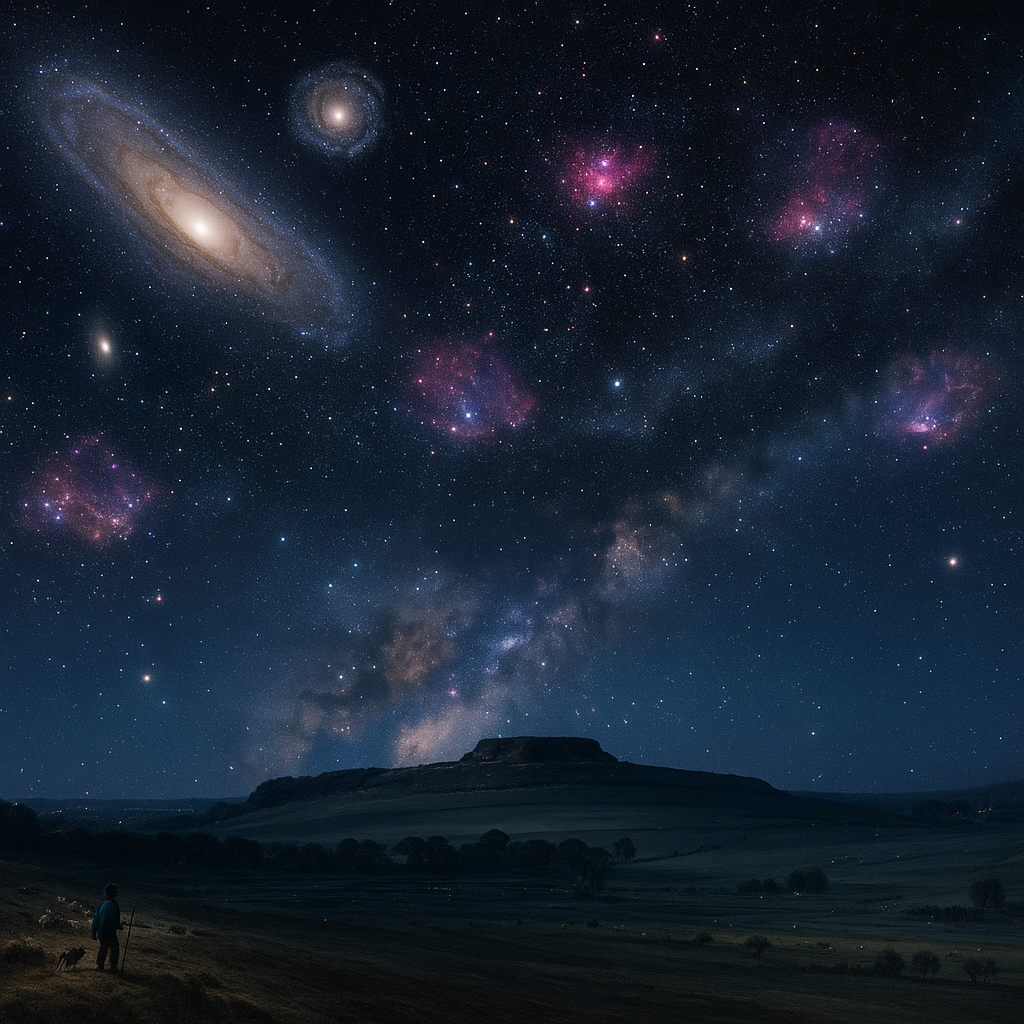
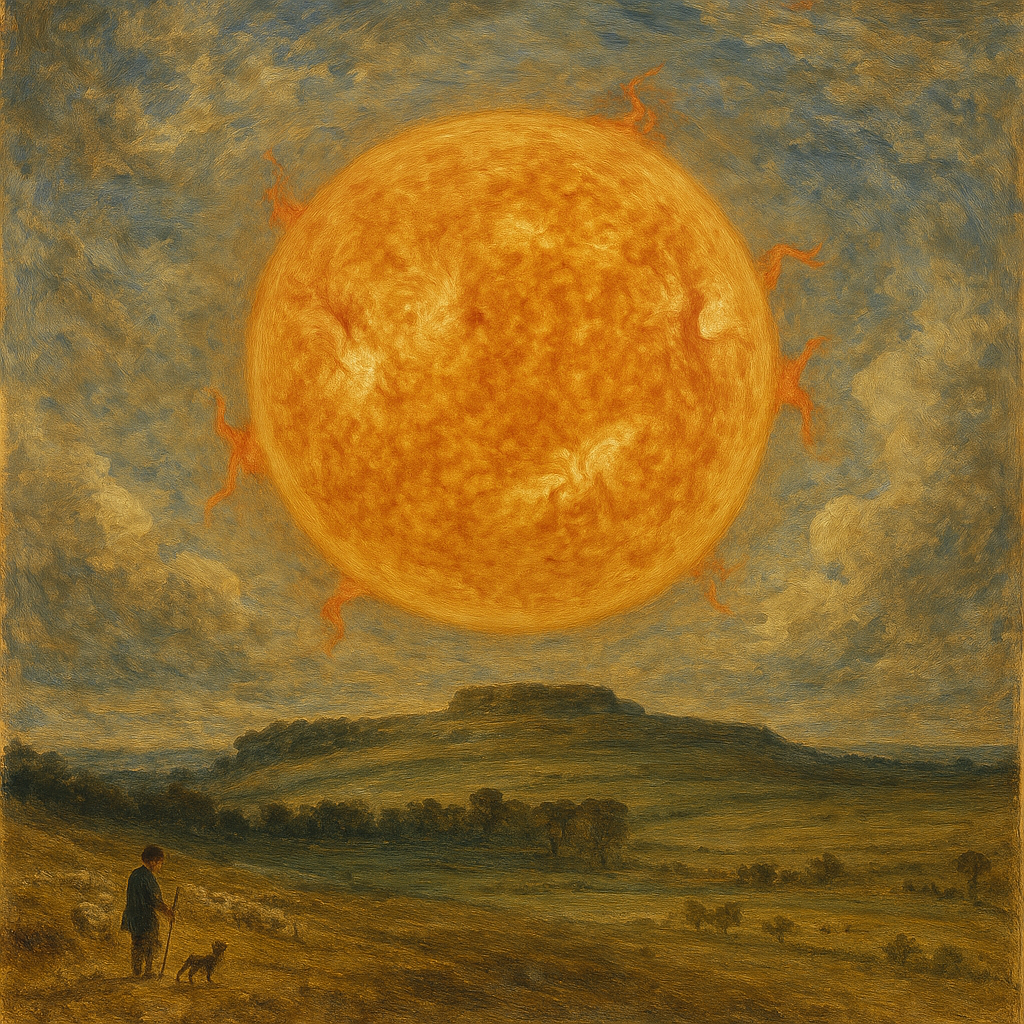
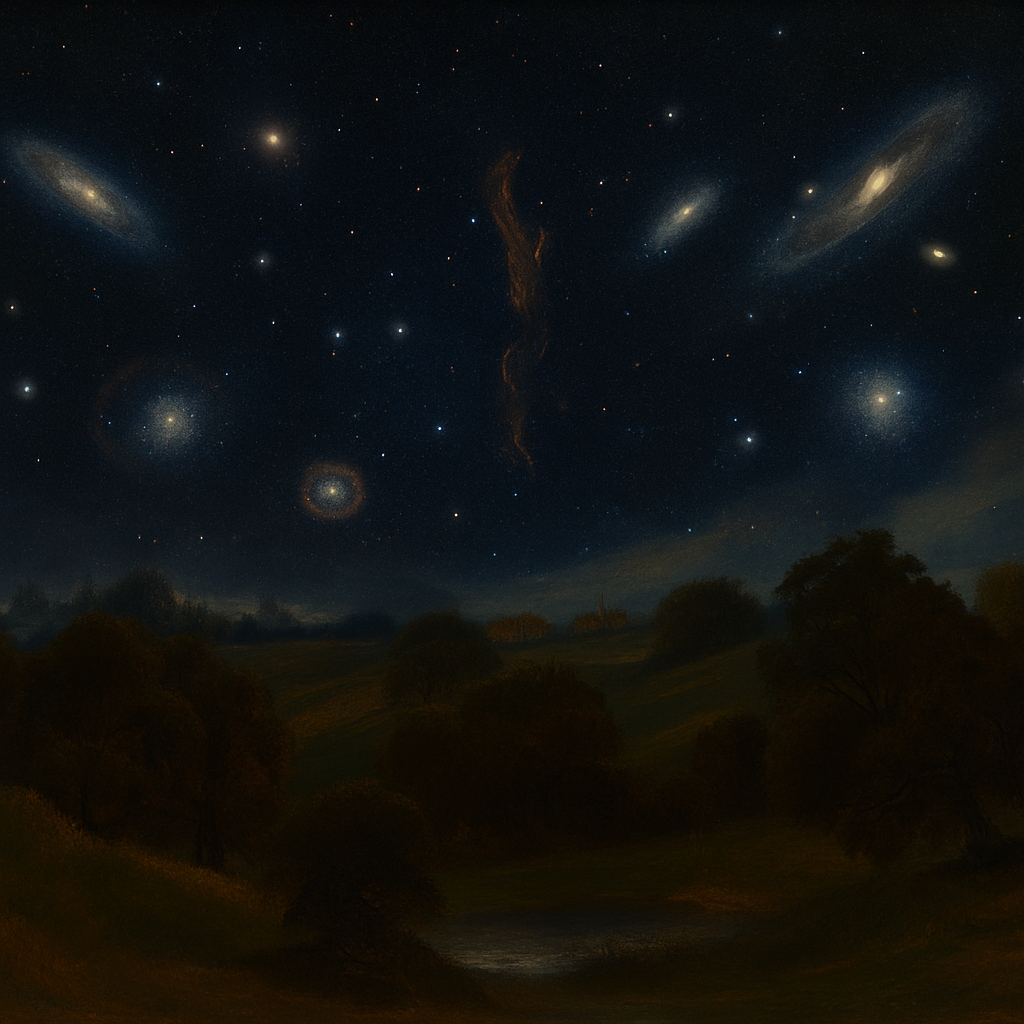
This month the images are being inspired by one of England’s most famous artists, John Constable. So we start with a noctilucent skies version of the Hay Wain. more info on the original can be found here.
Welcome to June’s What’s up! I can’t believe we’re halfway through the year already!
We’re well into the lighter nights now, it can be hard to pick out even the brighter stars in the twilight skies of June. One of the compensations is to look out for noctilucent clouds (which I mentioned last month). June is one of the best months for spotting these so keep an eye out around midnight.
Here’s what’s up this month!
This Months York Astro Presentations
This month we can look forward to
06/06/2025 Members evening. Talks by our members
20/06/2025 Visual Astronomy: Alive and Kicking! by Simon Bennet
Other upcoming events
Upcoming events to put in your diary
| Date | Title | Speaker |
|---|---|---|
| 04/07/2025 | Galaxies: Citizens of the Universe| | Dave Armeson |
| 18/07/2025 | When Worlds Collide | Roy Gunson |
For further details see the events page Astronomy Presentations by guest speakers | York Astro and our Facebook group (20+) The York Astronomical Society Chat Group | Facebook
So what’s on this month?

Despite the summer twilight, some southern sky sights are still visible. Libra lies due south, while the red supergiant Antares in Scorpius glows low in the southeast—though the Scorpion’s tail stays below the horizon. Above, the large constellation Ophiuchus sits between the two halves of Serpens (Caput to the west, Cauda to the east), with the Sun spending more time here than in neighbouring Scorpius. Higher still, Boötes, Corona Borealis, and Hercules are well placed—perfect for viewing the brilliant globular cluster M13.
Sky Diary
This table captures the astronomical events for June, including phases of the moon, planetary alignments, and other notable occurrences.
| Date | Event |
|---|---|
| 01 | Venus reaches greatest western elongation (45.9°) |
| 01 | Mars (mag 1.2) appears 1.4° south of the Moon |
| 02 | Regulus is 1.8° south of the Moon |
| 03 | First Quarter Moon |
| 06 | Spica lies 0.5° north of the Moon |
| 07 | Moon reaches apogee (405,553 km) |
| 10 | Antares appears 0.3° north of the Moon |
| 11 | Full Moon |
| 12 | Venus reaches aphelion |
| 17 | Mars (mag 1.4) is 0.7° north of Regulus |
| 18 | Last Quarter Moon |
| 19 | Saturn (mag 1.0) is 3.4° south of the Moon |
| 21 | Summer Solstice |
| 21 | Mercury (mag -0.2) is 4.8° south of Pollux |
| 23 | Pleiades lies 0.6° south of the Moon |
| 23 | Moon reaches perigee (363,178 km) |
| 25 | Jupiter (mag -1.9) appears 5.1° south of the Moon |
| 25 | New Moon |
| 26 | Pollux lies 2.5° north of the Moon |
| 27 | Mercury (mag 0.1) is 2.9° south of the Moon |
| 29 | Regulus appears 1.5° south of the Moon |
| 30 | Mars (mag 1.4) is 0.2° south of the Moon |
Sky Maps
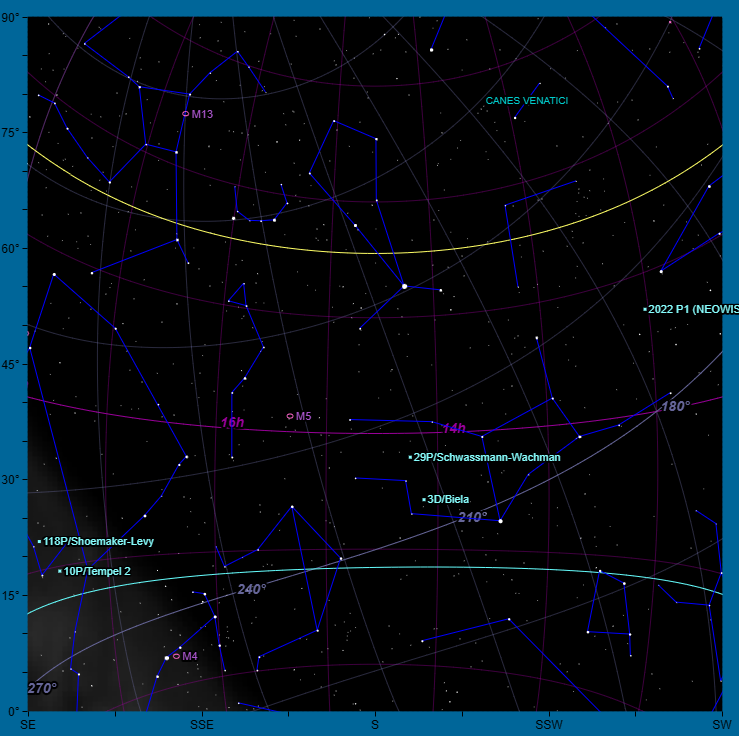
Looking South on the 15th at 22:00
Looking North on the 15th at 22:00
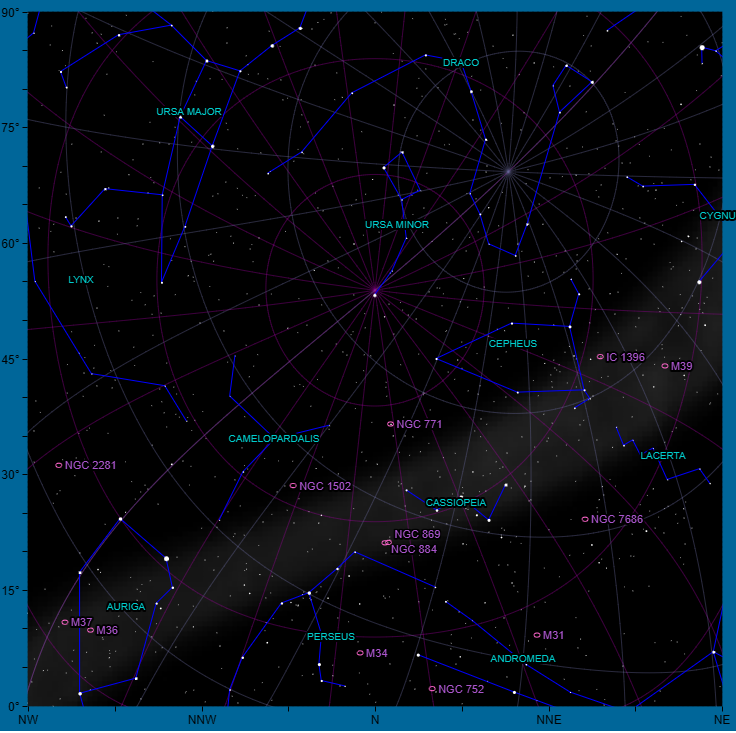
The two charts above show all DSOs of magnitude 6.0 or brighter. They are both taken from
SkyViewCafe.com and correct for the 15th of the month. For a clickable list of Messier objects with images, use the Wikipedia link.
Junes Objects
From Mays edition but it’s still relevant for the coming month!
Noctilucent cloud season is underway over the next few months, and I’ll try to post some forecasts here when I can.
Noctilucent clouds, also known as “night-shining” clouds, are high-altitude clouds that glow after sunset or before sunrise. They form around 80 km above Earth’s surface, where the atmosphere is extremely cold and thin. These clouds are composed of tiny ice crystals that catch the Sun’s rays, creating bright, ghostly displays.
In the Northern Hemisphere, noctilucent clouds typically appear between late May and mid-August, mainly between latitudes 50° and 70°. In the Southern Hemisphere, they are visible from late November to mid-February. To spot them, look low on the northern (or southern) horizon about an hour or two after sunset or just before sunrise, under clear, dark skies. Visibility can vary from faint, delicate wisps to striking, vibrant formations depending on conditions.
For more information, check out Noctilucent clouds – Met Office, and here’s a beautiful video capturing them:
Watch on YouTube
The Sun
🔭 Space Weather Outlook: May 26 – June 21, 2025
Data Source: NOAA SWPC
As we move into the early summer sky watching season, the Sun continues to show moderate levels of activity—good news for solar observers and aurora chasers alike. Here’s your detailed look at the coming month’s space weather, based on the latest 27-day forecast from NOAA’s Space Weather Prediction Centre (issued May 26, 2025).
☀️ Solar Activity: Moderate and Evolving
Solar activity is expected to trend downward through early June before picking up slightly mid-month. The 10.7 cm solar radio flux, a reliable proxy for solar ultraviolet emissions and sunspot activity, begins at 135 sfu on May 26 and dips to a low of 110 sfu by June 3–4. From there, it climbs modestly back to 125–130 sfu toward mid-June.
🔹 Expect visible sunspots and solar prominences on most days.
🔹 Ideal conditions for solar telescope observers and H-alpha imaging.
🌍 Geomagnetic Conditions: Storm Watch Mid-June
Most of the period will see quiet to unsettled geomagnetic conditions, with the planetary Kp index hovering around 2 to 4. However, models highlight June 13–14 as a window of heightened geomagnetic activity, with a possible minor G1-class geomagnetic storm on the cards:
| 📅 Date Range | Planetary A Index | Max Kp | Conditions |
|---|---|---|---|
| May 26–June 10 | 5–15 | 2–4 | Quiet to Unsettled |
| June 10–12 | 12–15 | 4 | Active spells possible |
| June 13–14 | 20–30 | 5 | Minor Storm (Aurora!) |
| June 15–21 | 8–12 | 3–4 | Unsettled to Quiet |
🔹 Best chance for aurora viewing—especially in northern latitudes—comes around June 13–14.
🔹 Amateur radio users may experience interference or reduced HF propagation during this period.
📡 Observing Tips
- Aurora Hunters: If you’re located in northern Europe, Canada, or the northern U.S., mark your calendars for mid-June. Stay alert for aurora alerts from space weather services.
- Astrophotographers: Monitor sunspot regions for potential solar imaging opportunities, especially on days with stable atmospheric seeing.
- Radio Operators: Expect generally stable conditions, except around geomagnetic storm periods (especially June 13–14).
Auroa Forecasts
A bit US centred but still useful
Aurora Dashboard (Experimental) | NOAA / NWS Space Weather Prediction Center
And our own Met-office have an excellent space weather forecast page here Space Weather – Met Office
The Moon
June Lunar Calendar
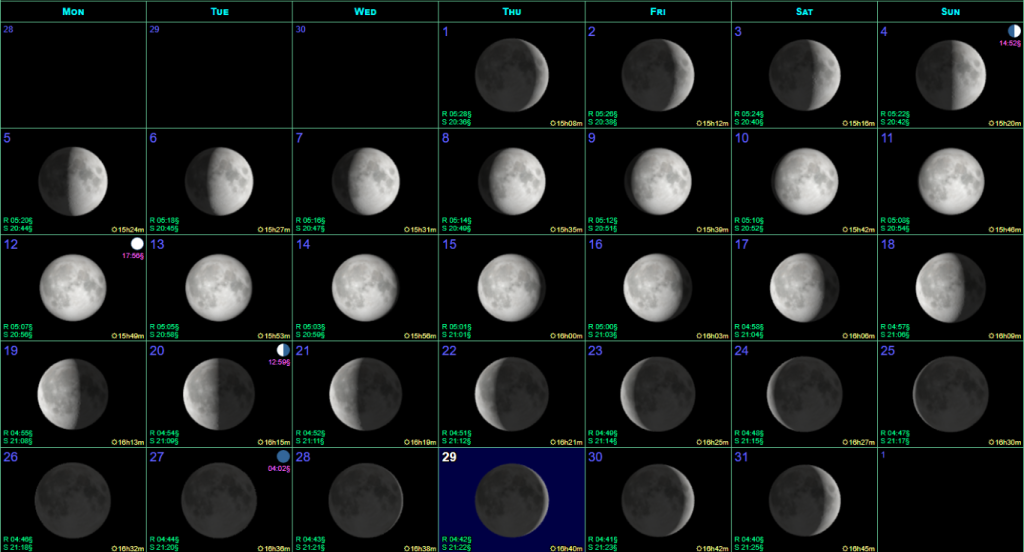
Junes’s moon calendar from Sky View Café (skyviewcafe.com)
A full yearly lunar calendar can be found here :-
https://www.mooninfo.org/moon-phases/2025.html
🌙 Moon Positions & Events – June 2025
| Date | Event | Moon Phase |
|---|---|---|
| 01 | Mars (mag 1.2) appears 1.4° south of the Moon | 🌓 Waxing Crescent |
| 02 | Regulus is 1.8° south of the Moon | 🌓 Waxing Crescent |
| 03 | First Quarter Moon | 🌓 First Quarter |
| 06 | Spica lies 0.5° north of the Moon | 🌔 Waxing Gibbous |
| 07 | Moon reaches apogee (405,553 km) | 🌔 Waxing Gibbous |
| 10 | Antares appears 0.3° north of the Moon | 🌕 Near Full Moon |
| 11 | Full Moon | 🌕 Full Moon |
| 18 | Last Quarter Moon | 🌗 Last Quarter |
| 19 | Saturn (mag 1.0) is 3.4° south of the Moon | 🌗 Waning Crescent |
| 23 | Pleiades lies 0.6° south of the Moon | 🌘 Waning Crescent |
| 23 | Moon reaches perigee (363,178 km) | 🌘 Waning Crescent |
| 25 | Jupiter (mag -1.9) appears 5.1° south of the Moon | 🌑 New Moon |
| 25 | New Moon | 🌑 New Moon |
| 26 | Pollux lies 2.5° north of the Moon | 🌒 Waxing Crescent |
| 27 | Mercury (mag 0.1) is 2.9° south of the Moon | 🌒 Waxing Crescent |
| 29 | Regulus appears 1.5° south of the Moon | 🌓 Waxing Crescent |
| 30 | Mars (mag 1.4) is 0.2° south of the Moon | 🌓 Waxing Crescent |
Moon Feature
June offers excellent opportunities to explore the Moon under high-altitude, shadow-rich lighting. Ideal for revealing surface detail.
Here are three lunar features, timed to both the waxing and waning phases.
🌒 Early June 2–5* The Apennine Mountains & Mare Imbrium
📅 Best dates: June 2–5 (Waxing Crescent to Gibbous)
🕰️ Best time: Evening (8 PM–11 PM local time)
📍 Hemisphere: Northern lunar hemisphere
One of the lunar highlights, the Apennine Mountains (Montes Apenninus) form the southern arc of Mare Imbrium, the Sea of Rains. This rugged, curved range contains peaks rising over 5,000 meters and was the landing site of Apollo 15. Nearby, you’ll find:
- Crater Archimedes – smooth floor, steep walls
- Crater Aristillus – central peaks and ray system
- The Straight Wall (Rupes Recta) – best seen around June 5 for dramatic contrast
🌓 Mid-June 10–13 Tycho & the Southern Highlands
🔭 Feature: Tycho & the Southern Highlands
🌕 Phase: Waxing Gibbous to Full Moon
🕘 Best time: Evenings, 10 PM onward
As the Moon approaches full (June 11), the southern highlands and Tycho Crater come into sharp relief. Tycho’s distinct central peak and surrounding ray system (bright streaks radiating outward) are especially eye-catching. Nearby craters Clavius and Longomontanus add complexity to this ancient landscape.
🌘 Late June 19–23 Schiller & the Southwest Limb
🔭 Feature: Schiller & the Southwest Limb
🌗 Phase: Waning Gibbous to Crescent
🕓 Best time: Pre-dawn, 3–5 AM
As the Moon wanes and rises later, switch to early morning observing. Catch the oddly-shaped Schiller Crater, along with rugged southern terrain. At this low Sun angle, long shadows stretch across crater walls.
Planets
Not a great deal to spot this month I’m afraid.
☀️ Mercury
Not well placed at the start of the month. but becoming a better target for observation after the middle of the month.
🟡 Venus
Although low on the horizon Venus is a bright morning object rising before the Sun in the eastern sky. Shining at a magnitude of around −4
🔴 Mars
Mars an be found in Leo and is visible in the evening sky. Setting earlier as the month progresses
🟠 Jupiter
Setting shortly after the sun, so very hard to see in the bright skies
🪐 Saturn
Morning planet and mainly lost in the suns glare,
🔵 Uranus
Not visible this month
🔷 Neptune
Not really a viable object to view this month
Meteor Showers
June Bootids
- Peak Date: June 27
- Radiant: Near the constellation Boötes
- ZHR (Zenithal Hourly Rate): Variable, historically between 0-100 meteors per hour
- Visibility: Best viewed after midnight
- Description: The June Bootids are known for their unpredictability. While they have produced strong displays in the past, they can also be very weak. The shower’s activity can vary greatly from year to year. If there is an outburst, it can be quite a treat for observers.
Comets
| Comet Name | Approx. Magnitude | Best Viewing Time | Visibility Notes |
|---|---|---|---|
| C/2023 A3 (Tsuchinshan–ATLAS) | +13 | Evening twilight | Fading post-perihelion; visible low in the west-northwest. |
Link here for further details of each comet and how to locate it.
Visual Comets in the Future (Northern Hemisphere) (aerith.net)
Deep Sky (DSO’s)
M13: The Great Hercules Cluster
This month we’ll have a deep dive on/into M13.
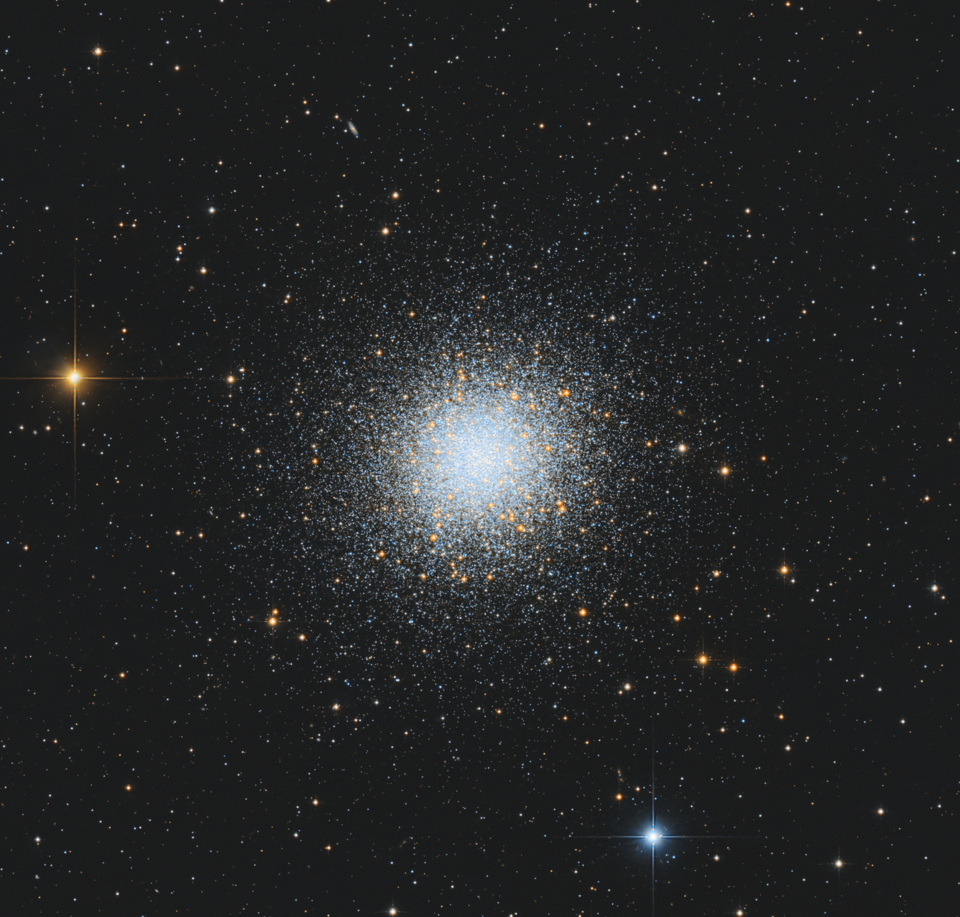
By Chuck Ayoub – Own work, CC0, https://commons.wikimedia.org/w/index.php?curid=163946870
M13 is located high in the summer sky, within the Keystone asterism of Hercules. This globular cluster spans about 145 light-years across and appears as a faint glow to the naked eye under dark skies. Through a modest telescope, M13 resolves into a dense ball of stars, with estimates of between 300,000 and 500,000 stars in total. The brightest star in the cluster is a red giant variable, V11, also known as V1554 Herculis.
M13 is 22,200 to 25,000 light years from Earth and is one of over a hundred globular clusters that orbit the centre of the milky way.
M13 was first noted in 1714 by Edmond Halley (of comet fame) and later catalogued by Charles Messier in 1764 as the 13th entry in his famous list of deep-sky objects. In 1779, William Herschel’s more powerful telescope transformed M13 from a “nebula” into a breathtaking swarm of stars, showcasing the true beauty of a globular cluster.
I did wonder if Chinese or other historical astronomers might have noted M13 in their observations as Ancient Chinese, Babylonian, or Greek astronomers often recorded bright celestial objects. But globular clusters like M13 were not commonly documented because they appear as faint, fuzzy patches rather than distinct stars or planets and were thought to be celestial vapours or cosmic clouds.
In 1974, M13 was selected as the target for the Arecibo message—a brief radio broadcast sent into space from the Arecibo radio telescope in Puerto Rico. The message, consisting of 1,679 binary digits, was intended as a symbolic demonstration of humanity’s technological capabilities and included basic information about our solar system, the human species, and our numbering system. Although the signal is expected to take around 22,000 years to reach M13 and another 22,000 years for any reply to return, I wonder if anyone will be around to listen for a reply!
Throughout June, M13 rides high in the south after nightfall, a jewel of the summer sky. Grab a pair of binoculars or a telescope and treat yourself to a direct encounter with one of the oldest, most spectacular structures in our galaxy.
ISS and other orbiting bits
🛰 International Space Station (ISS) Visible Passes – May
No sightings for the beginning of the month. Use the link below to check mid month.
Use the this NASA website for exact timings for York overpasses. York, England, United Kingdom | Sighting Opportunity | Spot The Station | NASA
Useful Resources
StarLust – A Website for People with a Passion for Astronomy, Stargazing, and Space Exploration.
http://www.n3kl.org/sun/noaa.html
http://skymaps.com/downloads.html
Astronomy Calendar of Celestial Events 2024 – Sea and Sky (seasky.org)
https://www.constellation-guide.com
IMO | International Meteor Organization
and of course the Sky at Night magazine!