A monthly look at astronomical events in the sky and on Earth
Compiled by Steve Sawyer
Hi, wishing you all a Happy New Year from York Astronomy Society!
The society has many events planned for 2023 including our 50th Anniversary! Have a look at the society pages for full details of our events program which includes star parties and outreach events.
So what’s on this month?
This month we will (hopefully) be able to view Moon-planet conjunctions, a meteor shower, possibly a bright comet and some beautiful constellations.
A quick summary of what’s happening or is going to take place this next month.
| Date | Description | |
| 1st | Hangovers and the Moon occults Uranus | |
| 2nd | Moon near Pleiades | |
| 3rd | Moon very near Mars | |
| 4th | Quadrantid meteor shower peak (details below). Also the Earth is at perihelion, its closest point to the Sun (147 million km away), you may be able to turn the central heating down 🙂. | |
| 6th | Full Moon | |
| 7th | Moon near Castor & Pollux | |
| 8th | Moon near Praesepe (M44 Beehive cluster) | |
| 9th | Moon near Regulas | |
| 11th | New York! Manhattanhenge at Sunrise | |
| 12th | C/2022 E3 (ZTF) at perihelion | |
| 14th | Moon near Spica (Spica is the brightest object in the constellation of Virgo and one of the 20 brightest stars in the night sky) | |
| 15th | Last quarter Moon | |
| 21st | New Moon | |
| 22nd | Venus-Saturn Conjunction | |
| 23rd | Moon-Saturn & Moon-Venus conjunctions | |
| 25th | Jupiter above the crescent Moon | |
| 30th | Mars near the Moon, Alderbaran and Pleiades |
Onto this month’s viewing.
Sky Charts
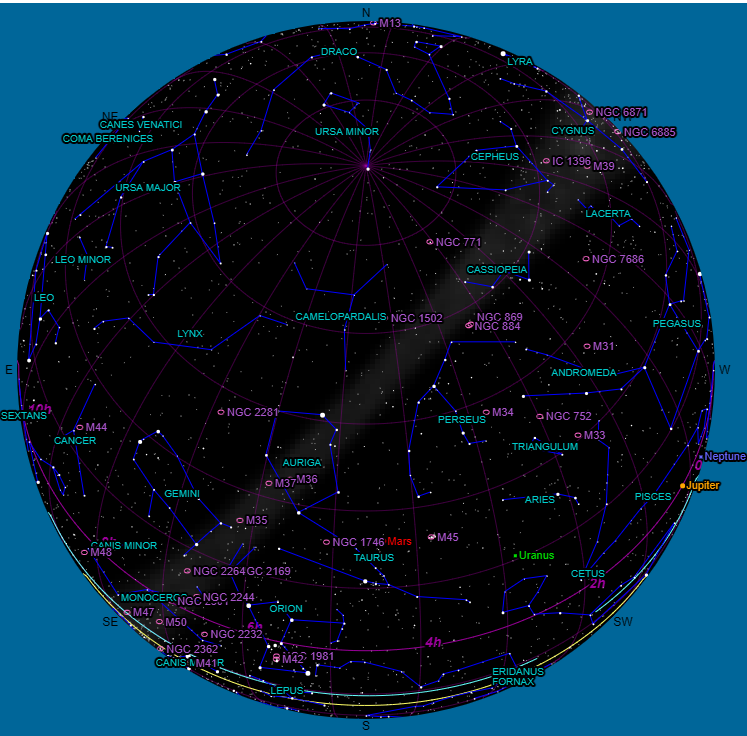
Looking South on the 15th at 21:00
Looking North on the 15th at 21:00 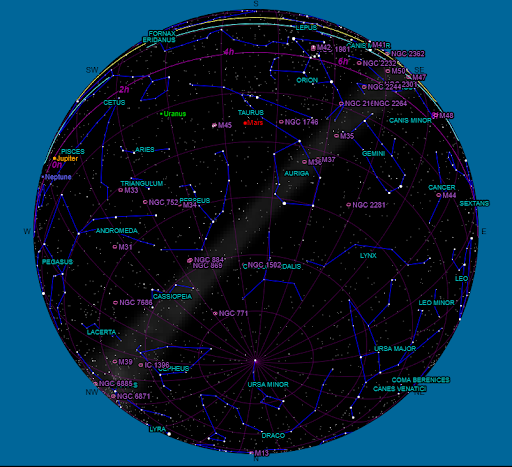
The two charts above show all DSOs of magnitude 6.0 or brighter, the first being the
whole sky and the second a 100° span centred on the zenith. They are both taken from
SkyViewCafe.com and correct for the 15th of the month. For a clickable list of Messier objects with images, use the Wikipedia link. To look up NGC objects, the best way is to enter NGC<object number> into Wikipedia.
January’s Objects
The Sun
The sun is currently quite active with the current sunspot number being 121 and a number of recent CME events that have caused geomagnetic storms with visible aurorae at high latitudes. Locally one of the best places to go is apparently Bempton cliffs as you can get a good Northerly view point.
A potential storm is expected on the 4th Jan. See http://spaceweather.com for up to date details
For more info on the sun and solar weather look here : –
https://www.swpc.noaa.gov/communities/space-weather-enthusiasts
The Moon
The Full Wolf Moon will occur on January 6, at 23:08 GMT). With the Moon being located in the constellation Gemini. Technically, the Full Moon lasts only for a moment when the Moon is on the opposite side of the Earth from the Sun, but the lunar disk will appear full for one day before and after it.
The New Moon will occur on January 21, at 20:53 GMT). At this point, our natural satellite will stay between the Earth and the Sun, so its bright side will be facing away from the Earth. It’s the best time for stargazing because the Moon’s light won’t hinder the view.
On January 23, at 07:22 GM), Saturn (magnitude 0.7) will meet the 2-day-old Moon in the constellation Capricornus. The apparent distance between the two objects will be 3°49′.
Later that day, at 08:20 GMT the Moon will pass near Venus (magnitude -3.9). The distance between the two bodies will be 3°27′.
On January 31, at 04:27 GMT), Mars will meet the 11-day-old Moon in the constellation Taurus. The apparent distance between the two objects will be only 0°06′. This will be their closest conjunction this year.
A full lunar calendar can be found here :-
https://www.mooninfo.org/moon-phases/2022.html
The Planets
Mercury
Look for Mercury low in the sky during the 2nd half of the month. You’ll find the planet very low in the south-eastern sky just before sunrise.
Venus
Visible in the south-west just after sunset and moves towards Saturn as the month progresses. The planets will be very close together on the 22nd.
Mars
Mars is still a great planet to view this month, currently located in Taurus to the West of the Pleiades Dropping in brightness towards the end of the month.
Jupiter
Best viewing is at the start of the month. Visible all month at mag -2.3 in Pisces. A waxing crescent moon is near the planet on the 25th and 26th of Jan.
Saturn
Early evening planet and not best placed for observation other than the conjunction on the 23rd
Uranus
Well placed for viewing this month being visib;e under dark sky condition for most of the month in the south.
Meteor Showers
There’s one big meteor shower this month
The Quadrantids
The Quadrantid meteor shower runs from December 12 to January 12 and peaks on the 4th January. The radiant point is located in the constellation Bootes (look North East).
Under ideal conditions, you could see up to 110 meteors an hour, though this year, the meteor shower peaks near the Full Moon (92%), whose light will obstruct the view. So, it is better to observe the meteor shower after the moonset until sunrise.
Comets
Comet c/2022 E3 ZTF makes a move through the skies this month brightening as it goes. Starting off at around +7.5 brightening to +5.6 which may make it visible to the naked eye later on this month. There’s a great guide in the Sky at Night this month and the link below has some good star charts to follow.
Sourced from Visual Comets in the Future (Northern Hemisphere) (aerith.net)
| Comet | Mag | h |
| C/2022 E3 (ZTF) | 4 | 45 |
| C/2020 V2 (ZTF) | 9 | 38 |
| C/2022 A2 (PanSTARRS) | 10 | 6 |
| C/2019 L3 (ATLAS) | 11 | 22 |
| C/2019 U5 (PanSTARRS) | 12 | 13 |
| 118P/Shoemaker- Levy 4 | 12 | 69 |
| C/2022 U2 (ATLAS) | 13 | 44 |
| 29P/Schwassmann- Wachmann 1 | 13 | 84 |
| C/2021 Y1 (ATLAS) | 13 | 32 |
Deep Sky Objects (DSOs)
Lot’s of galaxies to image or fuzzy grey blobs for visual observers. There’s a really good guide here
https://www.galactic-hunter.com/post/winter-the-15-best-astrophotography-targets
Here’s a quick summary of the best objects to go for. (Size in arcminutes.)
| Object | Type | Size / Mag. | Notes |
| M39 | Open cluster | 29 / 5.5 | Very loose. Use binoculars. |
| M31 | Galaxy | 190 / 3.5 | “The Andromeda Nebula” |
| M33 | Galaxy | 60 / 5.7 | “The Triangulum Galaxy” |
| NGC752 | Open cluster | 75 / 5.7 | “Caldwell 28” |
| M34 | Open cluster | 35 / 5.5 | Very loose. Use binoculars. |
| M45 | Open cluster | 110 / 1.6 | “The Pleiades”. Wonderful |
| NGC884/869 | Twin open clusters | 60 / 3.7 & 3.8 | “The double cluster”. Superb |
Man’s Space Activities
Spotting the International Space Station
The following ISS sightings are possible.
Ref: Spot the Station website (York, UK)
| Sun Jan 1, 4:55 AM | 1 min | 16° | 16° above ESE | 10° above ESE |
| Sun Jan 1, 6:28 AM | 4 min | 28° | 24° above SW | 10° above SE |
| Mon Jan 2, 5:42 AM | 2 min | 29° | 29° above SSE | 10° above SE |
| Mon Jan 2, 7:15 AM | 3 min | 12° | 10° above WSW | 10° above SSW |
| Tue Jan 3, 4:55 AM | < 1 min | 13° | 13° above SE | 10° above ESE |
| Tue Jan 3, 6:28 AM | 3 min | 16° | 16° above SW | 10° above S |
| Wed Jan 4, 5:42 AM | 1 min | 17° | 17° above S | 10° above SSE |
Useful Resources
http://www.n3kl.org/sun/noaa.html
http://skymaps.com/downloads.html
http://www.seasky.org/astronomy/astronomy-calendar-2022.html
https://www.rmg.co.uk/stories/topics/what-are-names-full-moons-throughout-yearhttp://www.deepskywatch.com/deepsky-guide.html
Top 10 Winter Sky Targets for Skywatchers | Space
and of course the sky at night magazine!
Brillent this Steve, well done on the hard work… its a asset to YAS…
Nice work Steve, appreciated.
Many thanks for this Steve.
Info like this is always a spur to YAS members to look up.