A monthly look at astronomical events in the sky and on Earth
Compiled and written by Steve Sawyer
Welcome to October’s spooky edition of What’s Up!
Welcome to October! Autumn is now well and truly settled in, bringing longer, darker evenings and crisp nights. Don’t forget the clocks go back on the 25th (2:00am) , so we’ll have even longer and darker evenings at the end of the month.
This month belongs firmly to the giant worlds. Saturn takes pride of place as it reaches opposition on October 4, shining at its closest and brightest for all of 2026. Meanwhile, in the pre-dawn hours, Mars stages an unmissable celestial encounter on October 11, parking itself smack in the middle of the Beehive Cluster (M44)—a brilliant ruby set against a field of diamond stars.
We also have the peak of the annual Orionid meteor shower on the night of October 21/22, and an enchanting lunar occultation of the Pleiades on October 27/28.
This Month’s York Astro Presentations
Our autumn speaker season is in full swing! Join us this month for fascinating talks from our guest speakers and club members.
| Date | Title | Speaker |
|---|---|---|
| 02/10/2026 | Atmospheres of our Solar System (The First in a Four-Part Trilogy) | Paul Money |
| 16/09/2026 | AGM + Review of Solar Eclipse Event | York AS Members |
For full details, times, and venue information, check out our events page Astronomy Presentations by guest speakers | York Astro and join the conversation in our Facebook Chat Group.
So what’s on this month?
Northern & Southern Sky

The Northern Highlights
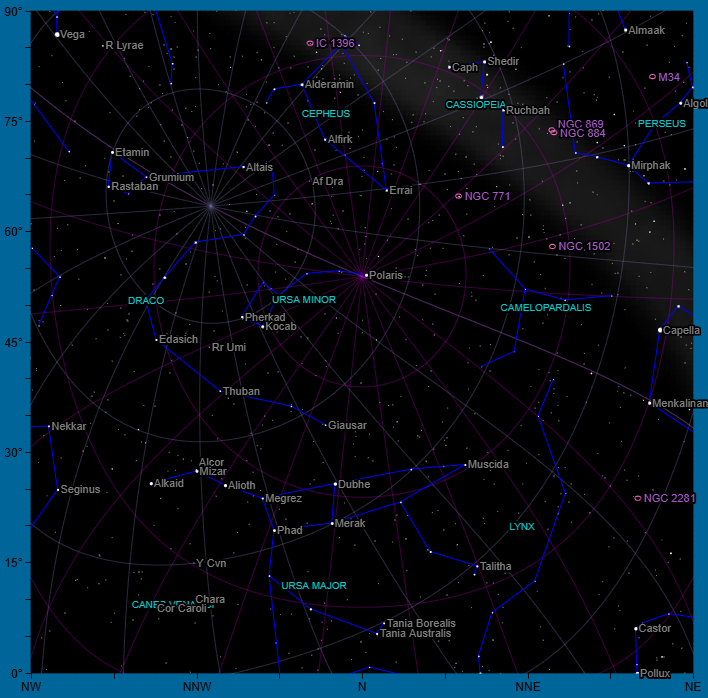
High in the northern sky, the celestial dragon Draco winds its serpentine body between the Two Bears, with its diamond-shaped head positioned not far from Vega. Below Polaris, the Plough (Ursa Major) skims low across the northern horizon during the early evening hours. Over towards the northeast, Capella in Auriga gleams brilliantly, heralding the first arrivals of the winter constellation crew.

The Southern Highlights
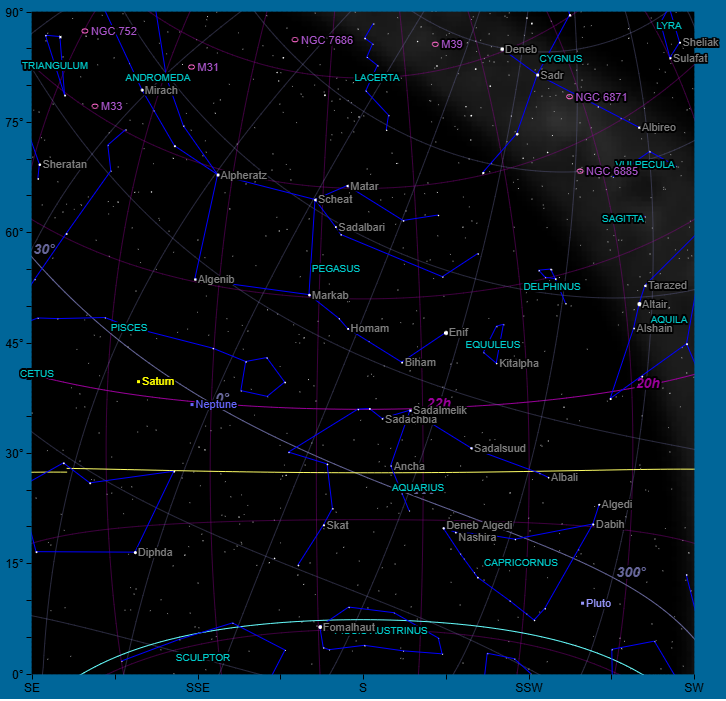
Dominating the southern meridian mid-evening is the Great Square of Pegasus, representing the mythical winged horse. Below Pegasus lies Saturn, gleaming steadily on the border between Pisces and Cetus. Looking towards the southeast, the early winter constellations are beginning to climb into view: the sparkling open star clusters of the Pleiades and the Hyades in Taurus herald the rising of Orion later in the night.
October 2026 Calendar
| Date | Time (UT) | Event | Details |
|---|---|---|---|
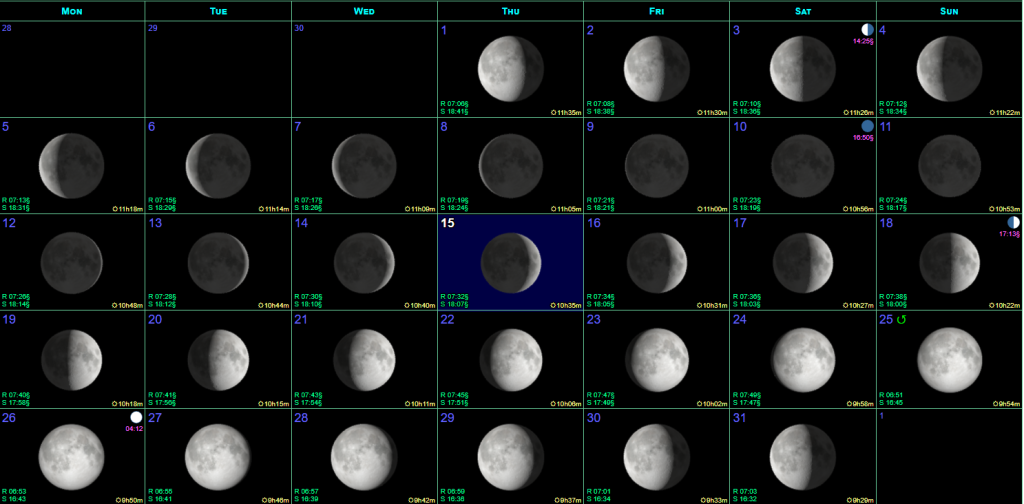
| Oct 01 | 20:41 | Moon at Perigee | Distance: 369,338 km |
| Oct 03 | 13:25 | Last Quarter Moon | |
| Oct 04 | 12:21 | Saturn at Opposition | Closest approach to Earth (1,262 million km); visible all night (mag +0.3). |
| Oct 05 | 05:30 | Moon & Mars | Mars lies just 25′ / 1.2° south of the waning crescent Moon before dawn. |
| Oct 06 | Before dawn | Moon & Jupiter | Jupiter lies just below the crescent Moon; lunar occultation visible in parts of the world. |
| Oct 06 | All night | Asteroid 2 Pallas at Opposition | Reaches opposition in Cetus (mag +8.2). |
| Oct 07–08 | Night | Draconid Meteors | Peaks with favourable dark skies as the Moon approaches New. |
| Oct 10 | 15:50 | New Moon | Perfect dark-sky weekend for deep-sky observation. |
| Oct 10 | Night | Southern Taurid Meteors | First peak of the Taurid stream; known for slow, bright fireballs. |
| Oct 11 | 06:00 | Mars in the Beehive Cluster | Mars (mag +1.0) sits right in the centre of the Praesepe cluster (M44) before dawn. |
| Oct 12 | 10:00 | Mercury at Greatest Elongation | Reaches 25.2° east of the Sun in the evening sky. |
| Oct 13 | All night | Asteroid 4 Vesta at Opposition | Brightest asteroid reaches opposition in Cetus (mag +6.5). |
| Oct 16 | 22:56 | Moon at Apogee | Distance: 404,639 km |
| Oct 18 | 16:13 | First Quarter Moon | |
| Oct 21–22 | Night/AM | Orionid Meteor Shower Peak | Fast debris from Halley’s Comet; best observed in pre-dawn hours. |
| Oct 23–24 | Evening | Moon & Saturn | Waxing gibbous Moon passes beside and above Saturn. |
| Oct 24 | — | Venus at Inferior Conjunction | Venus transitions from Evening Star to Morning Star. |
| Oct 25 | 02:00 BST | BST Ends (Clocks go back) | Revert to GMT (clocks fall back 1 hour). |
| Oct 26 | 04:12 | Full Moon | |
| Oct 27–28 | 23:30–03:00 | Moon Occults the Pleiades | The bright Moon glides across the northern stars of the Pleiades cluster. |
Sky Maps
Looking South on the 15th at 22:00 BST
Looking North on the 15th at 22:00 BST
October’s Sky Guide
The Sun

Source: NOAA Space Weather Prediction Centre (SWPC) | Data:** 27-Day Outlook (Issued 28 September 2026)
October 2026 brings an exciting mix of space weather for autumn stargazers. Overall solar activity remains at moderate levels, with radio flux values holding between 88 and 105 sfu. Two distinct active geomagnetic windows line up remarkably well with this month’s main astronomical highlights offering both pristine, dark-sky observing conditions for key deep sky events and a potential G1 Minor Geomagnetic Storm right at the peak of the Orionid meteor shower!
🌌 Aurora Watch: Key October Windows
The Kp Index measures global geomagnetic activity. For October, NOAA forecasts two main periods of geomagnetic unrest:
- Early October Unrest (4–6 October): Right as Saturn reaches opposition on 4 October, geomagnetic activity surges to Kp 4 (with the Planetary A-index reaching 15 on 5 October). Northern observers in Scotland and northern England should keep an eye on the northern horizon for faint auroral displays.
- The Spooky Orionid Storm Window (21–24 October): The standout aurora window of the month arrives just in time for Halloween preparations! Activity ramps up to Kp 4 on 21 October, peaking with a G1 Minor Geomagnetic Storm (Kp 5) and a Planetary A-index of 20 on 22 October, before settling back through Kp 4 on 23–24 October. Because this storm coincides directly with the peak of the Orionid meteor shower (night of 21/22 October), dark-sky observers might enjoy the rare treat of shooting stars streaking across a glowing auroral backdrop!
🔭 Dark Sky & Observing Windows
- Pristine New Moon Weekend (9–10 October): A wonderfully calm period with geomagnetic activity resting at Kp 2. Combined with the New Moon on 10 October, this provides ideal, undisturbed dark-sky conditions for deep-sky imaging and observing the Draconid meteors.
- Mid-Month Quiet Spell (15–20 October): A extended 6-day stretch of very quiet space weather (Kp 2, A-index 5), ideal for evening observing before the late-month storm arrives.
☀️ Sunspot & Radio Flux Trends
For solar observers tracking sunspots and active regions:
- 10.7 cm Radio Flux: Starts the month around 105 sfu, hovering around 98–102 sfu through mid-October, before gradually declining to 88 sfu towards late October.
- While lower than the peak flux values seen during summer, these numbers indicate steady, well-defined active regions rotating across the visible solar disk, perfect for crisp telescopic views in autumn sunlight.
📊 October 2026 Solar Activity Table
| Date Range | Max Solar Flux (10.7 cm) | Max Geomagnetic A Index | Max Kp | Activity Notes & Highlights |
|---|---|---|---|---|
| Oct 01–07 | 105 sfu | 15 | 4 | Quiet start; active disturbance (Kp 4) on 4–6 October during Saturn opposition. |
| Oct 08–14 | 102 sfu | 9 | 3 | Pristine Dark Sky Window (9–10 Oct) for New Moon; mild unrest (Kp 3) on 11–14 Oct during Mars/Beehive event. |
| Oct 15–21 | 102 sfu | 15 | 4 | Quiet mid-month (Kp 2), with activity building to Kp 4 on 21 October. |
| Oct 22–31 | 92* sfu | 20 | 5 | Major Aurora Alert! G1 Minor Storm (Kp 5) on 22 October coinciding with Orionid meteor peak! (NOAA forecast extends to 24 Oct). |
Aurora Forecasts
The Moon
Moon Features
Occultation of the Pleiades (Night of October 27/28)
Late on the night of October 27 into the early hours of October 28 (from approximately 11:30 pm to 3:00 am), the bright waning gibbous Moon will pass directly in front of the upper stars of the Pleiades open cluster (M45). Even though the brilliant lunar glare will wash out the fainter cluster members to the naked eye, watching several of the bright Seven Sisters snap out of sight behind the Moon’s limb through binoculars or a small telescope is a breathtaking spectacle!
PLANETS
🪐 Saturn (Headline Planet)
October is Saturn’s prime month! The ringed world reaches opposition on October 4, placing it directly opposite the Sun and at its closest point to Earth for the year (1,262 million km). Shining steadily at magnitude +0.3 on the borders of Pisces and Cetus, it is visible all night long. In a telescope, its famous rings are slowly opening up following their near-edge-on presentation last year, and you can easily spot its giant moon Titan glowing nearby. Look for the Moon passing close to Saturn on October 23 and 24.
🔴 Mars
Mars rises around 0:30 am and moves rapidly through Cancer this month, brightening to magnitude +1.0. On the morning of October 5, the crescent Moon passes just above the Red Planet. Then, on the morning of October 11, Mars puts on the show of the month: it sits smack-bang in front of the Beehive Cluster (M44). Through binoculars, it looks like a glowing ruby dropped into a bowl of glittering diamonds. By late October, Mars is approaching Jupiter.
🟠 Jupiter
Rising around 2:00 am in Leo, the King of Planets blazes at a magnificent magnitude –1.9. On the morning of October 6, the crescent Moon sits just above Jupiter. By the end of the month, Jupiter forms a striking trio with Mars above it and the bright star Regulus below.
🔵 Uranus & 🔷 Neptune
- Uranus: Located in Taurus, Uranus shines at magnitude +5.6, right on the threshold of naked-eye visibility from dark rural sites. It rises around 7:30 pm and is an easy find with binoculars.
- Neptune: Fresh from its September opposition, Neptune resides in Pisces at magnitude +7.7. You will need binoculars or a small telescope to spot this distant, deep-blue ice world.
⚪ Mercury & 🟡 Venus
- Mercury: Although reaching its greatest eastern elongation (25.2° from the Sun) on October 12, Mercury stays very low in the bright evening twilight for UK observers and is difficult to catch.
- Venus: Venus plunges rapidly towards the Sun in the first half of the month, ending its long reign as the Evening Star. It reaches inferior conjunction on October 24, passing between Earth and the Sun, before swiftly emerging into the morning dawn sky next month.
Minor Planets: Vesta & Pallas at Opposition
October is an exceptional month for asteroid hunters:
- 4 Vesta: The brightest of all asteroids reaches opposition on October 13 in Cetus. At magnitude +6.5, it is easily tracked using binoculars.
- 2 Pallas: Reaches opposition on October 6 in Cetus, glowing at magnitude +8.2, well within range of small telescopes.

METEOR SHOWERS
🌠 The Orionids (Peak: Night of October 21/22)
Active throughout October, the Orionids are famous for being composed of high-speed debris shed by none other than Halley’s Comet (1P/Halley). Hitting Earth’s atmosphere at a blistering 67 km/s, they frequently leave persistent trains. The shower peaks on the night of October 21/22. While a waxing gibbous Moon will illuminate the first half of the night, the early morning hours before dawn after moonset will offer the best opportunity to spot them!
🌠 The Draconids & Southern Taurids
- Draconids (October 7–8): A short-lived, quirky shower emanating from Comet 21P/Giacobini-Zinner. The Moon is approaching New phase, giving dark skies for this early-evening display.
- Southern Taurids (October 10): Peaking under moonless skies around October 10, the Taurids are known for producing slow, graceful, and remarkably bright fireballs.
COMETS

| Comet Name | Predicted Magnitude | Visibility Period | Notes |
|---|---|---|---|
| 161P/Hartley-IRAS | ~11 – 12 | Midnight / Morning | Halley-type comet moving through Equuleus and Pegasus, steadily brightening towards its November peak. |
| 88P/Howell | ~11 – 12 | Morning | Moving past perihelion, making its closest approach to Earth this autumn. |
| 29P/Schwassmann-Wachmann 1 | ~13 (Variable) | All Night | The unpredictable cryovolcanic comet; always worth monitoring for sudden outburst flares. |
DEEP SKY (DSOs)
Deep Dive: Autumn’s Island Universes
With the dense star clouds of the summer Milky Way slipping into the west, October provides a window into deep intergalactic space.
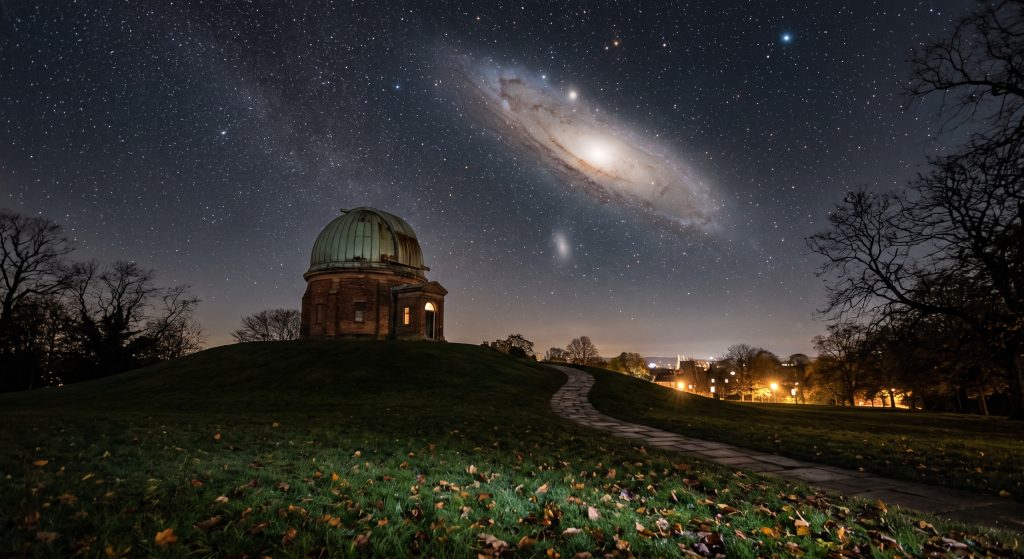
The Great Andromeda Galaxy (M31)
Riding nearly overhead at the zenith on October evenings, the Andromeda Galaxy is the most distant object visible to the unaided human eye (approx. 2.5 million light-years away).
- How to Find It: Start at the Great Square of Pegasus, look to the northeastern corner star Alpheratz, and hop two stars along Andromeda’s northern arc to Mirach. Slew upwards, and you will spot a soft, oval smudge of light.
- Viewing Tip: In binoculars, M31 appears as an elongated, ghostly spindle of milky light with an intensely bright galactic core. A moderate telescope will reveal its companion dwarf galaxies, M32 and M110
The Triangulum Galaxy (M33)
Located just south of Andromeda in the tiny constellation of Triangulum, M33 is a face-on spiral galaxy and the third-largest member of our Local Group. Because its light is spread over a broad area, it has a low surface brightness—making a dark sky and low-power, wide-field binoculars far more effective than high magnification!
🔭 Junior Stargazers: A Ruby in a Field of Diamonds!
A special guide for young astronomers. Grab your coat, step outside, and look up!

Welcome to October, Junior Stargazers!
This month brings one of the best treats of the whole year: the clocks go back! On Sunday 25 October, British Summer Time ends. That means the Sun sets an hour earlier, giving us dark, starry skies well before bedtime!
The Cosmic Treasure Chest (October 11)
If you can wake up early before school or on the weekend around October 11, ask a grown-up to help you look east with a pair of binoculars.
In the constellation of Cancer, there is a famous swarm of stars called the Beehive Cluster (or Praesepe). Usually, it looks like a fuzzy little cloud, but binoculars reveal dozens of glittering blue and white stars that look just like tiny diamonds.
On the morning of October 11, the Red Planet Mars will drift directly into the middle of the cluster! Because Mars shines with a warm, fiery orange-red glow, the view through binoculars looks just like a glowing red ruby dropped right into a treasure chest of sparkling diamonds!
Lord of the Rings
Don’t forget to look out for Saturn all month long! It looks like a steady, bright golden star shining in the south. If you have access to even a small telescope at school or with York Astro, take a peek: you can see its amazing rings encircling the planet like a cosmic halo!
ISS and other orbiting bits
🚀 ISS Overpasses
Date	Mag	Start Time	Start Alt	Start Az	Max Time	Max Alt	Max Az	End Time	End Alt	End Az	Visibility
3 Oct	-3.0	18:51:04	10°	NNW	18:53:54	32°	NE	18:53:54	32°	NE	visible
4 Oct	-0.9	19:41:21	10°	W	19:43:25	17°	WSW	19:43:25	17°	WSW	visible
5 Oct	-2.2	18:53:20	10°	WNW	18:56:26	36°	SW	18:59:33	10°	SSE	visible
8 Oct	-1.2	04:55:48	10°	S	04:58:34	23°	SE	05:01:19	10°	ENE	visible
8 Oct	-0.7	18:09:25	10°	W	18:11:34	16°	SW	18:13:44	10°	SSW	visible
9 Oct	-0.4	04:10:20	10°	SE	04:11:22	11°	SE	04:12:23	10°	ESE	visible
10 Oct	-3.7	04:57:30	10°	SW	05:00:49	55°	NW	05:04:07	10°	NNE	visible
11 Oct	-3.0	04:14:02	52°	E	04:14:02	52°	E	04:16:57	10°	NE	visible
12 Oct	-1.5	05:03:34	10°	NW	05:03:34	10°	NW	05:03:51	10°	NNE	visible
🛰️ Highlights fOR OCTOBER
- 3 October (Evening): A striking early-evening flyby at magnitude –3.0, reaching 32° altitude in the north-east.
- 10 October (Pre-dawn): The brightest pass of the month at a dazzling magnitude –3.7, soaring high to 55° altitude in the north-west around 5:00 am.
- 11 October (Pre-dawn): Another brilliant early-morning pass at magnitude –3.0, starting high in the east at 52° altitude.
Useful Resources
- York Astronomical Society
- Sky at Night Magazine
- Heavens-Above Satellite Tracking
- International Meteor Organization (IMO)
Great work as always Steve, The illustrations this month are great (Like the pay your subs!)