
Welcome to September’s edition of What’s Up
Welcome to September! And the beginning of Autumn’s dark nights. I hope you all enjoyed August’s eclipse. Myself and my family saw the full eclipse in Valencia, and I know others also travelled to Spain. It really was a special event to see. In York, around 500 people visited Beetle Bank Farm, where the society has its observatory to see the event.
This month marks a major transition in our skies as we say goodbye to the short summer nights. The Sun crosses the celestial equator on September 23, bringing the Autumn Equinox, when day and night are of almost equal length.
In the evening sky, Venus reaches its absolute maximum brilliance as the “Evening Star” before it begins to drop rapidly out of sight. It’s also a fantastic month for the outer gas giants, with Neptune reaching opposition and making its closest approach to Earth. On the starry front, the sky is completely shifting its character; the summer Milky Way is giving way to a sky awash with the “watery” constellations.
This Month’s York Astro Presentations
With the summer break behind us, we are thrilled to kick off our exciting new 2026/2027 season of guest speakers this month!
| Date | Title | Speaker |
|---|---|---|
| 04/09/2026 | Observing Variable Stars | Andrew Stephenson |
| 18/09/2026 | Total Eclipse of the Sun: 29 June 1927 | Graham McLoughlin |
For further details see the events page Astronomy Presentations by guest speakers
Astronomy Presentations by guest speakers | York Astro
And our Facebook group : The York Astronomical Society Chat Group | Facebook
So what’s on this month?
The month’s headline act is undoubtedly Venus, blazing away low in the western dusk at an eye-watering magnitude –4.8. She reaches her absolute peak brilliance on the 22nd, putting on one last dazzling show before plunging out of sight into the Sun’s glare. If you’re an early riser, set an alarm for 5:00 am on the 8th to catch the slender crescent Moon gliding right in front of the sparkling Beehive Cluster (Praesepe), with brilliant Jupiter hanging like a golden lantern just below. Add to that a potential sprinkle of 45P-id meteors on the 9th, the Autumn Equinox on the 23rd marking equal day and night, Neptune at opposition on the 25th for telescope hunters, and a handsome Full Moon pairing with Saturn on the 26th, and there’s plenty to tempt you out into the garden with a warm brew and a pair of binoculars!
Northern & Southern Sky
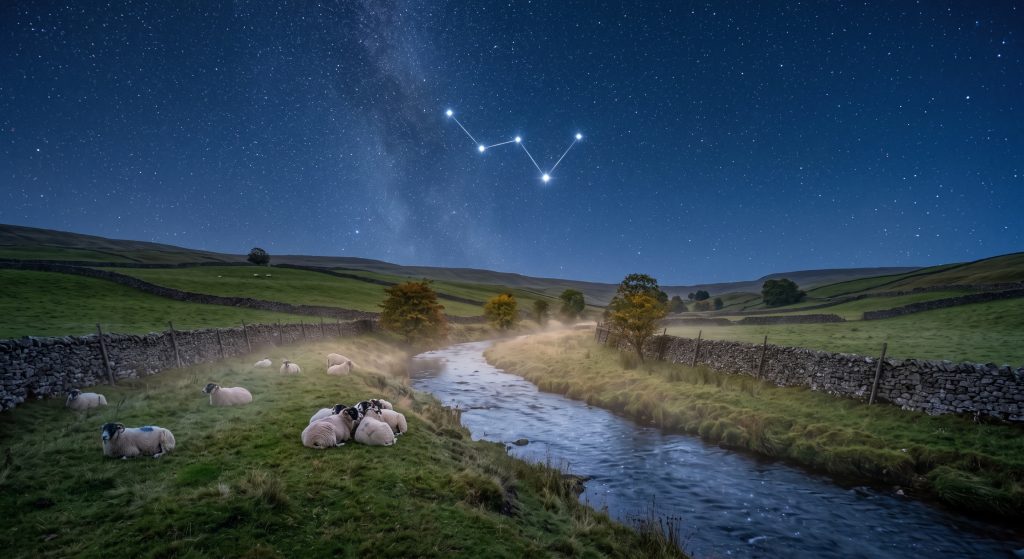
The Northern Highlights
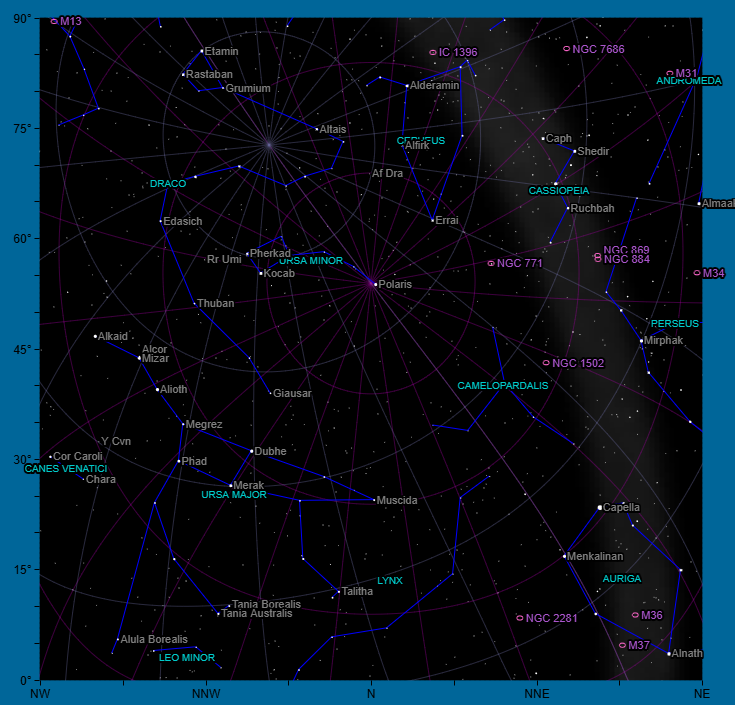
Looking almost directly overhead this month, you will easily spot the five stars of Cassiopeia forming a distinctive “W” shape. According to Greek mythology, this constellation represents Queen Cassiopeia of Ethiopia. Unusually, its central star is known internationally by its Chinese name, Tsih (the Whip)—an unstable star spinning at breakneck speed and flinging out streams of gas. Cassiopeia is accompanied high in the north by her husband King Cepheus, and the hero Perseus.
The Southern Highlights
Looking south, the sky is awash with what ancient astronomers considered the “watery” constellations. The faint but expansive star patterns of Piscis Austrinus (the Southern Fish) and Aquarius (the Water Carrier) dominate the view. They are joined by Delphinus (the Dolphin), Capricornus (the Sea Goat), Cetus (the Sea Monster), and the two fishes of Pisces. It’s a darker, quieter region of the sky compared to the dense summer Milky Way, making it a great area to explore with binoculars.
September 2026 Calendar
| Date | Time (UT) | Event | Details |
|---|---|---|---|
| Sep 04 | 08:51 | Last Quarter Moon | |
| Sep 08 | 05:00 | Moon Occults Praesepe | The crescent Moon passes in front of the Praesepe star cluster, with Jupiter below. |
| Sep 09 | AM | Moon & Jupiter | Jupiter lies just above the crescent Moon before dawn. |
| Sep 09 | Night | 45P-id Meteors | Earth crosses dust from comet 45P/Honda-Mrkos-Pajdušáková, offering a chance of celestial fireworks. |
| Sep 11 | 04:27 | New Moon | |
| Sep 14 | Evening | Moon & Venus | Venus lies close to the crescent Moon just after sunset. |
| Sep 18 | 21:44 | First Quarter Moon | |
| Sep 22 | Evening | Venus at Max Brightness | Venus reaches its greatest brilliance as an Evening Star (mag –4.8). |
| Sep 23 | 01:05 | Autumn Equinox | Nights become longer than days as the Sun moves south of the Equator. |
| Sep 25 | All Night | Neptune Opposition | Neptune is nearest to Earth and opposite the Sun. |
| Sep 26 | 17:49 | Full Moon | Occurs near Saturn. |
| Sep 26 | Night | Moon & Saturn | The Full Moon is near the ringed planet. |
Sky Maps
Looking South on the 15th at 22:00
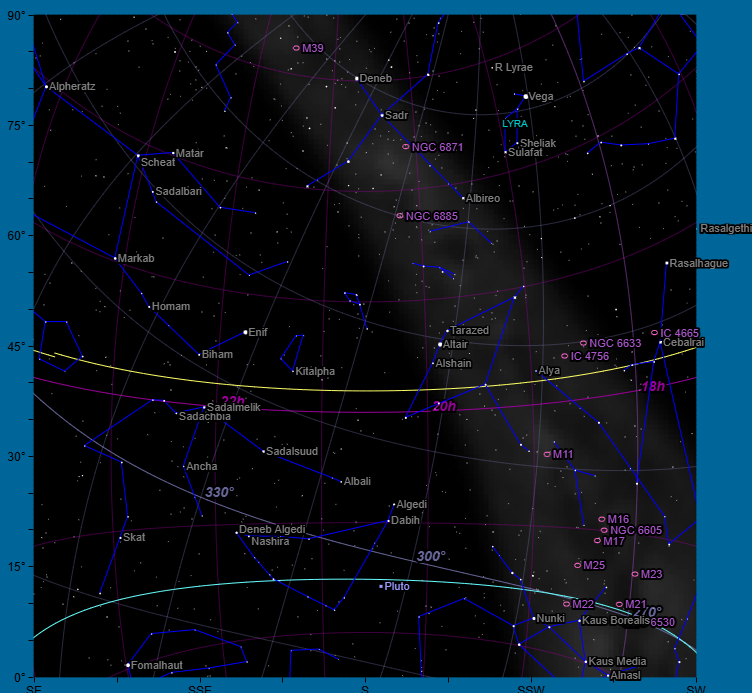
Looking North on the 15th at 22:00
☀️ Solar Forecast – September 2026
Source: NOAA Space Weather Prediction Centre (SWPC) | Data: 27-Day Outlook (Issued 31 August 2026)
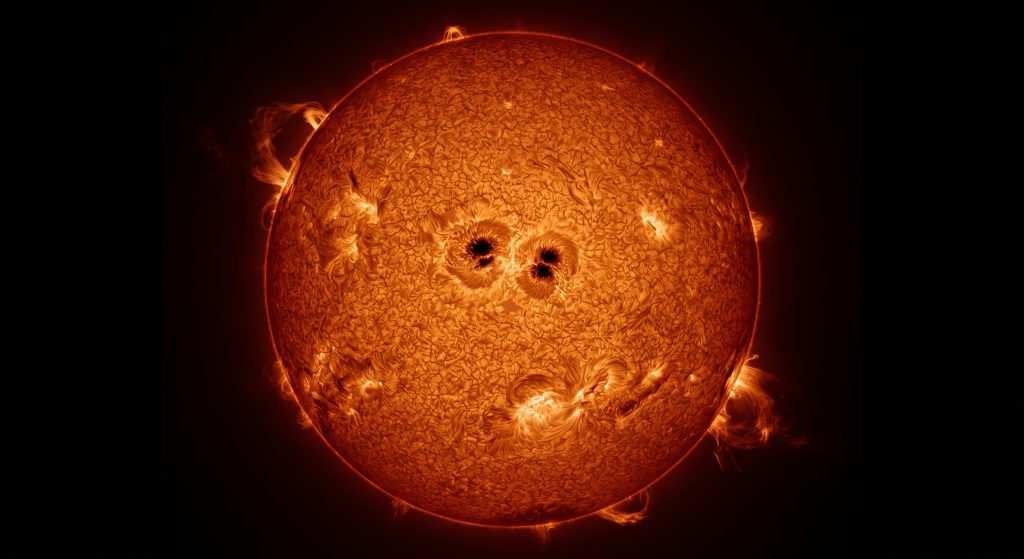
As we move into early autumn and approach the Autumn Equinox, our local star is settling into a noticeably quieter phase compared to the high-energy outbursts seen earlier in the summer. Overall solar activity is trending lower this month, with extended stretches of very calm geomagnetic conditions. Ideal for pristine dark-sky observing, punctuated by an unsettled spell mid-month and a notable aurora opportunity toward the end of September.
🌌 Aurora Watch: Key September Windows
The Kp Index measures global geomagnetic activity. For September, NOAA predicts two main periods of geomagnetic unrest:
- Mid-Month Unrest (12–16 September): Earth will encounter a minor solar wind disturbance, pushing geomagnetic activity up to unsettled levels (Kp 3 and a Planetary A-index peaking at 15 on 13 September). While unlikely to trigger widespread UK displays, northern observers in Scotland may catch faint photographic auroral glow on dark horizons.
- Late-Month Storm Window (24–26 September): This is the primary window for UK aurora chasers! A strong geomagnetic disturbance is forecast to arrive on 24 September (Kp 4), escalating to a G1 Minor Geomagnetic Storm (Kp 5) on both 25 and 26 September, accompanied by a high Planetary A-index of 22. Given the “Russell-McPherron effect”—which naturally enhances auroral activity around the equinoxes due to favourable alignment of Earth’s and the Sun’s magnetic fields, this late-September surge could offer our best chance of visible northern lights this month if local skies remain clear.
🔭 Observational Windows & Dark Skies
- Early September (1–11 September): An exceptionally quiet solar period with the geomagnetic field resting steadily at Kp 2. This guarantees undisturbed skies with zero auroral glow during the 8 September Praesepe lunar occultation and the 9 September 45P-id meteor window.
- Equinox Window (17–23 September): A prolonged period of calm, quiet space weather (Kp 2) leading up to the Autumn Equinox on 23 September, perfect for enjoying the brilliant peak of Venus in the western dusk.
☀️ Sunspot & Radio Flux Trends
For solar observers tracking sunspots or using dedicated H-alpha filters:
- 10.7 cm Radio Flux: The flux begins the month around 105–110 sfu, dipping slightly into double figures (95–100 sfu) through mid-month, and bottoming out around 90–92 sfu by late September.
- This downward trend indicates fewer complex, multi-spot active regions rotating across the visible solar disk compared to August, though observers should still look out for compact, well-defined spot groups and quiet-Sun prominences along the solar limb.
📊 September 2026 Solar Activity Table
| Date Range | Max Solar Flux (10.7 cm) | Max Geomagnetic A Index | Max Kp | Activity Notes & Highlights |
|---|---|---|---|---|
| Sep 01–07 | 105 sfu | 5 | 2 | Quiet Sun Window. Very low geomagnetic activity. Calm and stable conditions. |
| Sep 08–14 | 110 sfu | 15 | 3 | Quiet early on; unsettled disturbance (Kp 3) arrives 12–14 September. |
| Sep 15–21 | 100 sfu | 8 | 3 | Brief early unrest settling back into quiet, stable conditions (Kp 2) from 17 Sep. |
| Sep 22–30 | 95 sfu | 22 | 5 | Equinox Aurora Alert! G1 Minor Storm (Kp 5) forecast for 25–26 September. (NOAA outlook extends to 26 Sep). |
Aurora Forecasts
- A bit US-centred but still useful: Aurora Dashboard (Experimental) | NOAA / SWPC
- The Met Office space weather forecast: Space Weather – Met Office
The Moon

September’s Lunar Calendar

Moon Feature
Occultation of Praesepe (September 8)
If you are an early riser, point your binoculars or small telescope towards the eastern horizon around 5:00 am on September 8. The waning crescent Moon will pass directly in front of (occult) the outer regions of the beautiful Praesepe star cluster (also known as the Beehive Cluster). To make the scene even more spectacular, the brilliant giant planet Jupiter will be shining brightly just below the pairing!
Planets
🟡 Venus
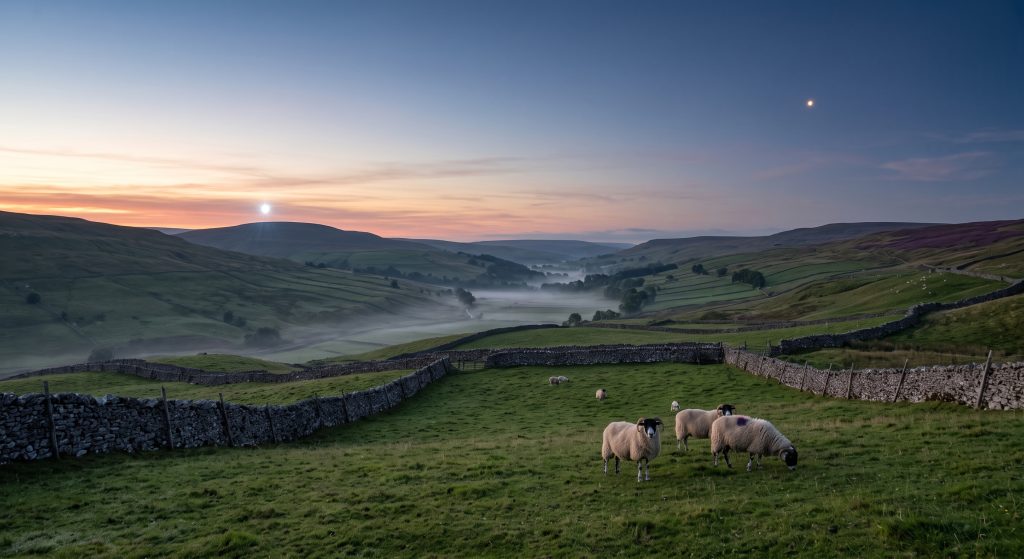
Venus puts on a spectacular but fleeting show this month. It starts September low in the west, setting around 8 pm. It reaches its absolute maximum brilliance for the year—a dazzling magnitude –4.8—on September 22. However, it drops rapidly into the dusk twilight and soon swings between Earth and the Sun, disappearing from our evening skies. Look for a lovely pairing with the crescent Moon on September 14.
🪐 Saturn
The ringed planet rises about 8 pm in the constellation of Cetus. Shining steadily at magnitude +0.4, it is well placed for evening observation. The Moon passes close by on September 26 and 27.
🔷 Neptune & 🔵 Uranus
Neptune reaches opposition on September 25. Lying in Pisces, about ten degrees to the right of Saturn, it is at its closest point to Earth (4,470 million km) and visible all night. However, at magnitude +7.7, you will absolutely need optical aid to see it. Uranus is in Taurus, sitting on the borderline of naked-eye visibility at magnitude +5.7, rising around 9:30 pm.
🟠 Jupiter
Jupiter is now brilliant in the morning sky. Rising around 3 am, it blazes at an unmistakable magnitude –1.8 in the constellation Cancer. The Moon passes nearby on September 8 and 9.
🔴 Mars
Rising about 1 am, Mars travels rapidly through Gemini this month. Shining at magnitude +1.2, it is about the same brightness as Gemini’s leading stars, Castor and Pollux. On the morning of September 25, the Red Planet will line up directly with the twin stars.
⚪ Mercury
Mercury is too close to the Sun to be visible this month.
Meteor Showers
The 45P-ids (September 9)
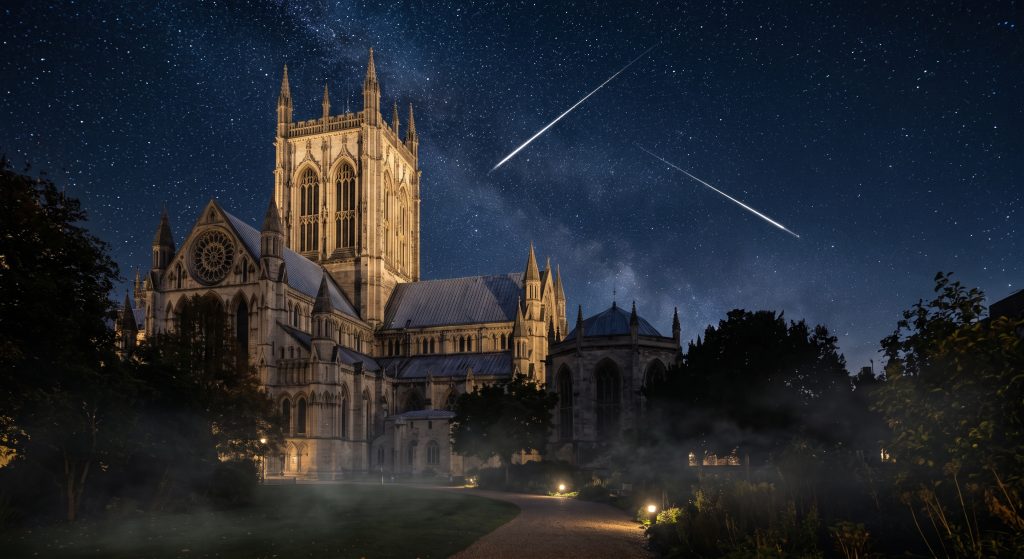
While September isn’t traditionally known for major meteor showers, this year offers a unique chance for celestial fireworks! On September 9, the Earth is predicted to cross a smattering of dust particles shed by comet 45P/Honda-Mrkos-Pajdušáková back in 1927. You may catch a few meteors streaming outwards from the border of Pisces and Aquarius in the early hours.
Comets
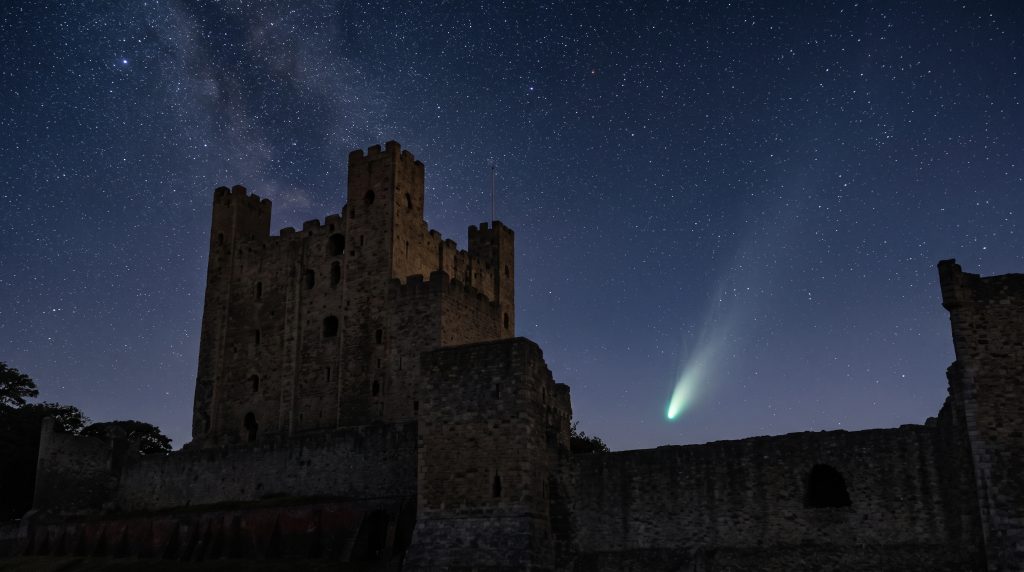
September continues to offer good targets for telescope users, particularly for those willing to stay up past midnight into the early morning hours.
| Comet Name | Predicted Magnitude | Visibility Period | Notes |
|---|---|---|---|
| 10P/Tempel 2 | 8 | Midnight / Morning | Moving away from perihelion but still a solid magnitude 8 target in the morning sky. |
| 161P/Hartley-IRAS | 10 | Midnight / Morning | A Halley-type comet visible in the early hours. |
| 169P/NEAT | 10 – 11 | Midnight / Morning | A fainter telescopic target sharing the morning sky. |
Deep Sky (DSOs)
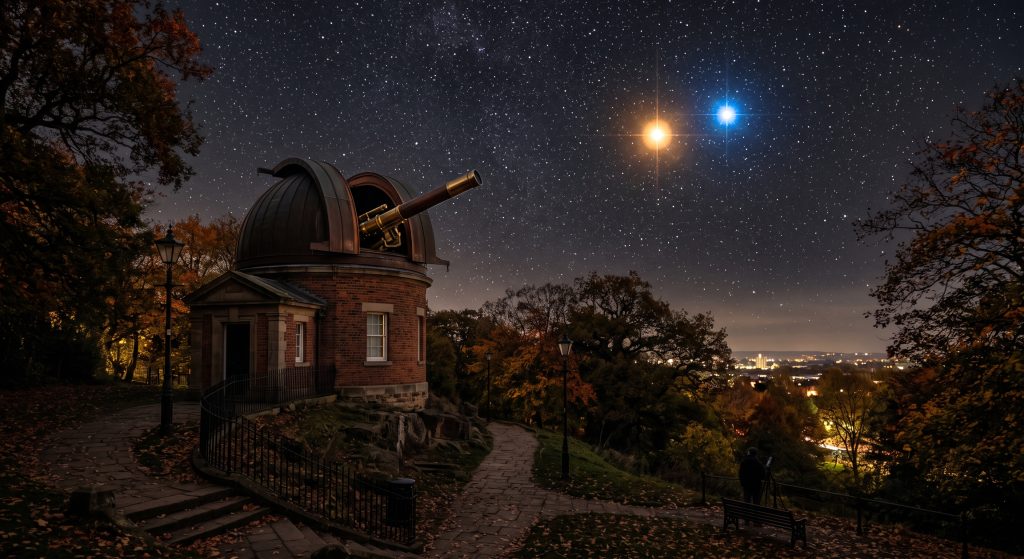
Deep Dive: Seeing Double!
The Sun is actually an exception in living a solitary life; over half the stars you see in the sky are paired up. This month is a perfect time to explore these beautiful binary systems.
Optical Illusions vs. True Binaries
In some cases, stars just happen to line up in our line of sight. To the naked eye, the star Algedi in Capricornus looks double, but the fainter star actually lies nine times further away than the brighter one. However, most double stars are true “binary stars” orbiting each other.
Top Targets for September:
- Mizar and Alcor: The most famous celestial double act lies in the handle of the Plough in Ursa Major. Known historically as ‘the horse and rider’, they are easily split with the naked eye, and a telescope reveals that Mizar itself is a close double.
- Albireo: Mark the head of Cygnus (the Swan) with a small telescope and you are in for a treat: a stunning colour contrast featuring a golden primary star paired with a sapphire-blue companion.
- The Double-Double: Look toward Lyra to find a star system that is exactly what its name proclaims: two pairs of stars in orbit around each other.
September’s Special Object: Delta Cephei
At first glance, Delta Cephei (in the constellation Cepheus) seems like an ordinary magnitude +4 yellow star. However, this star holds the key to measuring the size of the Universe!
Check it carefully, and you will see its brightness changes regularly from +3.5 to +4.4 every 5 days and 9 hours. This happens because the star is physically swelling and shrinking. Astronomer Henrietta Leavitt discovered that stars like this (Cepheid variables) show a direct link between their pulsing period and their true luminosity, allowing astronomers to calculate immense distances across space.
🔭 Junior Stargazers: Farewell to the Evening Star!
A special guide for our young astronomers. Grab your coat, step outside, and look up!

Welcome to September, Junior Stargazers! We hope you enjoyed the August eclipse! It was an amazing sight to see.
Moving onto the coming month of September and as well as going back to school 🙁 .
Did you know that on September 23rd, the whole world experiences something called the Autumn Equinox?
The word “Equinox” means “Equal Night.” On this special day, the daytime and the night time are almost exactly the same length! From this day until spring, our nights in the UK will be longer than our days. That means more time for stargazing before bedtime!
Saying Goodbye to Venus
For the last few months, you might have noticed an incredibly bright “star” shining in the west just after the Sun goes down. That isn’t a star at all it’s the planet Venus!
Venus is covered in thick, white clouds that reflect sunlight like a giant mirror. Because it is closer to the Sun than Earth is, it moves quickly around the solar system. On September 22nd, Venus will reach its absolute brightest point for the whole year. It will look like a dazzling diamond in the twilight sky!
But after that, it will start to drop closer and closer to the Sun each night. By the end of the month, it will disappear completely from our evening sky as it moves between the Earth and the Sun. So make sure you go out just after dinner in early September to wave goodbye to the Evening Star!
🚀 ISS Overpasses
| Date | Mag | Start Time | Start Alt | Start Az | Max Time | Max Alt | Max Az | End Time | End Alt | End Az | Visibility |
| 2 Sep | -2.2 | 18:51:47 | 10° | S | 18:54:07 | 20° | SE | 18:54:07 | 20° | SE | visible |
| 3 Sep | -1.7 | 19:40:39 | 10° | WSW | 19:43:33 | 27° | NW | 19:43:33 | 27° | NW | visible |
| 4 Sep | -3.4 | 18:52:51 | 10° | SW | 18:56:12 | 68° | NW | 18:59:31 | 10° | NNE | visible |
| 6 Sep | -0.5 | 18:56:27 | 10° | W | 18:58:00 | 13° | NW | 18:59:34 | 10° | NNW | visible |
| 7 Sep | -0.6 | 04:55:49 | 10° | NNE | 04:57:37 | 14° | NE | 04:59:25 | 10° | E | visible |
| 9 Sep | -3.7 | 04:56:09 | 11° | NNW | 04:59:23 | 76° | NE | 05:02:44 | 10° | SE | visible |
| 10 Sep | -1.7 | 04:12:28 | 28° | ENE | 04:12:28 | 28° | ENE | 04:14:56 | 10° | ESE | visible |
| 11 Sep | -2.0 | 05:01:35 | 18° | SW | 05:01:35 | 18° | SW | 05:03:30 | 10° | S | visible |
Notable Passes:
- 4 September (Evening): A brilliant early-evening flyby blazing at magnitude –3.4, soaring right up to 68° altitude in the north-west.
- 9 September (Pre-dawn): The standout pass of the month at magnitude –3.7, climbing to a towering 76° altitude in the north-east before sunrise.
Useful Resources
- StarLust – A Website for People with a Passion for Astronomy, Stargazing, and Space Exploration.
- https://www.spacedaily.com/
- http://www.n3kl.org/sun/noaa.html
- http://skymaps.com/downloads.html
- Astronomy Calendar of Celestial Events – Sea and Sky (seasky.org)
- http://www.deepskywatch.com/deepsky-guide.html
- https://www.constellation-guide.com/
- IMO | International Meteor Organization
- https://in-the-sky.org/
- And of course, the Sky at Night magazine!
Great work Steve, Hopefully see you for the first meeting Friday>
Thanks. I’ll be there on Friday