A monthly look at astronomical events in the sky and on Earth
Compiled and written by Steve Sawyer

Welcome to March’s edition of What’s Up
Welcome to the March 2026 edition of “What’s Up”! This month marks a major transition in our skies as we say goodbye to the dark depths of winter, and hopefully the murk and damp that seems to have been the weather since the start of the year!
Welcome the astronomical start of spring. The Sun crosses the celestial equator on March 20, bringing the Vernal Equinox, where day and night are of almost equal length. For observers in the UK and Ireland, don’t forget that British Summer Time (BST) begins on March 29, so clocks will go forward.
This month we’re using Monet inspired images.
https://en.wikipedia.org/wiki/Claude_Monet
This Months and Upcoming York Astro Presentations
Upcoming events to put in your diary
| Date | Title | Speaker |
|---|---|---|
| 06/03/2026 | How the Universe Will End | Brad Gibson |
| 20/03/2026 | The Physics of Stars, From Birth to Death | Mark Laughton |
| 03/04/2026 | Good Friday No Meeting | |
| 17/04/2026 | Members Evening – Short Talks | York AS Members |
For further details see the events page Astronomy Presentations by guest speakers | York Astro and our Facebook group (20+) The York Astronomical Society Chat Group | Facebook
So what’s on this month?
Northern Sky
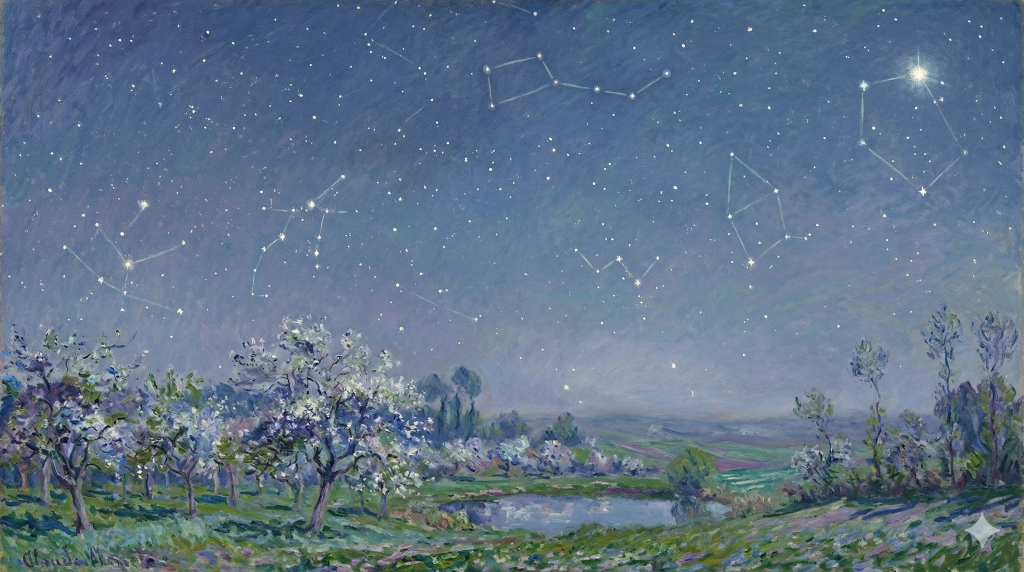
An artistic view of the Northern night sky
In March, the familiar shape of Ursa Major, containing the Big Dipper (or Plough), is now “upside down” and riding extremely high in the sky for northern observers. Auriga, featuring the brilliantly bright star Capella, is also very high on the opposite side of the meridian. You will find the constellation of Perseus positioned between Auriga and Andromeda over in the western sky. Due north, the distinctive “W” of Cassiopeia and the house-shaped Cepheus are prominent, while Vega and Deneb sit very low near the horizon, often lost in the atmospheric haze.
Southern Sky
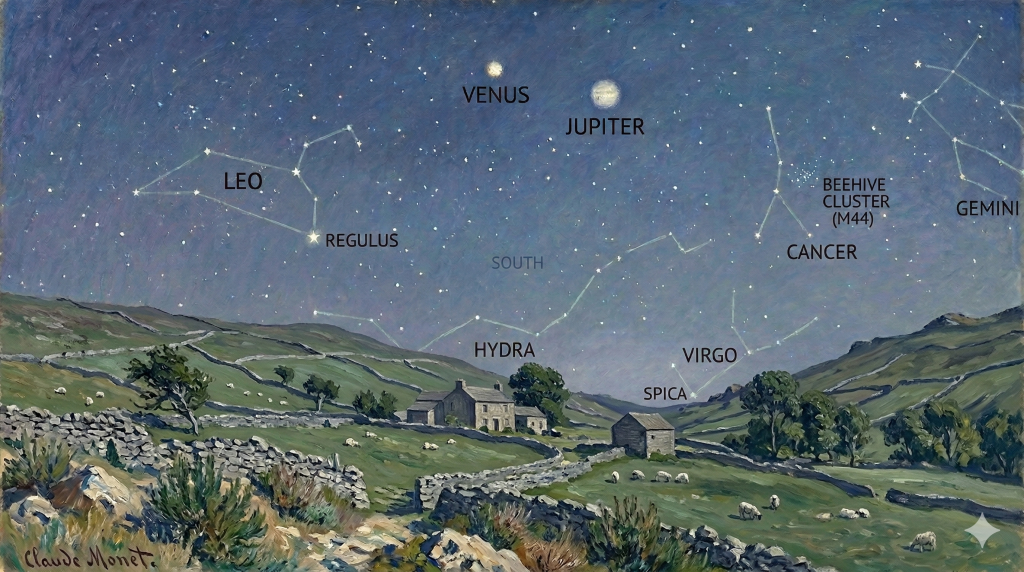
An artistic view of the southern night sky
Looking south, the dazzling planets Venus and Jupiter continue to dominate the evening views. They are joined by the large spring constellations of Leo (led by bright Regulus), Virgo (featuring Spica), and Hydra. Nestled between Gemini in the west and Leo in the east is the zodiacal constellation of Cancer the Crab, home to the famous Beehive Cluster.
March 2026 Calendar
| Date | Time (UT) | Event | Details |
|---|---|---|---|
| Mar 02 | 12:00 | Moon & Regulus | Regulus 0.4°S of the Moon |
| Mar 03 | 11:34 | Total Lunar Eclipse | Visible from Americas, Asia, Australasia (Not UK) |
| Mar 03 | 11:38 | Full Moon | |
| Mar 06 | 17:24 | Moon & Spica | Spica 1.8°N of the Moon |
| Mar 07 | 11:30 | Venus & Neptune | Venus passes 4 arcminutes from Neptune (close conjunction) |
| Mar 08 | — | Venus & Saturn | Saturn 55 arcminutes left of Venus |
| Mar 10 | 11:32 | Moon & Antares | Antares 0.7°N of Moon (Occultation in Antarctica/NZ) |
| Mar 11 | 09:39 | Last Quarter Moon | |
| Mar 14 | Night | γ-Normid Meteors | Peak of shower |
| Mar 15 | 19:34 | Mercury & Mars | Mercury 3.4°N of Mars |
| Mar 17 | 14:07 | Moon & Mercury | Mercury 2.0°N of the Moon |
| Mar 19 | 01:23 | New Moon | Cycle resets |
| Mar 20 | 12:39 | Moon & Venus | Venus 4.6°S of the thin crescent Moon |
| Mar 20 | 14:46 | Vernal Equinox | First day of astronomical spring |
| Mar 23 | 08:32 | Moon & Pleiades | Pleiades cluster 1.1°S of Moon |
| Mar 25 | 19:18 | First Quarter Moon | |
| Mar 26 | 12:13 | Moon & Jupiter | Jupiter 3.9°S of Moon |
| Mar 27 | 03:18 | Moon & Pollux | Pollux 3.0°N of Moon |
| Mar 29 | 01:00 | BST Begins | Clocks go forward 1 hour in UK |
| Mar 29 | 19:00 | Moon Occults Regulus | Regulus 0.4°S of Moon; visible from UK, Europe, Africa, Asia |
| This table captures the astronomical events for March, including phases of the moon, planetary alignments, and other notable occurrences. |
Sky Maps
Looking South on the 15th at 22:00
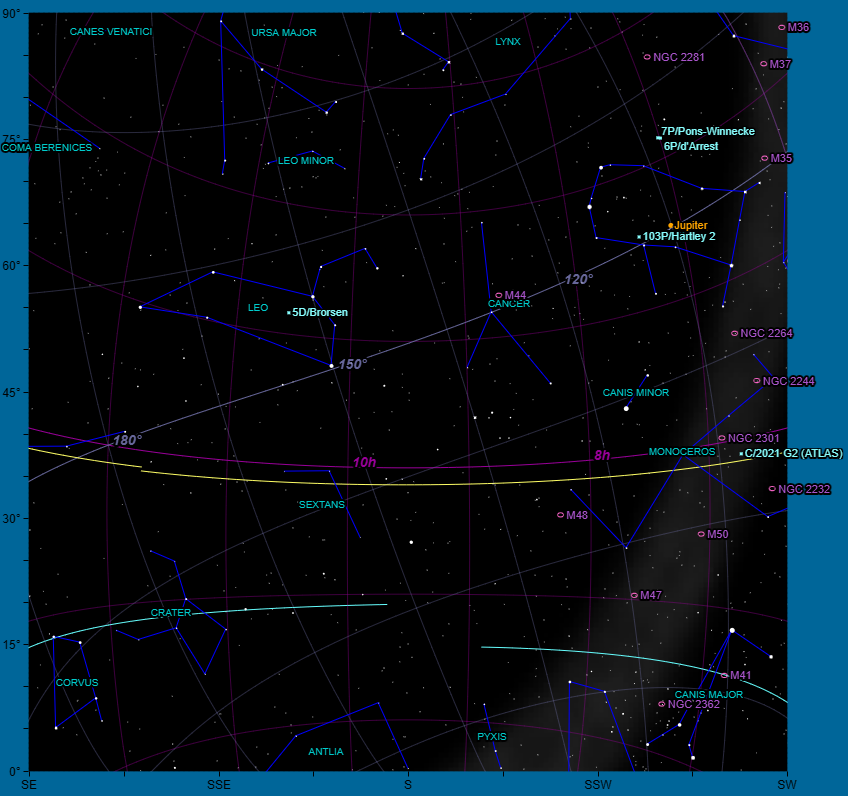
Looking North on the 15th at 22:00
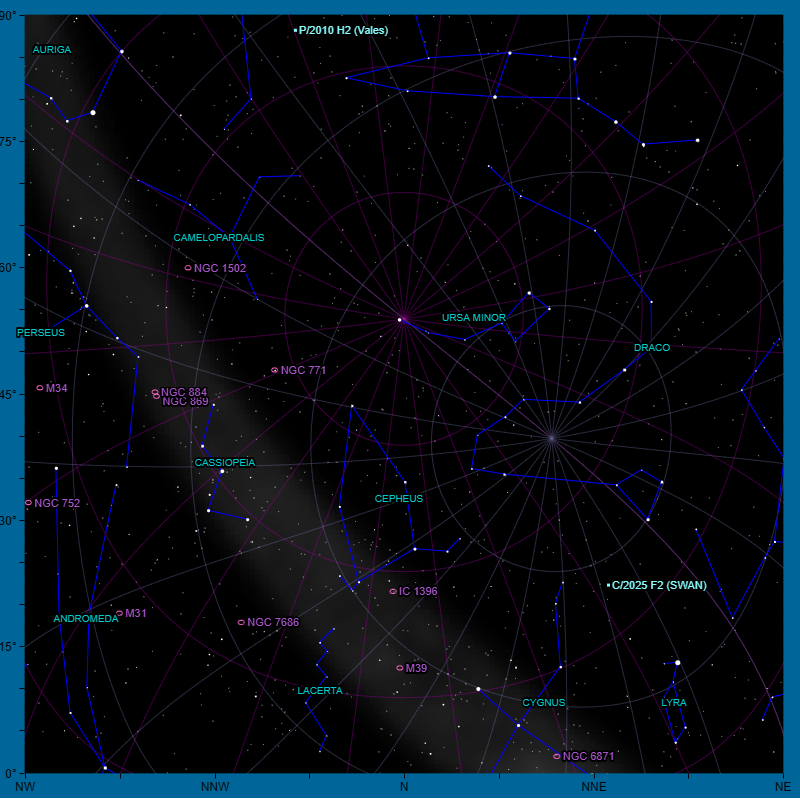
The two charts above show all DSOs of magnitude 6.0 or brighter. They are both taken from
SkyViewCafe.com and correct for the 15th of the month.
March Sky Guide
The Sun
☀️ Solar Forecast – March 2026
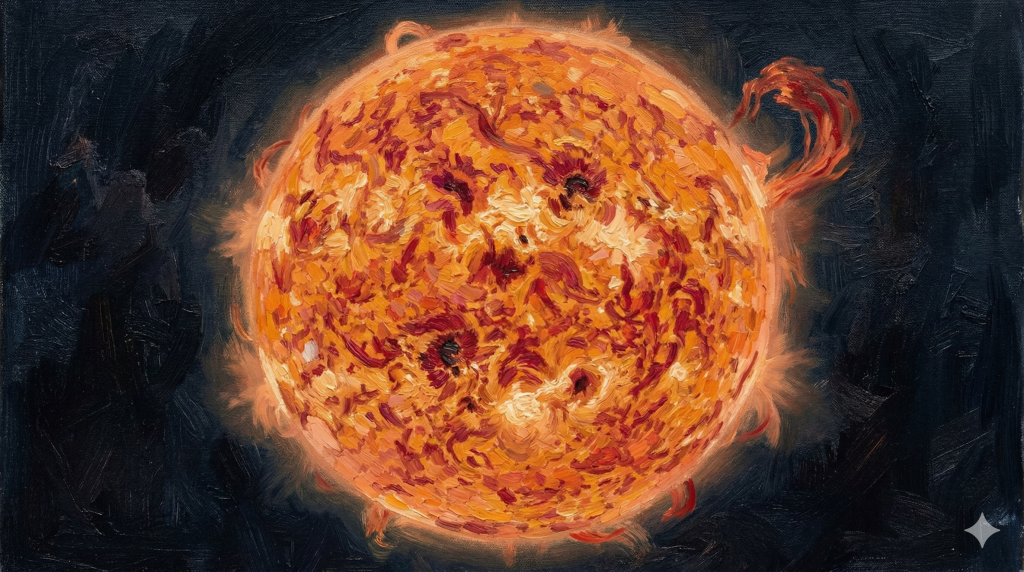
Source: NOAA Space Weather Prediction Centre (SWPC) | Data: 27-Day & 45-Day Outlook (Issued 23-25 Feb 2026)
As we navigate the heightened activity of Solar Cycle 25, predicting space weather is essential for knowing when to look out for auroras or complex sunspots. For March, the forecast shows moderate solar flux but points to a very exciting mid-to-late month period for geomagnetic storms and potential aurora sightings!
🌌 Aurora Watch: Key Storm Windows
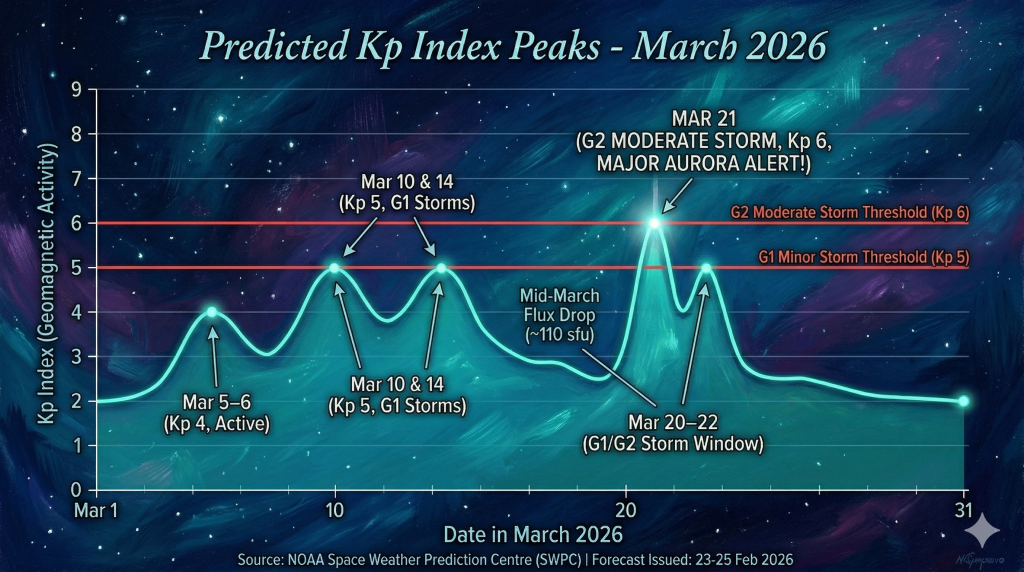
The Kp Index measures global geomagnetic activity. For March, NOAA forecasts several periods where the index is expected to reach Kp 5 (a G1 Minor Geomagnetic Storm) and even Kp 6 (a G2 Moderate Geomagnetic Storm).
- March 10 & 14: Kp 5 (G1 Minor Storm). Two distinct spikes are predicted during this week. High-latitude observers should keep a close eye on real-time data.
- March 20 – 22: Kp 5 to Kp 6 (G1 to G2 Storms). This is the most significant predicted event of the month! Activity peaks sharply on March 21 with an A-index of 38 and a Kp of 6. This represents a fantastic opportunity for aurora chasers across the UK, potentially pushing displays well south into England and Wales if conditions align.
☀️ Solar Activity: Sunspot & Radio Flux Trends
For those using solar telescopes or safe filters, the 10.7cm Radio Flux (a proxy for sunspot complexity) sits at moderate levels this month:
- Early March (1 – 9 Mar): The month opens with healthy activity levels, peaking at 130 sfu around March 6–8. Expect some good, stable sunspot observing.
- Mid-to-Late March (10 – 22 Mar): The radio flux drops slightly, reaching a low of 110 sfu by March 20-21. Interestingly, this dip in solar emission coincides with the highest geomagnetic disturbances of the month.
- End of March (23 – 31 Mar): Flux values gradually climb back up to 125 sfu as things settle into a quiet, stable geomagnetic period (Kp 2), making it an excellent time for deep-sky observation.
📊 Summary Table
| Date | Max Solar Flux (10.7 cm) | Max Geomagnetic A Index | Max Kp | Activity Notes |
|---|---|---|---|---|
| Mar 01–07 | 130 | 15 | 4 | Quiet start, becoming active (Kp 4) around Mar 5–6. |
| Mar 08–14 | 130 | 20 | 5 | G1 Storm expected on Mar 10 and Mar 14. Good aurora chances. |
| Mar 15–21 | 116 | 38 | 6 | Major Aurora Alert! G1 storms on Mar 20, peaking at G2 on Mar 21. |
| Mar 22–28 | 122 | 20 | 5 | Active start on the 22nd (G1 possible), then settling down quickly. |
| Mar 29–31 | 125 | 5 | 2 | Very quiet and stable conditions. |
📊 Forecast Visualisation
The chart below highlights the correlation between the G1/G2 storm thresholds (red lines) and the predicted Kp peaks for the period.
Aurora Forecasts
A bit US centred but still useful Aurora Dashboard (Experimental) | NOAA / NWS Space Weather Prediction Center And our own Met-office have an excellent space weather forecast page here Space Weather – Met Office
Auroa Forecasts
A bit US centred but still useful
Aurora Dashboard (Experimental) | NOAA / NWS Space Weather Prediction Center
And our own Met-office have an excellent space weather forecast page here Space Weather – Met Office
The Moon
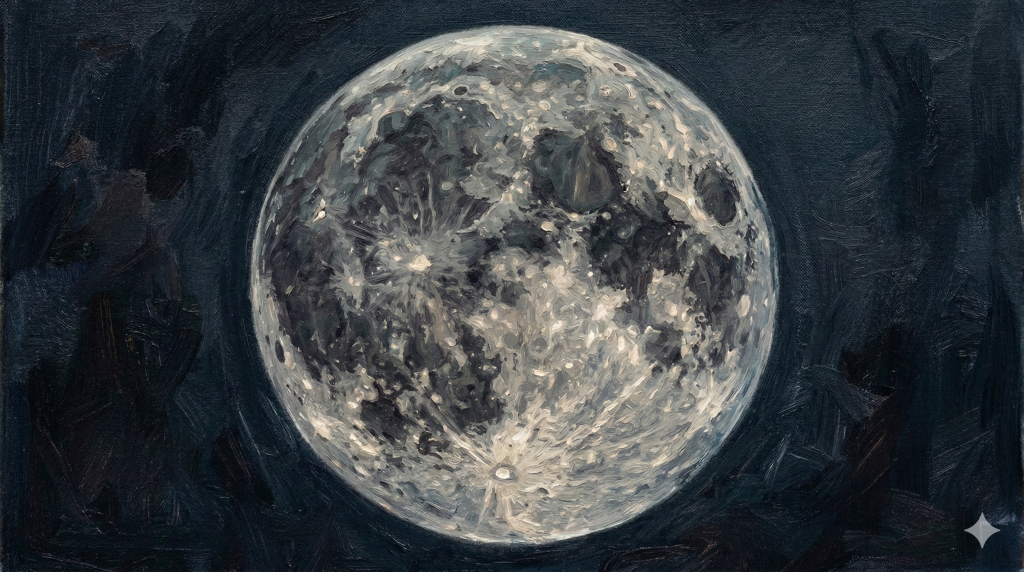
March’s Lunar Calendar
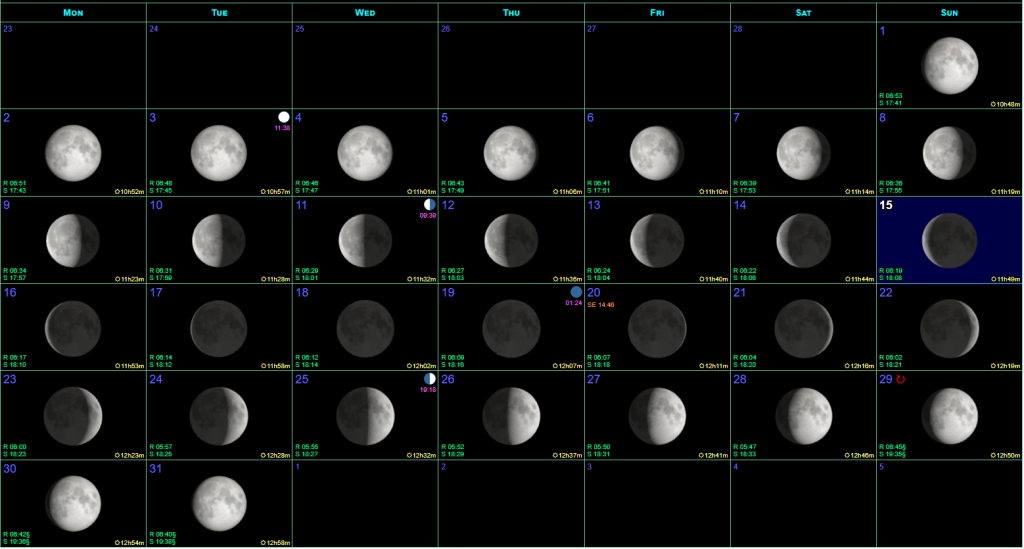
March’s moon calendar from Sky View Café (skyviewcafe.com).
Lunar Guide
Regulus Occultation (March 29)
For UK observers, the Moon provides a fantastic treat on the evening of March 29. At around 8:20 pm (exact times depend on location), the bright star Regulus will emerge from behind the Moon following an occultation. If you use binoculars, you will first see the star’s fainter companion, Regulus B (mag +8.1), appear from behind the lunar disk, followed six minutes later by the brilliant primary star itself (mag +1.4).
A full yearly lunar calendar can be found here :-
https://www.mooninfo.org/moon-phases/2026.html
Moon Feature
Montes Apenninus (The Apennine Mountains)
As the Moon reaches its First Quarter phase on March 25, the lunar terminator (the dividing line between lunar day and night) sweeps across one of the most spectacular mountain ranges on the Moon: Montes Apenninus. Forming the southwestern rim of the vast Mare Imbrium (Sea of Rains), these mountains were thrust upward by the giant meteoroid impact that excavated the Imbrium basin over 4 billion years ago.
- Best Time to View: March 25–27, as the Sun rises over the First Quarter and Waxing Gibbous Moon.
- What to Look For: Using binoculars or a small telescope, watch as the craggy peaks cast exceptionally long, dramatic shadows across the dark, flat basaltic plains of the mare. Along the eastern flank of the mountain range, see if you can spot Hadley Rille—a meandering collapsed lava tube that served as the historic landing site for the Apollo 15 astronauts. Just to the west of the mountains, look for the large, relatively smooth-floored crater Archimedes.
Planets
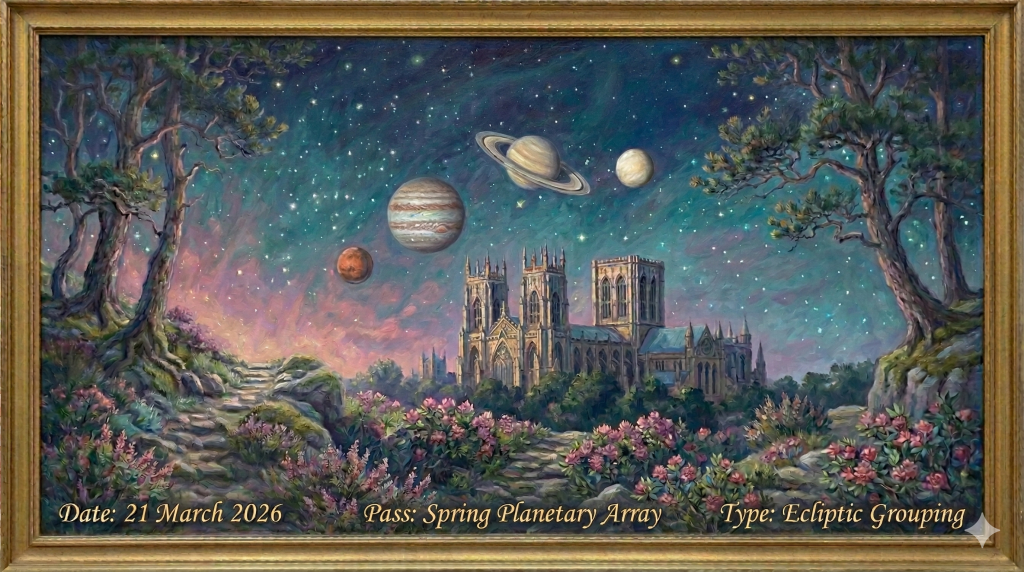
⚪ Mercury
Mercury starts the month trailing the Sun in Pisces, but it rapidly moves into the dawn sky in Aquarius. It’s joined by Mars on March 15 (passing 3.4° north of the Red Planet). However, its position makes it very challenging to spot this month.
🟡 Venus
Venus is a brilliant Evening Star this month, shining at magnitude -3.9 low in the west like a lantern in the dusk twilight. Setting around 7:30 pm, it passes less than a degree from Saturn on March 8. On March 20, Venus forms a stunning, highly photogenic pair with a thin crescent Moon.
🔴 Mars
Mars spends the month in Aquarius, shining relatively faintly at magnitude +1.1 to +1.2. It remains too close to the Sun’s glare to be easily visible to observers.
🟠 Jupiter
Jupiter continues to lord over the night-time sky. Blazing at magnitude -2.4 to -2.2 in the constellation Gemini, it is brilliantly placed high up and doesn’t set until around 4 am. It ends its retrograde motion on March 11 and sits near the Moon on March 26.
🪐 Saturn
At the start of March, Saturn (magnitude +1.0) can be found in Pisces, setting around 7:30 pm above Venus. Venus quickly passes it on March 8, and by mid-month, Saturn will drop down into the Sun’s glare, completely out of sight, before swinging into the dawn sky later in the month.
🔵 Uranus
Uranus lies in Taurus, below the Pleiades star cluster. At magnitude +5.8, it sets around midnight and requires binoculars or a telescope to be spotted against the background stars.
🔷 Neptune
Neptune spends March in Pisces at magnitude +7.8. Venus passes incredibly close to Neptune (just 4 arcminutes) on March 7, though this specific conjunction is best visible from eastern Asia. By the end of March, Neptune approaches the Sun and transitions into the dawn sky.
Meteor Showers
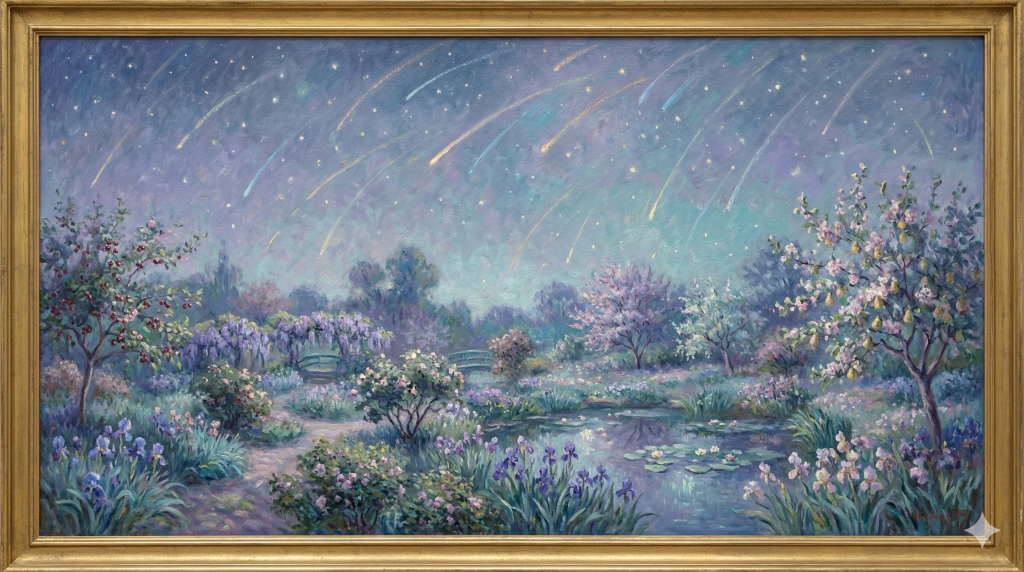
March is relatively quiet for meteors. The only notable shower is the γ-Normids (Gamma-Normids), which peak on March 14. This is a minor shower primarily for southern hemisphere observers, with a very low maximum rate of about 6 meteors per hour. They can be quite difficult to distinguish from random, sporadic meteors.
Comets

| Comet Name | Predicted Magnitude | Visibility Period (Approx.) | Notes |
|---|---|---|---|
| C/2024 E1 (Wierzchos) | 8 | Evening | The brightest evening comet this month. Well-placed for binoculars or small telescopes. |
| C/2025 R3 (PanSTARRS) | 8 | Morning | A great morning target, shining equally as bright as Wierzchos but visible before dawn. |
| C/2026 A1 (MAPS) | 9 | Evening | A solid target for the evening sky; requires a telescope. |
| 88P/Howell | 9 | Morning | Reaches perihelion on March 18. Visible very low in the pre-dawn sky. |
| 24P/Schaumasse | 10 | Midnight to Morning | Fading from its earlier peak, but climbs high in the sky through the early hours. |
| 29P/Schwassmann-Wachmann 1 | 13 (Variable) | Most of the night | Distant centaur object infamous for unpredictable, massive outbursts. Always worth checking. |
| 240P/NEAT | 13 | Evening to Midnight | Very faint, telescopic object for experienced observers. |
| C/2025 L1 (ATLAS) | 13 | Most of the night | Very faint, reaches its highest altitude in the morning sky. |
C/2024 E1 (Wierzchos) & C/2025 R3 (PanSTARRS)
For comet hunters, March offers a beautiful symmetry with two magnitude 8 comets gracing our skies. C/2024 E1 (Wierzchos) is your prime evening target. Having made its closest approach to Earth last month, it remains bright enough to be an excellent binocular and small-telescope object as soon as the sky darkens. For the early risers, C/2025 R3 (PanSTARRS) takes over the morning sky, offering similar brightness before the dawn twilight washes it out.
88P/Howell
The short-period Jupiter-family comet 88P/Howell makes its perihelion passage (closest approach to the Sun) on March 18. While it should brighten to around magnitude 9 this month, it sits very low on the horizon in the morning sky, making it a tricky but rewarding target to track down in the pre-dawn glow.
24P/Schaumasse
24P/Schaumasse continues to be a reliable telescopic target, though it has faded to magnitude 10 following its peak earlier in the winter. It is best viewed from midnight into the early morning, where it will be riding reasonably high in the sky.
29P/Schwassmann-Wachmann 1
As always, keep an eye out for 29P. Technically listed at a challenging magnitude 13, this comet is famous for its sudden cryovolcanic outbursts. It can rapidly jump several magnitudes in brightness over a short period, suddenly bringing it within range of smaller amateur scopes.
Link here for further details of each comet and how to locate it: Visual Comets in the Future (Northern Hemisphere) (aerith.net)
Deep Sky (DSOs)
Deep Dive: The Beehive Cluster (M44 / Praesepe)

Also known by its Latin name Praesepe (meaning “manger”), Messier 44 (M44) is a prominent open star cluster located in the heart of the constellation Cancer. Ranking among the nearest star clusters to Earth at roughly 577 light-years away, it has been recognized since antiquity.
The Greek astronomer Ptolemy described it in the 2nd century AD as a “nebulous mass in the breast of Cancer,” which perfectly describes its diffuse, fuzzy appearance when viewed with the naked eye under dark skies. Later, M44 became one of the very first celestial objects studied by Galileo Galilei, who used his primitive telescope to resolve more than 40 individual stars within the haze—a remarkable achievement for the time.
🔭 Quick Facts
| Constellation | Cancer |
| Distance | ~577 light-years |
| Apparent Magnitude | +3.7 |
| Mass | 500–600 solar masses |
| Age | 600–700 million years |
| Total Stars | ~1,000 |
🧪 Structure and Stellar Population
M44 is closely related to the famous Hyades cluster in Taurus. Both share similar ages and proper motions through space, which is a strong indicator that they share a common origin.
The Beehive is rich in stellar diversity. It contains roughly 680 M-type red dwarfs, about 300 Sun like stars (F, G, and K type), and a handful of massive A type stars. Astronomers have also identified at least 11 white dwarfs hiding in the cluster, which are the ghostly remnants of massive B type stars that have already exhausted their fuel. Curiously, the cluster is quite deficient in brown dwarfs; it is highly likely that these low mass members have been stripped away from the cluster’s halo by tidal forces over millions of years.
⚖️ Dynamics and Evolution
Like many open clusters, M44 exhibits “mass segregation”—a dynamic process where heavier stars slowly drift toward the cluster core while lighter stars migrate outward.
Interestingly, recent research from Leicester University and Queen’s University Belfast suggests that M44 might actually be the merging remnant of two smaller clusters. This would neatly explain its unusually high star count. If this scenario is correct, the cluster’s structure is gravitationally unstable, and it is expected to completely disperse into the Milky Way within the next 10 million years.
🪐 Exoplanets in the Beehive
In 2012, astronomers made a groundbreaking discovery: two “Hot Jupiter” exoplanets (Pr0201b and Pr0211b) were found orbiting Sun like stars within M44. These were the very first confirmed detections of such planets inside an open star cluster. Follow up observations in 2016 revealed a second planet in one of the systems, confirming M44 as a site of active planetary systems and proving that planet formation is common even in densely packed stellar nurseries.
👁️ How to Observe
Naked Eye: From a dark sky site, look exactly halfway between the bright stars Castor/Pollux (in Gemini) and Regulus (in Leo). M44 will appear as a faint, hazy patch of light.
Binoculars / Small Telescope: Because the cluster is so large (nearly 90 arcminutes, or three times the width of the Full Moon), binoculars or a telescope using your lowest power eyepiece are the best tools. You will instantly resolve the haze into dozens of sparkling stars, including a few prominent members that shine with a distinct orange red hue against the blue white background.
ISS and other orbiting bits
🚀 ISS Overpasses

| Date | Brightness (mag) | Start Time | Start Alt | Start Az | Highest Time | Highest Alt | Highest Az | End Time | End Alt | End Az | Pass Type |
|---|---|---|---|---|---|---|---|---|---|---|---|
| 1 Mar | -2.8 | 04:58:12 | 32° | SSW | 04:58:12 | 32° | SSW | 05:01:04 | 10° | SE | visible |
| 2 Mar | -1.4 | 04:13:22 | 18° | SE | 04:13:22 | 18° | SE | 04:14:26 | 10° | SE | visible |
| 2 Mar | -1.7 | 05:46:23 | 12° | WSW | 05:47:29 | 14° | SW | 05:49:18 | 10° | S | visible |
| 3 Mar | -1.8 | 05:01:37 | 17° | SSW | 05:01:37 | 17° | SSW | 05:03:14 | 10° | SSE | visible |
| 12 Mar | -1.8 | 19:33:13 | 10° | S | 19:34:58 | 16° | SSE | 19:34:58 | 16° | SSE | visible |
| 13 Mar | -1.5 | 18:47:13 | 10° | SSE | 18:48:36 | 12° | SE | 18:49:58 | 10° | ESE | visible |
| 13 Mar | -2.0 | 20:21:36 | 10° | SW | 20:23:17 | 24° | SSW | 20:23:17 | 24° | SSW | visible |
| 14 Mar | -2.7 | 19:34:46 | 10° | SW | 19:37:46 | 29° | SSE | 19:38:28 | 26° | SE | visible |
| 14 Mar | -0.9 | 21:10:55 | 10° | WSW | 21:11:28 | 14° | WSW | 21:11:28 | 14° | WSW | visible |
| 15 Mar | -2.2 | 18:48:03 | 10° | SSW | 18:50:47 | 22° | SSE | 18:53:30 | 10° | E | visible |
| 15 Mar | -3.0 | 20:23:52 | 10° | WSW | 20:26:30 | 43° | SSW | 20:26:30 | 43° | SSW | visible |
| 16 Mar | -3.3 | 19:36:51 | 10° | WSW | 19:40:07 | 45° | SSE | 19:41:26 | 29° | ESE | visible |
| 16 Mar | -1.2 | 21:13:23 | 10° | W | 21:14:25 | 18° | W | 21:14:25 | 18° | W | visible |
| 17 Mar | -2.9 | 18:49:52 | 10° | SW | 18:53:02 | 37° | SSE | 18:56:13 | 10° | E | visible |
| 17 Mar | -3.4 | 20:26:16 | 10° | W | 20:29:16 | 55° | SSW | 20:29:16 | 55° | SSW | visible |
| 18 Mar | -3.5 | 19:39:08 | 10° | WSW | 19:42:29 | 57° | S | 19:44:03 | 28° | ESE | visible |
| 18 Mar | -1.3 | 21:15:50 | 10° | W | 21:17:02 | 19° | W | 21:17:02 | 19° | W | visible |
| 19 Mar | -3.3 | 18:52:01 | 10° | WSW | 18:55:20 | 52° | S | 18:58:39 | 10° | E | visible |
| 19 Mar | -3.3 | 20:28:39 | 10° | W | 20:31:45 | 51° | SSW | 20:31:45 | 51° | SSW | visible |
| 20 Mar | -3.5 | 19:41:27 | 10° | W | 19:44:48 | 57° | S | 19:46:27 | 26° | ESE | visible |
| 20 Mar | -1.2 | 21:18:18 | 10° | W | 21:19:25 | 17° | WSW | 21:19:25 | 17° | WSW | visible |
| 21 Mar | -3.4 | 18:54:15 | 10° | W | 18:57:37 | 59° | S | 19:00:58 | 10° | E | visible |
| 21 Mar | -2.8 | 20:31:00 | 10° | W | 20:34:06 | 37° | SSW | 20:34:06 | 37° | SSW | visible |
| 22 Mar | -3.1 | 19:43:45 | 10° | W | 19:47:02 | 45° | SSW | 19:48:45 | 23° | SE | visible |
| 22 Mar | -1.0 | 21:21:01 | 10° | WSW | 21:21:44 | 13° | WSW | 21:21:44 | 13° | WSW | visible |
| 23 Mar | -3.2 | 18:56:29 | 10° | W | 18:59:49 | 52° | S | 19:03:07 | 10° | ESE | visible |
| 23 Mar | -2.0 | 20:33:29 | 10° | W | 20:36:12 | 22° | SSW | 20:36:24 | 22° | SSW | visible |
| 24 Mar | -2.3 | 19:46:04 | 10° | W | 19:49:04 | 29° | SSW | 19:51:04 | 16° | SSE | visible |
| 25 Mar | -2.6 | 18:58:42 | 10° | W | 19:01:53 | 37° | SSW | 19:05:01 | 10° | SE | visible |
| 25 Mar | -1.2 | 20:36:35 | 10° | WSW | 20:38:00 | 12° | SW | 20:38:45 | 11° | SSW | visible |
Useful Resources
StarLust – A Website for People with a Passion for Astronomy, Stargazing, and Space Exploration.
http://www.n3kl.org/sun/noaa.html
http://skymaps.com/downloads.html
Astronomy Calendar of Celestial Events 2024 – Sea and Sky (seasky.org)
https://www.rmg.co.uk/stories/topics/what-are-names-full-moons-throughout-year
http://www.deepskywatch.com/deepsky-guide.html
https://www.constellation-guide.com
IMO | International Meteor Organization
and of course the Sky at Night magazine!
Very good that Steve, well done and thank you for the hard work… MD