A monthly look at astronomical events in the sky and on Earth
Compiled and written by Steve Sawyer
Welcome to November’s edition of What’s Up
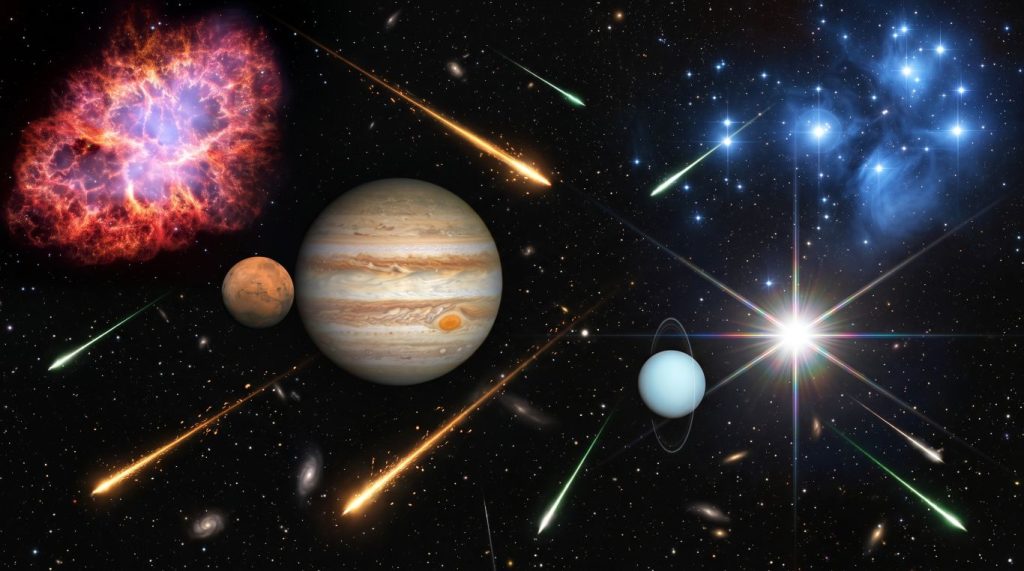
Welcome to November! As Bonfire Night arrives and the autumn air turns properly crisp, we’re all used to fireworks lighting up our local skies. But the cosmos puts on its own, far grander fireworks display every single night!
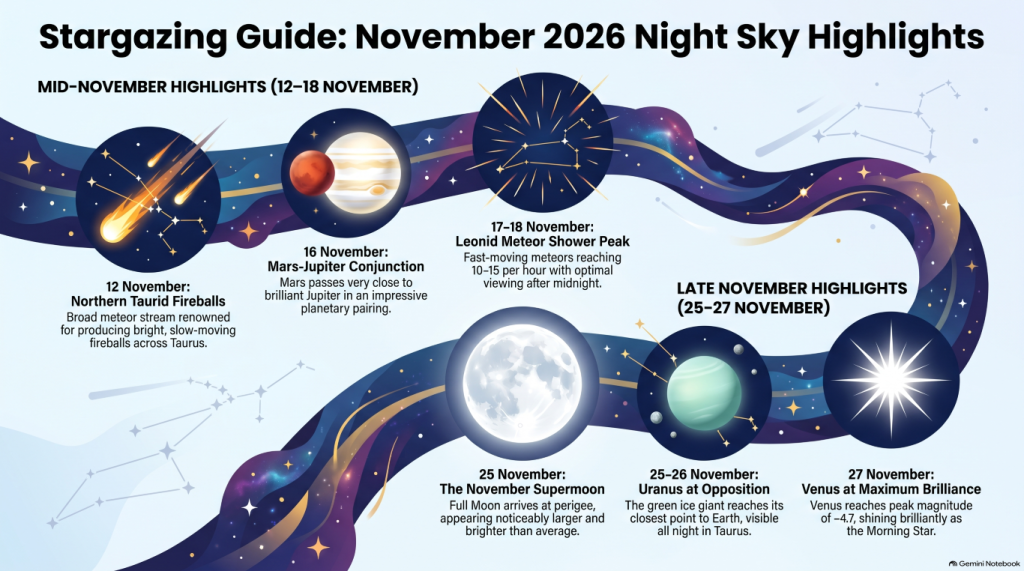
This month is packed with celestial pyrotechnics. We have the Northern Taurid meteor shower bringing slow, brilliant fireballs that can rival Venus in brightness, followed by the high-speed Leonids shooting across the sky at a blistering 70 km/s on the night of November 17/18.
For planetary observers, November is a landmark month: Venus reaches its maximum brilliance of the entire year as the Morning Star on November 27 (shining at an eye watering magnitude –4.7), Mars and Jupiter engage in a tight conjunction on November 16, and Uranus reaches Opposition on November 25. To top it all off, we enjoy the year’s second Supermoon on November 24/25!
This Month’s York Astro Presentations
Join us this month for our autumn speaker series and discussions!
| Date | Subject | Speaker |
|---|---|---|
| 06/11/2026 | The Far Side of Sir Patrick Moore | Gain Lee |
| 20/11/2026 | Edwin Powell Hubble | Roy Gunson |
For full details, times, and venue information, check out our events page Astronomy Presentations by guest speakers | York Astro and join the conversation in our Facebook Chat Group.
So what’s on this month?
Northern & Southern Sky
The Northern Highlights
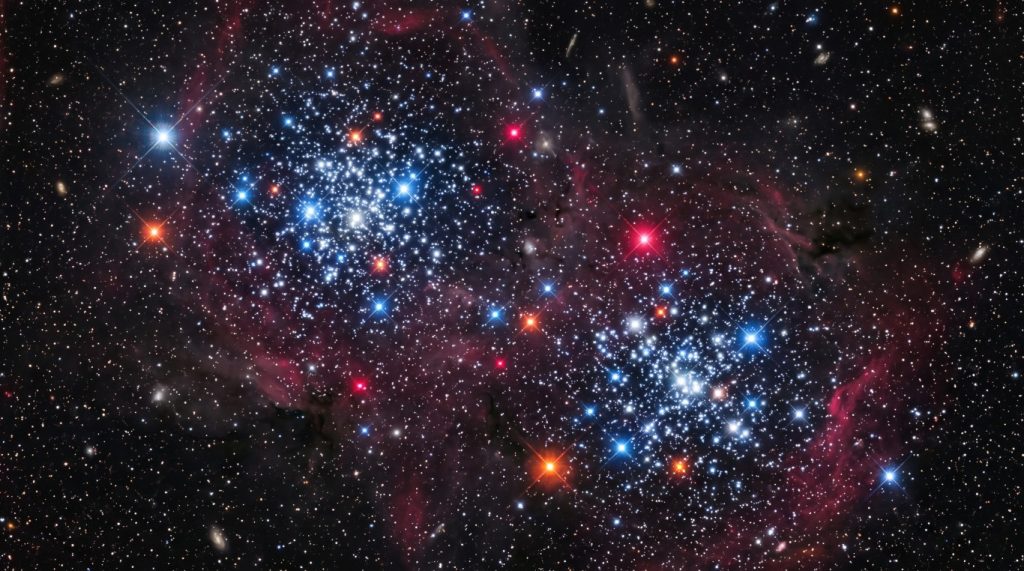
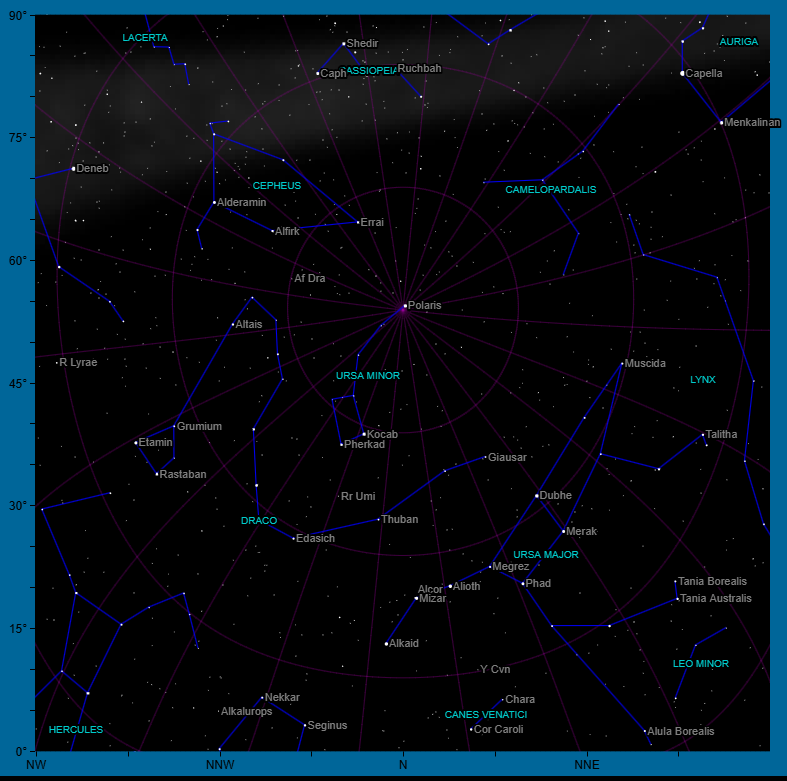
Looking north, the Milky Way arches high across the zenith through Cassiopeia and Cepheus. The Summer Triangle is finally setting into the western haze, though Deneb and Vega remain visible low down. Ursa Major (The Plough) is sweeping upward in the northeast, while Capella in Auriga shines brilliantly overhead.
The Southern Highlights
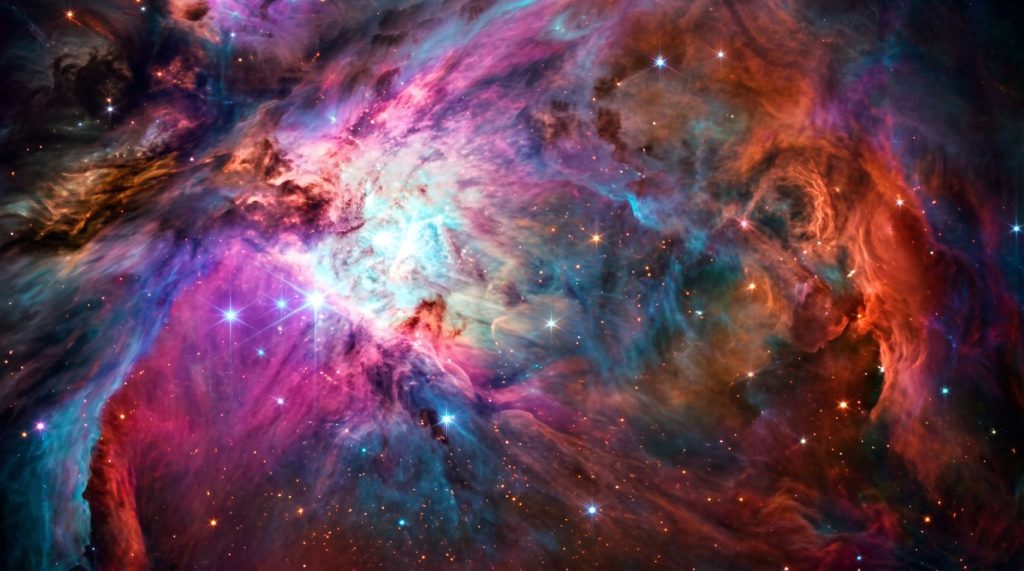
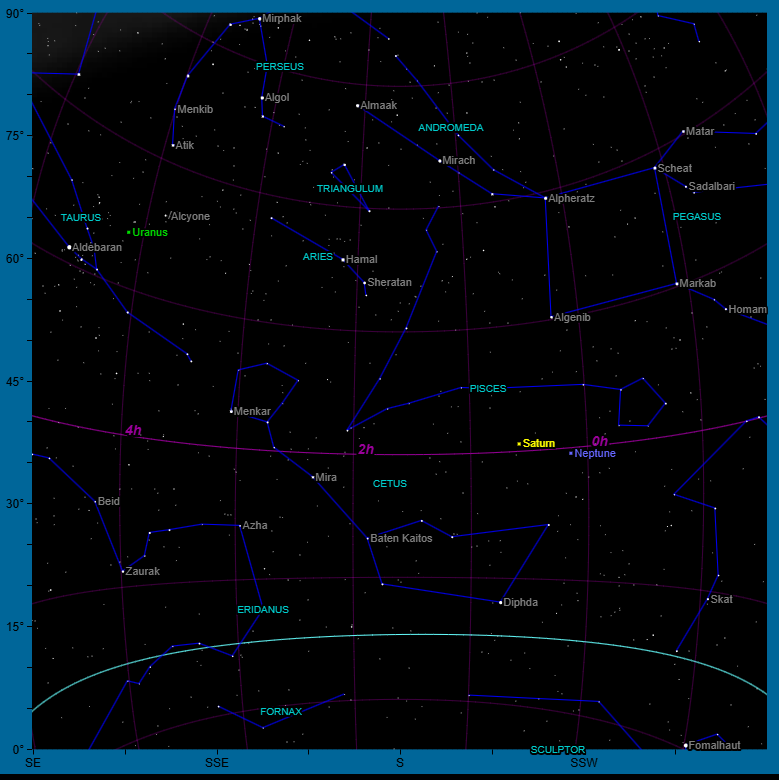
The southern sky is now dominated by the grand winter constellations. Taurus the Bull climbs high in the southeast, housing the sparkling Pleiades (M45) and Hyades star clusters. Orion the Hunter makes its grand evening entrance, clearing the eastern horizon by mid-evening. High above Orion sits the Great Square of Pegasus and the sprawling Andromeda Galaxy.
November 2026 Calendar
| Date | Time (UT) | Event | Details |
|---|---|---|---|
| Nov 01 | 20:28 | Last Quarter Moon | |
| Nov 01 | 23:00 | Moon Occults Praesepe | Waning Moon passes across the Beehive Cluster (M44). |
| Nov 02 | 14:23 | Moon & Mars | Waning crescent Moon passes 1.0° from Mars. |
| Nov 02 | 23:11 | Moon & Jupiter | Moon passes 0.5° from Jupiter in Leo. |
| Nov 07 | 06:00 | Moon & Venus | Thin morning crescent Moon forms a stunning pair with Venus near Spica. |
| Nov 09 | 07:33 | New Moon | Darkest skies of the month; ideal for deep-sky observing. |
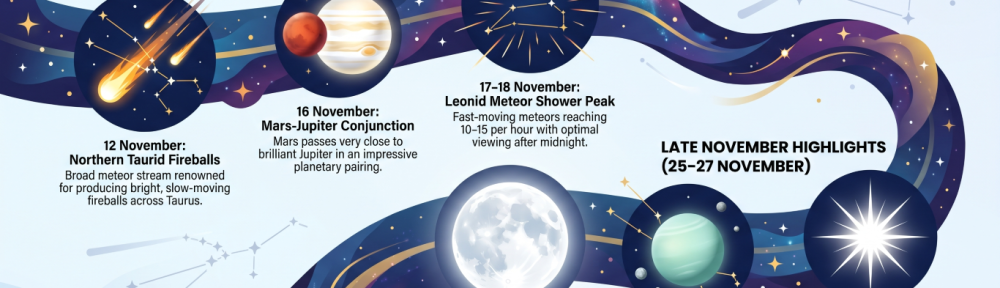
| Nov 09–12 | Night | Northern Taurid Meteor Peak | Renowned for slow, bright, long-lasting fireballs. |
| Nov 16 | Pre-dawn | Mars & Jupiter Conjunction | Mars passes just 1.2° from giant Jupiter in Leo. |
| Nov 17 | 11:48 | First Quarter Moon | |
| Nov 17–18 | Night/AM | Leonid Meteor Shower Peak | Ultra-fast meteors (70 km/s) with persistent trains. |
| Nov 20 | 05:30 | Mercury at Greatest Elongation | Best morning view of the year (18° W of Sun, mag –0.5). |
| Nov 24 | 14:53 | Full Supermoon | Second Supermoon of 2026; Moon at perigee. |
| Nov 24 | Night | Moon Occults Pleiades | Full Supermoon glides across the Pleiades (M45). |
| Nov 25 | All night | Uranus at Opposition | Closest to Earth (2,759 million km); visible all night (mag +5.6). |
| Nov 26 | Pre-dawn | Mars near Regulus | Mars passes 1.5° from Regulus in Leo. |
| Nov 27 | Pre-dawn | Venus at Greatest Brilliance | Blazes at magnitude –4.7 in the morning sky. |
| Nov 28 | 23:00 | Moon Occults Praesepe | Waning Moon passes across the Beehive Cluster. |
| Nov 30 | Pre-dawn | Moon, Jupiter & Mars | Waning gibbous Moon forms a trio with Jupiter and Mars in Leo. |
Sky Maps
Looking South on the 15th at 22:00 GMT
Looking North on the 15th at 22:00 GMT
November’s Sky Guide
The Sun
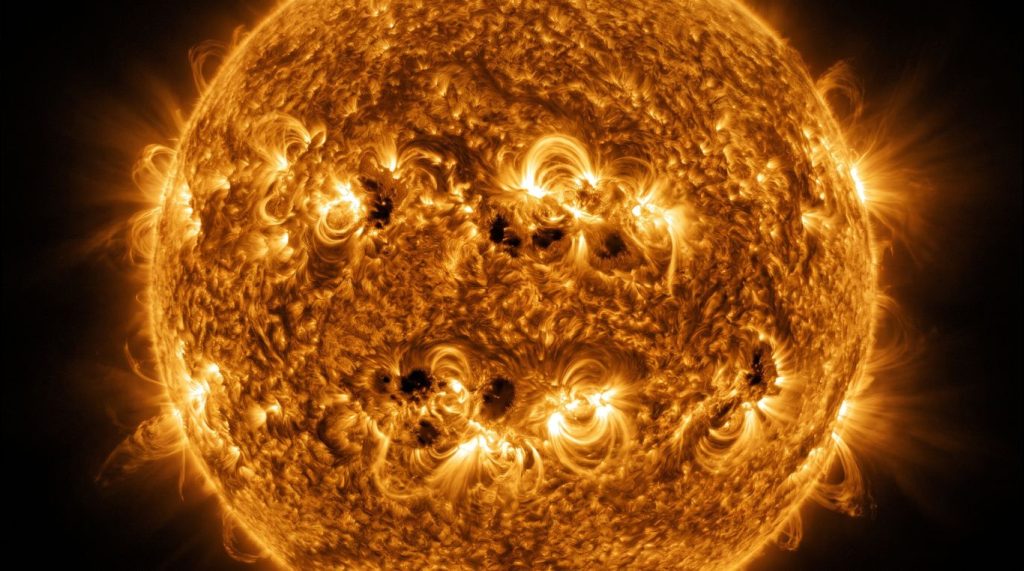
☀️ Solar Forecast – November 2026
Source: NOAA Space Weather Prediction Centre (SWPC) | Data: 27-Day Outlook (Issued 26 October 2026)
Space weather throughout November remains at steady, moderate levels, with 10.7 cm radio flux values holding between 80 and 88 sfu. While solar flux is slightly lower than autumn averages, geomagnetic activity delivers several exciting windows for aurora chasers—including elevated activity directly coinciding with both the New Moon Taurid window and the peak of the Leonid meteor shower!
🌌 Aurora Watch: Key November Windows
- The Halloween / Bonfire Night Kickoff (31 Oct – 1 Nov): Geomagnetic activity peaks sharply on Halloween night with a G1 Minor Geomagnetic Storm (Kp 5, A-index 30) on 31 October, with active conditions (Kp 4) spilling directly into 1 November. Observers in northern England and Scotland should scan northern horizons after dark.
- New Moon & Taurid Window (9 November): Activity surges back up to Kp 4 (A-index 15) on 9 November. Arriving on the very night of the New Moon, this provides pristine dark skies for observers looking out for both faint auroral glows and slow-moving Taurid fireballs.
- The Leonid Aurora Window (17–18 November): A second key geomagnetic window hits Kp 4 (A-index 20) across 17 and 18 November. Because this aligns perfectly with the Leonid meteor shower peak, observers under dark skies might catch fast-moving shooting stars against a glowing northern horizon!
🔭 Dark Sky & Observing Windows
- Mid-Month Quiet Spell (13–15 November): A wonderfully calm 3-day window resting at Kp 2 (A-index 5), ideal for deep-sky imaging ahead of the Mars–Jupiter conjunction on 16 November.
- Late-Month Calm (20–21 November): Quiet space weather (Kp 2) surrounding Mercury’s greatest elongation on 20 November.
☀️ Sunspot & Radio Flux Trends
- 10.7 cm Radio Flux: Begins the period at 88 sfu, settling into a steady range of 80–84 sfu throughout the rest of November. This indicates well-behaved sunspot groups rotating across the visible solar disk, ideal for white-light solar viewing during crisp autumn days.
📊 November 2026 Solar Activity Table
| Date Range | Max Solar Flux (10.7 cm) | Max Geomagnetic A Index | Max Kp | Activity Notes & Highlights |
|---|---|---|---|---|
| Oct 26–31 | 88 sfu | 30 | 5 | G1 Minor Storm (Kp 5) on 31 Oct; quiet earlier in the week (Kp 2). |
| Nov 01–07 | 84 sfu | 20 | 4 | Active start (Kp 4 on 1 Nov); settling to Kp 2 on 3–4 Nov before mild unrest (Kp 3) on 5–7 Nov. |
| Nov 08–14 | 84 sfu | 15 | 4 | New Moon Aurora Alert (Kp 4 on 9 Nov) during Northern Taurid peak; quiet (Kp 2) on 13–14 Nov. |
| Nov 15–21 | 80 sfu | 20 | 4 | Leonids Aurora Window (Kp 4 on 17–18 Nov) during Leonid meteor peak! (NOAA forecast extends to 21 Nov). |
Aurora Forecasts
The Moon
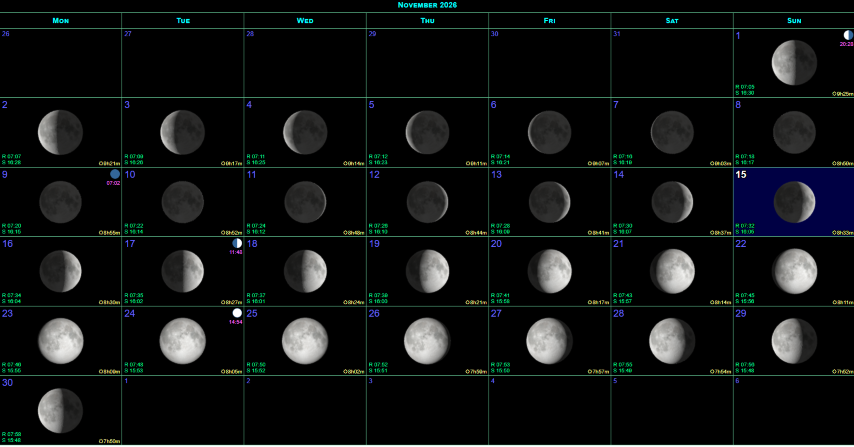
November’s Lunar Calendar
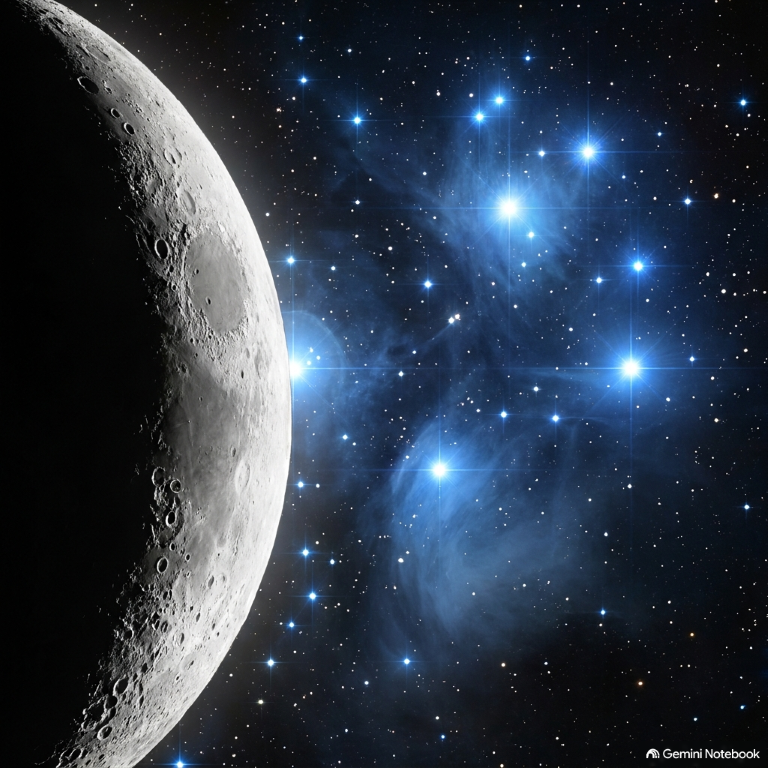
🌕 November’s Full Supermoon & Pleiades Occultation (24/25 November)
November brings the second Supermoon of 2026 on November 24, as the Full Moon reaches perigee (its closest point to Earth). But the real highlight occurs that same evening: the dazzling Moon will glide right across the Pleiades star cluster (M45), occulting several of the “Seven Sisters” in a stunning celestial dance. Grab binoculars or a small telescope to watch stars pop behind the lunar disk!
❄️ Look Out for Lunar Halos!
With chilly November nights comes high-altitude cirrus clouds. Keep an eye out for a 22° Lunar Halo—a ghostly ring of light encircling the Moon caused by moonlight refracting through hexagonal ice crystals in the upper atmosphere. Traditionally known as a “Storm Ring,” it often signals an incoming weather front!
🔭 Telescopic Feature: Sinus Iridum (19–21 November)
On the nights leading up to Full Moon, turn your telescope toward the northwestern edge of Mare Imbrium to view Sinus Iridum (The Bay of Rainbows). Watch for the famous “Golden Handle” effect, where sunlight catches the high peaks of the Jura Mountains while the bay floor below remains in pitch darkness.
Planets
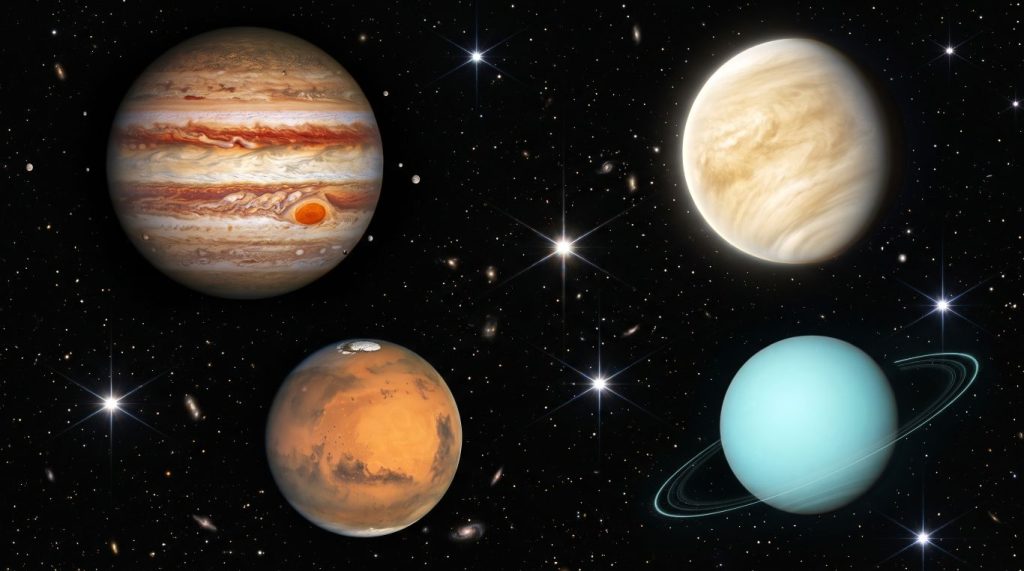
♀️ Venus (Morning Beacon)
Venus roars into the pre-dawn sky this month, reaching its maximum brilliance of the year (magnitude –4.7) on November 27. Rising as early as 4:00 am, it is an unmistakable, diamond-bright beacon in the east. Look for a stunning pairing with the thin crescent Moon on the morning of November 7 near Spica.
🔴 Mars & ♃ Jupiter (The Planetary Sparklers)**
- Conjunction (November 16): Rising around 11:00 pm in Leo, Mars and Jupiter steadily close in on each other until the morning of November 16, when Mars passes just 1.2° left of giant Jupiter. Jupiter (mag –2.1) outshines the reddish Mars (mag +0.7) by ten times, creating a striking duo.
- Mars & Regulus (November 26): Ten days later, Mars glides 1.5° past the bright star Regulus.
♅ Uranus (Opposition Month)
Uranus reaches opposition on November 25 in Taurus. At magnitude +5.6, it is visible all night between Aldebaran and the Pleiades. Under dark rural skies, it can just be glimpseed with the naked eye, while binoculars reveal its pale blue-green disk with ease.
☿ Mercury
The innermost planet puts on its best morning appearance of the year for UK observers. Reaching greatest elongation (18° west of the Sun) on November 20, it shines brightly at magnitude –0.5 low in the ESE around 5:30 am, positioned below and to the left of Venus.
♄ Saturn & ♆ Neptune**
- Saturn: The ringed world remains visible in the evening sky in Cetus/Pisces at magnitude +0.5, setting around 3:00 am. The Moon sits near Saturn on November 20.
- Neptune: Residing in Pisces at magnitude +7.7, Neptune requires binoculars or a telescope.
Meteor Showers: Cosmic Fireworks!
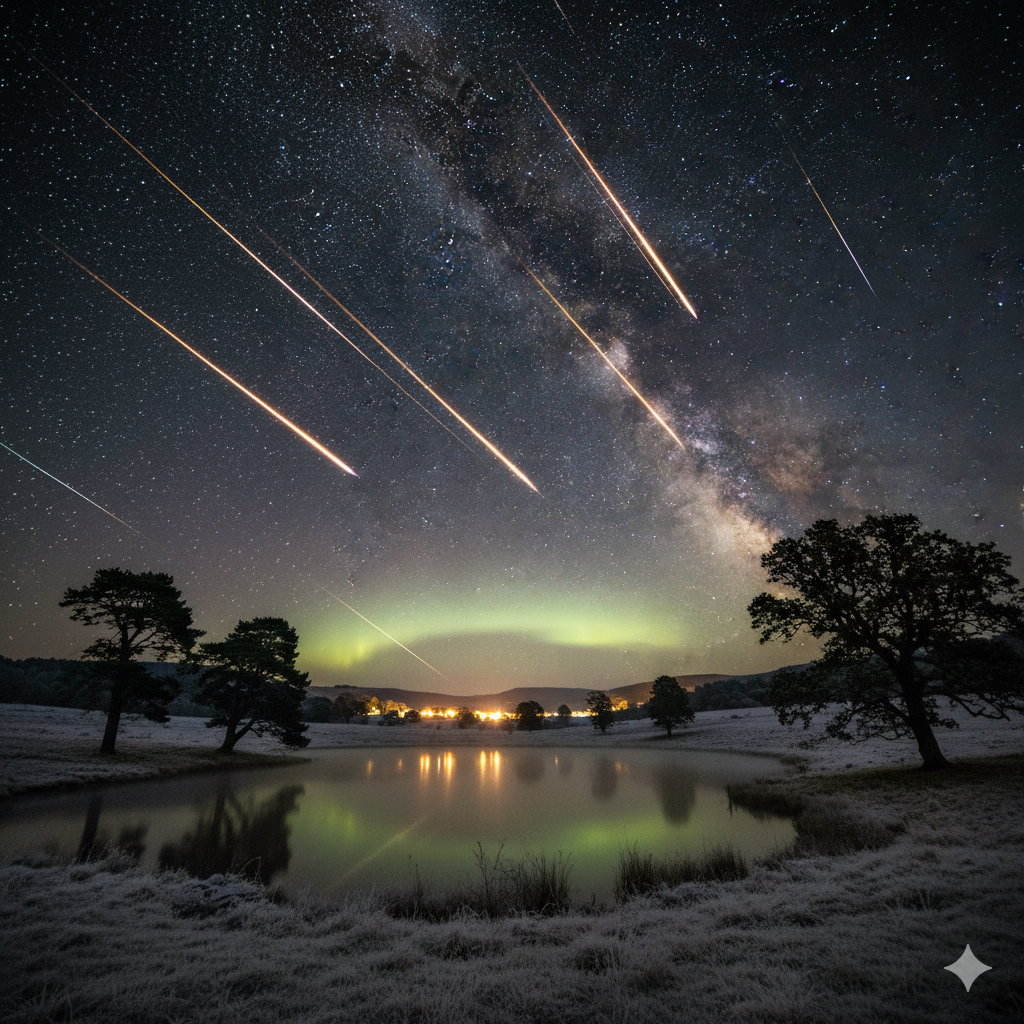
🌠 The Northern Taurids (Fireball Season)
- Peak: November 9–12
- Radiant: Taurus
- Notes: Debris from Comet 2P/Encke. While hourly rates are modest (approx. 5 per hour), the Taurids are famous for producing dazzling, slow-moving fireballs that can rival Venus and leave glowing trains!
🌠 The Leonids (The Speed Demons)
- Peak: Night of November 17/18
- Radiant: Leo (near Regulus)
- Notes: High-speed fragments shed by Comet 55P/Tempel-Tuttle hitting Earth’s atmosphere at a blistering 70 km/s. Expect 10–15 meteors per hour, with many leaving long, persistent vapor trains.
Comets
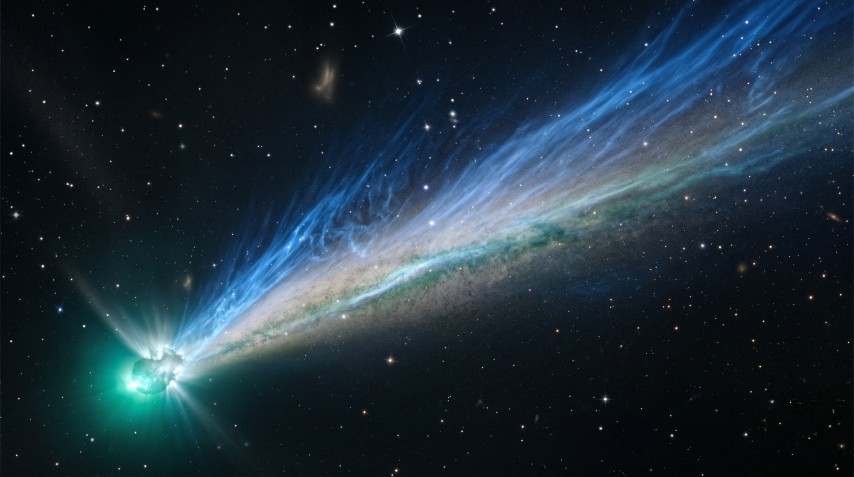
| Comet Name | Predicted Magnitude | Visibility Period | Notes |
|---|---|---|---|
| 161P/Hartley-IRAS | ~9.6 – 10.5 | All Night | Halley-type comet moving through Aquila/Sagitta, well-placed for telescopes. |
| 10P/Tempel 2 | ~11 | Midnight / Morning | Short-period comet fading slowly in the pre-dawn sky. |
| C/2024 T5 (ATLAS) | ~11 | Morning | Faint telescopic visitor in the early morning hours. |
| 252P/LINEAR | ~11 | Pre-dawn | Faint object climbing low in the east before sunrise. |
| 29P/Schwassmann-Wachmann 1 | ~13 (Variable) | All Night | The unpredictable cryovolcanic centaur; monitor for sudden outbursts. |
Deep Sky Feature: Cosmic Explosions
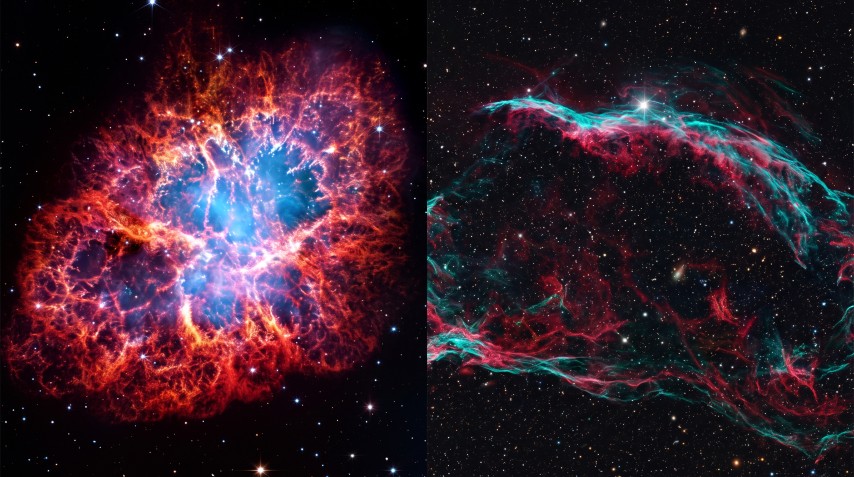
When stars reach the end of their lives, they don’t go quietly, they detonate in supernovae, cosmic explosions that release more energy in a few seconds than our Sun will produce in its entire lifetime. These stellar fireworks forge heavy elements like iron, gold, and iodine, seeding space with the building blocks for future solar systems and life.
**The Crab Nebula (M1 in Taurus)
The Historical Supernova of 1054 CE
- The “Guest Star”: On 4 July 1054 CE, court astronomers in China, along with observers in Japan, Korea, Türkiye, and likely Native Americans, documented the sudden appearance of a brilliant “guest star” in Taurus.
- Daytime Visibility: The supernova was so luminous that it was visible in broad daylight for several weeks and outshone Venus in the predawn sky.
- Progenitor: The explosion was a core-collapse supernova triggered when a massive star (estimated at 5 to 10 times the mass of our Sun) ran out of nuclear fuel.
📏 Physical Dimensions & Expansion
- Location & Distance: M1 lies approximately 5,000 to 6,300 light-years from Earth in the constellation Taurus, positioned just north of the star Zeta Tauri[
- Expanding Cloud: The glowing cloud of gas spans roughly 7 light-years across and is rushing outward into space at a speed of over 1,000 to 1,500 km per second[.
⚡ The Pulsar Powerhouse
- The Neutron Star: At the dead centre of the nebula lies the crushed core of the original star a neutron star just ~20 km in diameter[.
- 30 Spins per Second: Discovered via radio astronomy in 1968, the Crab Pulsar rotates 30 times every second (a period of ~0.03 seconds).
- Synchrotron Glow: As the pulsar’s intense magnetic field slows its rotation, that rotational energy powers an eerie, bluish background glow throughout the nebula caused by high-energy electrons gyrating in magnetic fields (synchrotron radiation).
🔭 Observing Tips
- Telescope View: Through a small-to-medium amateur telescope under dark skies, M1 appears as a dim, oval-shaped patch of light[.
- Dark Sky Essential: Because its light is spread over an extended oval, any light pollution or moonlight will easily wash it out.
The Veil Nebula (NGC 6960 / NGC 6992/5 in Cygnus)
💥 An Ancient Stellar Explosion
- Supernova Remnant: Located in the constellation Cygnus, the Veil Nebula represents the expanding, tangled shell of gas left behind by a massive supernova explosion that detuned roughly 10,000 years ago.
- Interstellar Shockwave: As the explosive blast wave ploughs into cool interstellar gas at high speed, it flash-heats the gas, causing threads of doubly ionized oxygen (glowing green/cyan) and hydrogen (glowing red) to shine.
🕸️ Intricate Filaments & Structure
- Vast Cosmic Bubble: Unlike the compact Crab Nebula, the Veil has expanded into a huge, delicate ring/bubble of fine filaments spanning several degrees across the sky.
- Key Components: The brightest sections are categorized under multiple NGC designations—including NGC 6960 (the Western Veil or “Witch’s Broom”, silhouetted against the star 52 Cygni) and NGC 6992/6995 (the Eastern Veil arc).
🔭 Observing Tips
- Wide-Field & Dark Skies: Due to its large angular size and faint, extended nature, dark rural skies are required
- The Secret Weapon (OIII Filter): An Oxygen-III (O-III) or UHC filter screwed into a wide-field eyepiece dramatically cuts ambient starlight and highlights the ghostly, lace-like tendrils of ionized oxygen gas
🔭 Junior Stargazers: Cosmic Fireworks & Bonfire Night!
A special guide for young astronomers.

Welcome to November, Junior Stargazers!
November is famous for Bonfire Night fireworks on Earth, but if you look up on clear nights, you can see real cosmic fireworks in space!
Shooting Star Fireballs!
Around 11–12 November, look towards the constellation Taurus in the east. You might spot a Taurid fireball—a super-bright meteor that burns with a green or golden streak as it zooms across the sky!
Then, on the night of 17 November, the Leonid meteors arrive. These are tiny specks of dust from Comet Tempel-Tuttle hitting Earth’s atmosphere at 70 km per second—so fast that they leave glowing trails that can linger in the sky for several seconds after the meteor vanishes!
The Morning Diamond (Venus)
If you are up early before school in late November, look east before the Sun comes up. You will see Venus blazing so brightly that it looks like a dazzling morning spotlight—it reaches its brightest point of the whole year on 27 November!
ISS and other orbiting bits
🚀 ISS Overpasses
(Note: Please consult Heavens-Above.com or satellite tracking apps closer to publication for live November 2026 ISS overpass schedules for your location).
Visible Passes for November 2026
| Date | Mag | Start Time | Start (Alt/Az) | Highest Time | Max (Alt/Az) | End Time | End (Alt/Az) |
|---|---|---|---|---|---|---|---|
| 01 Nov | –1.2 | 18:52:52 | 10° SSE | 18:53:05 | 11° SSE | 18:53:05 | 11° SSE |
| 02 Nov | –1.0 | 19:40:03 | 10° SW | 19:41:09 | 19° SW | 19:41:09 | 19° SW |
| 03 Nov | –3.8 | 18:52:27 | 10° SSW | 18:55:44 | 63° SE | 18:56:15 | 53° ENE |
| 04 Nov | –2.5 | 18:05:21 | 10° S | 18:08:11 | 25° SE | 18:11:00 | 10° ENE |
| 05 Nov | –1.5 | 18:54:35 | 10° WSW | 18:57:11 | 21° NW | 18:59:32 | 11° N |
| 06 Nov | –2.9 | 18:06:22 | 10° SW | 18:09:36 | 49° NW | 18:12:49 | 10° NNE |
| 08 Nov | –2.5 | 04:54:59 | 10° NNW | 04:58:09 | 39° NE | 05:01:21 | 10° SE |
| 09 Nov | –1.3 | 04:09:24 | 15° NNE | 04:10:32 | 17° NE | 04:12:53 | 10° E |
| 10 Nov | –2.8 | 04:57:27 | 17° WNW | 04:59:29 | 32° SW | 05:02:34 | 10° S |
| 11 Nov | –3.3 | 04:12:25 | 59° SSE | 04:12:25 | 59° SSE | 04:15:14 | 10° SSE |
| 12 Nov | –0.2 | 03:27:17 | 10° SE | 03:27:17 | 10° SE | 03:27:22 | 10° SE |
| 13 Nov | –1.0 | 04:15:03 | 11° SSW | 04:15:03 | 11° SSW | 04:15:11 | 10° SSW |
- Highlight Pass: Mark your calendar for Tuesday, 3 November at 18:55 UT for a spectacular magnitude –3.8 pass reaching high (63°) in the southeast sky!
Steve, your What’s Ups just keep getting better and better. In November’s, you have excelled yourself.
Thank you and well done.
Thanks John for the feedback 😀