A monthly look at astronomical events in the sky and on Earth
Solar System
The Moon
Best seen from Sunday 1st to Saturday 7th as it waxes from crescent through first quarter on the 2nd to gibbous, high in the sky to the SW and S. It can again be seen as a wafer-thin crescent low in the SW on the 27th through to the end of the month.
A monthly look at astronomical events in the sky and on Earth
The Moon
Best seen at the beginning of the month (first quarter on
the 2nd) through to around the 6th, then again from a wafer-thin crescent low
in the SW on the 25th through to the end of the month. As a waxing crescent, it
passes some degrees below and to the left of Venus on the 27th.
Hat Trick, the company who organise Mastermind, have contacted the Society via our website to canvas for potential candidates for the next series. Opportunity awaits – see the flyer below for details and if you apply, and are successful, let us know. Continue reading →
A monthly look at astronomical events in the sky and on Earth
One really has to wonder whether we are “poco
loco” to choose astronomy as our hobby. We’ve just had the cloudiest and
wettest couple of months that I can remember for some time, and although we may
have a few clear nights in the first week of December, the Met Office isn’t
forecasting much in the way of clear and stable conditions for the rest of the
month. Still, mustn’t grumble. Let’s at least take advantage of the odd
observing night that happens to come our way and be grateful for small mercies.
Important thing is to make sure that telescope is in tip-top condition and
ready for action if the opportunity presents itself.
A monthly look at astronomical events in the sky and on Earth
Well, it’s arrived: the astronomy season for real. Suddenly,
shockingly for some, now the clocks have
gone back it’s getting dark by just after 5 p.m. and that’ll be 4:30 p.m. at
the end of the month. No longer do we have to wait until after bedtime to see
anything. The whole evening is at our disposal. So what’s up there?
A monthly look at astronomical events in the sky and on Earth
The author is taking a break this month but recommends the following Jodrell Bank web site for an excellent run-down of what to observe this month: The Night Sky October 2019.
Special observing evening at Beetle Bank on Saturday 19 October 2019
After the short and light nights of summer, September is the
first month in which the sky goes completely dark every night (i.e. astronomical
twilight ends, and the sun dips to more than 18° below the horizon). At the
start of the month, total darkness runs from 2211 to 0355 BST, but by month
end, it runs from 2043 to 0504 BST. So in addition to other delights of the
night sky, we can observe faint and diffuse deep sky objects without having to
stay up really late.
August the 8th is the first night since early May that the sky goes completely dark – for a short time centred on 1 a.m. This increase in the length of the night is noticeable in the late evenings in August and heralds the “shoulder season” for astronomical observations. By the 15th, astronomical twilight ends at 2316 BST, and by the end of the month it’s at 2214. Just taking the dog for its last walk or strolling home from the pub, August is the month when one begins to notice the stars again. And with it being predominantly warm, August is probably the month with the best combination of evening comfort and darkness. So break out those 7 x 50s, dust off that ‘scope and get out there!
The Moon
Best seen as a thin waxing crescent low in the west after sunset on Mon 5th to late gibbous low in the south on Mon 12th. It doesn’t climb much above 13° altitude throughout this period due to the angle of the ecliptic at this time of year. Jupiter will be seen about 1.5° below it on the 9th.
Planets
Mercury
Mercury may be spotted low (6 – 10°) in the ENE very early in the morning at around 0440 to 0500 between the 8th and 15th of the month.
Venus and Mars
Are both on the far side of the sun and completely unobservable this month.
Jupiter and Saturn
Both can be seen low in the south by about 2100 BST. Jupiter is in Scorpio and fairly near the star Antares; Saturn is 30° to its left in Sagittarius. The low altitude of these planets is not conducive to seeing them at their best. However, the YAS has organised a special observing event for Saturday the 31st August where we will be bringing an armoury of high power telescopes to bear on Saturn. This is probably your best chance this year to see this spectacular planet. See the Events page for more details and to book a place.
Uranus and Neptune
Visible only after midnight. Wait until later in the year for these two.
Perseid meteor shower 11th – 13th
Normally the northern hemisphere’s favourite meteor show, the Perseids this year will be a bit of a challenge. The problem is the moon. As the shower reaches its peak, not only date-wise but hour-wise, the waxing gibbous moon will reduce the number of meteors seen. Despite this, if you are prepared to stay up very late or even go to bed then get up very early, the Perseids are definitely worth observing.
The graph below shows the daily Perseid numbers observed in 2017, and this year’s peak will be on the same day – the 13th. The numbers for 2017 were perfectly normal and typical of this shower.
Perseids 2017 ZHR graph
Data from Hong Kong Space Museum
[table id=7 /]
The zenithal hourly rate (ZHR) is what a single observer would expect to see each hour if the sky was perfectly clear and completely dark and the radiant was overhead. You’ll see the ZHR rises, especially from the 9th, reaches a peak on the 13th then quickly reduces.
From the UK, the radiant – at the northern end of the Perseus constellation – rises in the NE while it’s still light, but by 3 a.m. has risen to a very respectable 60° altitude. After that, the sky begins to brighten as dawn approaches. The number of meteors to be seen is roughly equal to the sine of the radiant altitude.
The ZHR column shows how the ZHR numbers change day by day.
The AHR (actual hourly rate) column shows the number of meteors actually expected to be seen by an observer in York.
The Moon Alt column gives the altitude of the Moon. Negative numbers mean it’s below the horizon.
The Sun Alt column shows how far below the horizon the sun is. Less than 18 means some sky glow.
So there are five one-hour slots centred on the times given when it’s worth giving it a try.
On the 11th, expect to see a meteor every 2½ minutes or so; on the 12th, one every 2 minutes; and on the 13th, if you wait until between 0230 and 0330, one every minute.
You don’t need to identify the constellation of Perseus to see these meteors. The best way is to set your chair or lounger to face north east (the opposite area of sky to where the moon is) and just relax. Good luck!
Non-Solar System Objects
Deep Sky
July was the month to focus on the many nebulae and clusters in Scorpio and Sagittarius. In August we should turn our attention to the summer triangle and surrounding area. In case you don’t know the summer triangle, it is formed by the stars Altair in Aquila, Vega in Lyra, and Deneb in Cygnus. During the first week of August – when the moon is not around – but particularly from the 22nd onwards, this area of sky through which the Milky Way passes on its route northwards is riding high in the south and is peppered with deep sky splendours. The Astronomy Now chart below shows the best of these. Look high in the south at 2300BST. Each object is described in the table below.
The Summer Triangle area of sky (Chart courtesy of Astronomy Now)
[table id=8 /]
Just lying on a lounger and with binoculars, sweeping the star fields in this area of the Milky Way, stretching right across the sky from SW to NE will reveal many beautiful star clusters. I find doing just that is amazingly relaxing. Do try it; it’s a tonic!
But if you would like the opportunity to see these objects with the array of society telescopes, we’ll be observing them at the event (previously mentioned) on Saturday 31st August. Go to the Event Page on our web site for more info.
Passes of the International Space Station (ISS)
The ISS is visible on only four nights in August: on the 1st and 3rd at around 10 p.m. and then on the 29th and 31st at around 5 a.m. See the Heavens-Above web site for more details.
Best seen as a thin waxing crescent low in the west after sunset on Fri 5th to late gibbous low in the south on Sat 13th. It doesn’t climb much above 18° altitude throughout this period due to the angle of the ecliptic at this time of year. Jupiter will be seen about 1.5° below it on the 13th.
Partial Eclipse of the Moon on July 16th
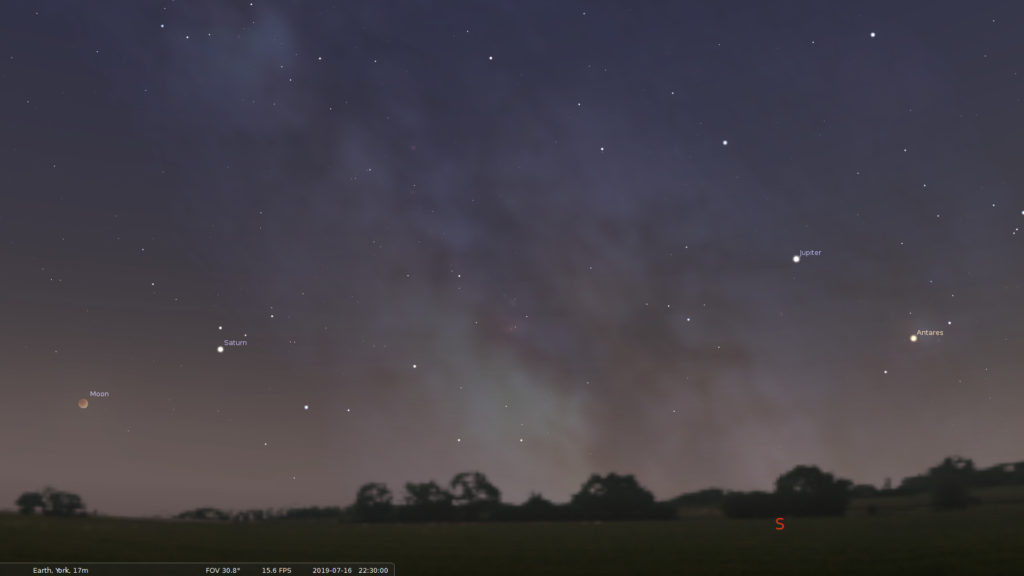
On that date, the moon will rise in the SE at 2123 BST partially eclipsed. The eclipse will continue until midnight, with its maximum at 2230. The sky view below shows the situation at 2230; note the partially eclipsed moon near lower left together with Jupiter and Saturn.
Night sky for partial lunar eclipse showing Saturn and Jupiter (Stellarium screenshot)
If you happen to be visiting the South Pacific, Chile or Argentina, then there’s a total solar eclipse on the 2nd July. All right for some!
Planets
Mercury, Venus and Mars:
All too near the sun to be observable this month.
Jupiter
Jupiter reached opposition on the 10th of June and is observable in the late evenings throughout the month. Unfortunately, it rises to only a little less than 14° so will suffer from poor seeing and a lessening of brightness due to that low altitude. The optimum time to view it is when it transits (is due south) and this occurs at 2330 on the 1st, 2230 on the 15th, and 2130 on the 30th.
One thing that’s not affected by poor seeing is the visibility of the four Galilean moons as they perform their orbital dance. As the moons pass behind Jupiter they disappear, but what’s worth looking out for is when they reappear. Interestingly, once we’re a week or so beyond opposition, a moon emerging from behind Jupiter is still in its shadow and is there but we can’t see it because it’s eclipsed. And if you’re looking at the right time, the moon suddenly appears as if by magic, not from behind Jupiter but some distance from it, to its east. Here are three examples that can be seen this month. Start looking two or three minutes before the time, to ensure you don’t miss the appearance. And make sure you know which way east is as seen in the eyepiece. If you’re not sure, it’s the direction away from which the planet is moving. If you have a driven telescope, stop the drive for a moment to see which way the planet drifts.
Date
Time (BST)
Satellite
Notes
July 14th
2319
Io
July 18th
2349
Europa
July 30th
2138
Io
Only 30 mins after sunset.
This is the view just after Io’s appearance on July 14. (From SkyViewCafe.com)
Saturn
Saturn reaches opposition on the 9th of July. Unfortunately, like Jupiter, it only climbs to an altitude of 14° and is thus best seen within an hour either side of transit. You might care to wait until August to see it, but if you don’t want to wait, the transit times are 0146 on the 1st, 0047 on the 15th, and 2339 on the 30th. One good thing about this opposition is that Saturn’s rings are really wide open and well seen.
Non-Solar System Objects
Deep Sky
June and July are difficult months to observe deep sky objects because the sky never gets really dark, but they are also the months when some famous nebulae and clusters are visible. These are clustered in the direction of the galactic centre and therefore low in the sky. If you don’t have a go at them in July – the best time – then you’ll miss out until next year. Unfortunately, the Moon is a big problem between the 10th and the 23rd, so avoid that 14 day period. The other thing you need to accept is that these objects can only be seen well very late at night. e.g. around 0100 BST before the 10th and midnight after the 23rd. But if you’re keen enough, your efforts will be rewarded.
The sky view below shows these objects at 0100 on the 5th (or midnight after the 23rd).
Deep sky objects visible in July 2019 (screenshot from SkyViewCafe.com)
Some of the objects listed in the table below can be seen with the naked eye and all are well seen in binoculars or a small telescope.
[table id=5 /]
Noctilucent Clouds
July is a great month for looking out for the eerie and beautiful noctilucent clouds. (From the Latin for night shining.) These are ice crystal clouds, and the highest on Earth, at about 50 miles up. They can only really be seen between midnight and 2 a.m. low above the northern horizon if the sky is otherwise clear. The image below was taken on 19th June this year.
Noctilucent clouds shot by Nando Harmsen of Fstoppers
Passes of the International Space Station (ISS)
July is a particularly good month to spot the ISS as it passes over the UK. It can be very bright as it catches the sunlight high above us when from the ground, the sun has already set. It is visible on the 5th then every night from the 7th to the 31st inclusive. On many nights it is visible twice, and on some nights, three times. The Heavens-Above web site has an excellent visibility table. Use it like this:
Note (in the top right) that I have set the link to provide the visibility from York.
Note the “Search period start” and “Search period end” indicators.
Move to a later or earlier date range by clicking the arrow buttons.
Ensure that the “visible only” radio button is selected.
If no table entries are shown for a particular date range, the ISS is not visible on those days.
The “Start”, “Highest Point” and “End” columns indicate when and in what direction the ISS can first be seen, reaches its highest point in the sky, and disappears respectively.
In the FAQ on the web site it states that all the times in the tables are “given in local time”.
The world famous Sky&Telescope magazine, founded in 1941, has been acquired by the professional organisation, the American Astronomical Society. The magazine has been published for some years by F+W Media, but they have just filed for bankruptcy. The AAS paid $1.23 million for the magazine and have assured staff and readers that the existing staff will remain in post and the magazine will carry on as normal. Full story here.