A monthly look at astronomical events in the sky and on Earth.
What to See in May
May, June and July are of course the months when the sky doesn’t get dark until 10pm or later, and for two or three weeks either side of the summer solstice (June 21st) observations of low surface brightness objects such as galaxies and nebulae are virtually impossible. So this is the time of year to concentrate on the Moon, the planets, double stars, and open and globular clusters. Further, the International Space Station (ISS) will be well seen in May. Oh yes, there’s also a meteor shower.
Finally, I would normally include a reminder that this is a good time of year to observe sunspots, but we are currently deep in the minimum of the Sun’s 11 year cycle and you’ll be lucky to see any sunspots at all.
The Moon
Best seen as a waxing crescent through first quarter to gibbous from Wed 8th to Wed 15th. It’s really well placed around the 12th. If you’d like something specific to spot, there’s a wonderful feature called Schroter’s Valley. It’s near the crater Aristarchus and is best seen when the moon is about 11 days old. That’s on the 15th this month. The moon is in Virgo and reasonably high in the south at about 10pm, shortly after the end of civil twilight.
You will find bright Aristarchus, its nearby much darker crater Herodotus and Schroter’s Valley in the north-west section of the moon in position 73/32 on the map below.

Aristarchus itself is an amazing crater worth your attention with a high power eyepiece, and when the sun is at the right angle, Schroter’s valley jumps out at you. It looks like a sinuous river valley and in a way it is, but the liquid was lava not water. It’s an old collapsed lava tube. Aristarchus, Herodotus and Schroter’s valley are well seen in this NASA image of the area.

Planets
Having said above that this is the time of year to observe the planets, unfortunately in May 2019 the planets are a dead loss. Why?
- Mercury: Unobservable.
- Venus: Very low before sunrise and not really worth looking for.
- Mars: 4° above the thin crescent moon low in the WNW on the 7th, but faint and unimpressive.
- Jupiter: Only visible after midnight, and very low in the S to SE. Forget it until June.
- Saturn: Only visible after 2 or 3 a.m. and very low. Forget it until July.
- Uranus: Unobservable.
- Neptune: Unobservable.
There, I told you!
Non-Solar System Objects
Mizar and Alcor
This famous naked eye double star one away from the tail end of the Great Bear is directly overhead in May and offers a quick opportunity to check your eyesight. The separation is about 12 arc minutes. Mizar itself is a double with a separation of 14 arc seconds and is easily seen with even a small telescope. This Sky and Telescope article describes them in more detail.
Three Globular Clusters: M3, M5 and M13
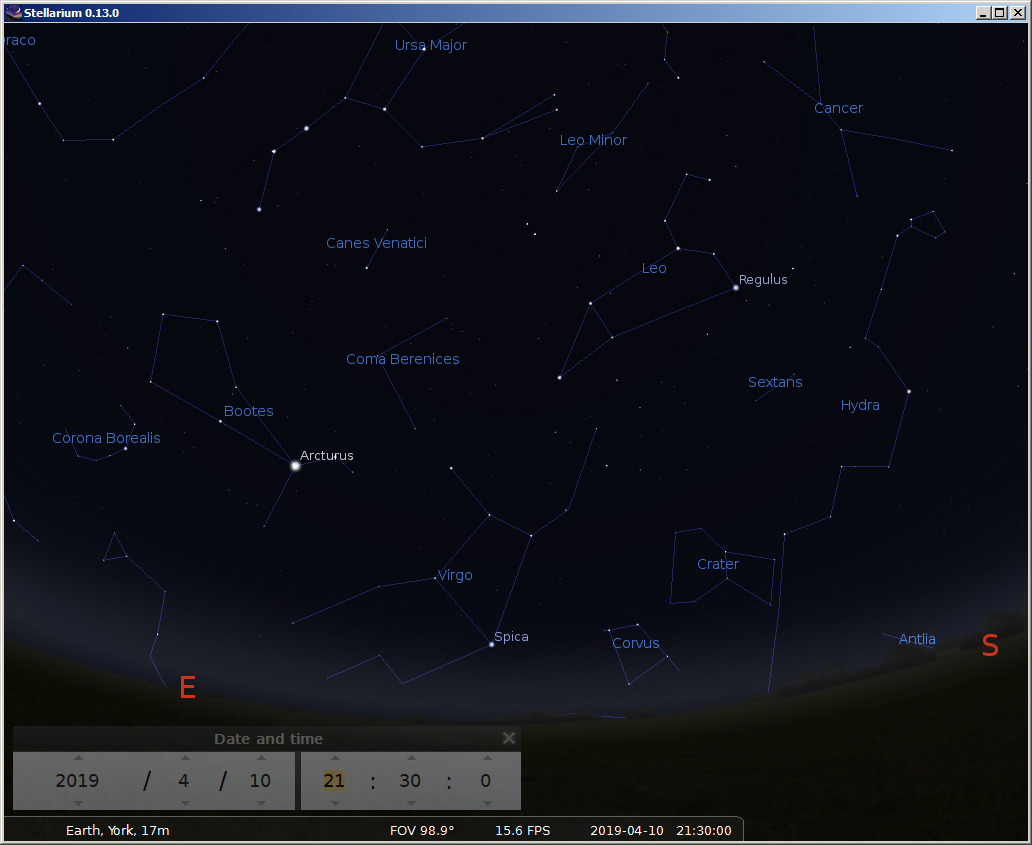
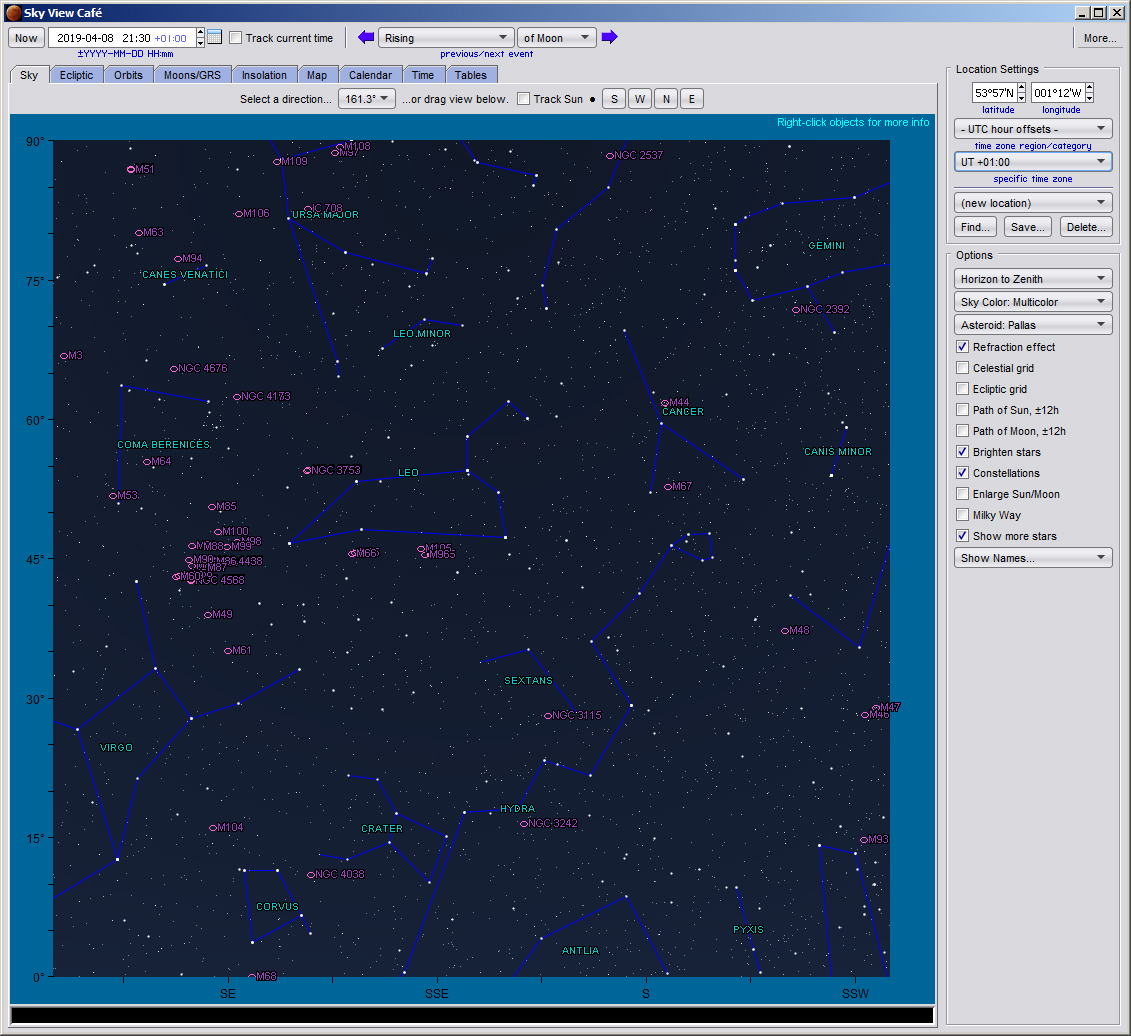
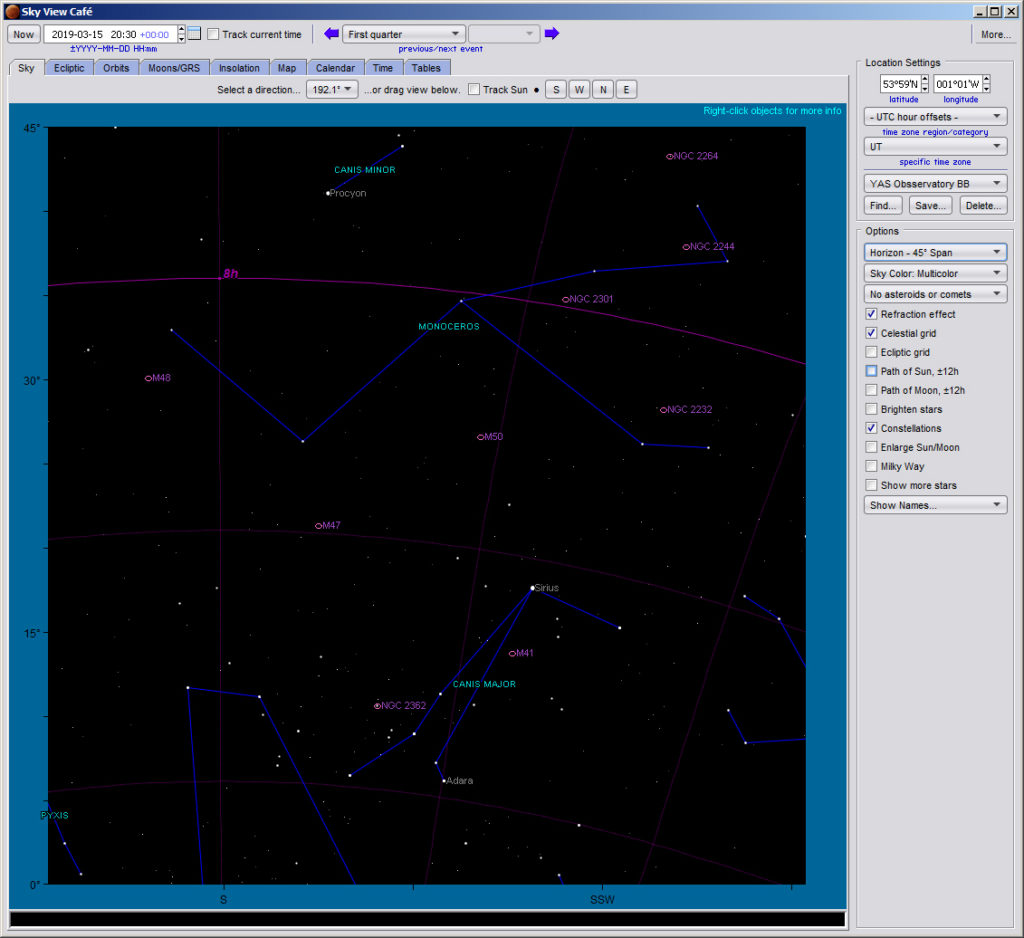
The star map below shows the locations of these three objects. Compass direction is shown along the horizon. For the best views, wait until way past 10 pm if possible.
For an insight into these mysterious objects, read the Wikipedia entry.

M3 is a truly fine globular about 18 arc minutes in diameter and of magnitude 6.2. It lies north of Arcturus and about half way between it and the 3rd magnitude star Cor Caroli. As with all globulars, whack up the magnification for a chance to see individual stars (of which there are 500,000!).
M5 is another stunning globular, magnitude 6.0 and 23 arc minutes in diameter. Find it by following the line of 4th magnitude stars running along the top edge of Virgo.
M13 is the daddy of all globulars and deserves the name “The Great Globular Cluster”. Its magnitude is 5.8, 2/3rds the apparent diameter of the moon and easy to find on the edge of the central “square” of Hercules. A small telescope will see it as a fuzzy patch but 6-inch telescope is needed to resolve its stars. Do give it a go.
The Eta Aquarids Meteor Shower and the ZHR Value
Unlike some astronomy web sites (such as one claiming you’ll be able to see “up to 55 meteors an hour” ), you’ll only get hype-free facts here. I’d rather this be the case than woo you with exaggerated claims about what you can see, only for you to be disappointed when you observe.
The Eta Aquarids meteor shower peaks on the 7th May with a ZHR of 55, but don’t get excited. Read on. ZHR stands for Zenithal Hourly Rate and is defined as:
ZHR is the number of meteors a single observer with an unobstructed view of the sky is likely to see on the date the radiant peaks and if the radiant is directly overhead and the sky is crystal clear and dark enough to see stars down to magnitude 6.5.
Now the Eta Aquarids’ radiant (the position in the sky from which the meteors appear to radiate) is – as the name suggests – centred close to the star Eta Aquarii. This star’s position on the celestial sphere is at RA 22h 20m and Dec. -1.0. In other words, it’s about on the celestial equator. So far so good. The problem is that on and around the peak date, the Sun’s position is at about 3h 0m and Dec. +17°. That means that the angular separation between the radiant and the Sun is about 70°. That in turn means that from nowhere on Earth and at no time of day for hundreds of years into the future, will the radiant be overhead when the Sun is below the horizon! The best place to see this shower from is actually latitude 10° S (Peru, Tanzania, Indonesia). From there, when the Sun is 18° below the horizon (the condition needed for total darkness and thus allowing us to see stars down to magnitude 6.5), the radiant is 52° above the horizon, not overhead.
So what if the radiant is not overhead? How does the altitude of the radiant affect the numbers of meteors one is likely to see? There’s a simple formula giving the number, N:
N = ZHR x sin(θ)
Where θ is the altitude of the radiant above the horizon in degrees. This formula is disputed in some quarters but it’s the only one that’s generally accepted.
Using this, from our favoured latitude of 10° S, we would expect to see 55 x sin(52) = 43. Not bad.
So, what about from York? Well, at the beginning of astronomical twilight, (0200 hrs), Aquarius is below the horizon so that’s no good. Let’s push it and consider looking out at nautical twilight (at 0336 hrs). By then, the radiant has risen and is 8.5° above the horizon. The formula is then:
N = 55 x sin(8.5°) = 8
Hmm! And if we waited until civil twilight (at 0434 hrs), the radiant has climbed to 16.6° and the formula gives us 16. But by then of course, the sky is getting pretty bright – and particularly so in that direction (east) – and it’s unlikely that we would spot many meteors.
So, this is a meteor shower whose ZHR is unachievable – world wide – and from York and most of the UK, the best we might expect is 8-10 meteors per hour. But if you’re an insomniac and fancy counting meteors not sheep (optimistically at an average rate of one every 6 minutes) any morning for two or three days either side of the 7th, and you have a window affording a good view down to near the eastern horizon, this is the meteor shower for you! There’s no moon to further lighten the background sky, and these meteors are some of the brightest of any shower, so, you never know.
Passes of the International Space Station (ISS)
This May – and particularly in the second half of the month – is a particularly good time to spot the ISS as it passes over the UK. It can be very bright as it catches the sunlight high above us when from the ground, the sun has already set. It is visible every night from the 4th to the 30th inclusive, and twice on some nights. The Heavens-Above web site has an excellent visibility table. Use it like this:
Note (in the top right) that I have set the link to provide the visibility from York.
- Note the “Search period start” and “Search period end” indicators.
- Move to a later or earlier date range by clicking the arrow buttons.
- Ensure that the “visible only” radio button is selected.
- If no table entries are shown for a particular date range, the ISS is not visible on those days.
- The “Start”, “Highest Point” and “End” columns indicate when and in what direction the ISS can first be seen, reaches its highest point in the sky, and disappears respectively.
- In the FAQ on the web site it states that all the times in the tables are “given in local time”.
Space News
M87’s Black Hole
See this S&T article for details.
Clearly, the extraordinary image of the black hole at the centre of the M87 galaxy has wowed the whole world. Here it is with annotations added by webcomic XKCD to give a sense of scale.

I’d just like to ponder the facts we’ve been given about it:
- Its diameter is roughly four times the diameter of the solar system (out to Pluto).
- It has a mass 6.5 billion times the mass of the sun.
The concept of “diameter” when applied to a black hole is worth a thought. I mean, it’s not as if there’s a solid object there like a planet or a star. So what is it a diameter of? The answer is that it’s the diameter of the event horizon. That’s the point of no return. Anything – including light – that’s within the event horizon cannot escape, so of course, it’s black. (See Schwarzschild radius)
Now, let’s consider this figure of 6.5 billion times the mass of the sun. If we gathered together 6.5 billion suns, moulded them into cubes so there was no space between them, and started piling them round the sun, by the time we finished, the diameter of that sphere would be about the same as the diameter of Saturn’s orbit. So we have a sun-like sphere the size of Saturn’s orbit, then presumably empty space out to the event horizon ten times further away. But wait; if we did gather together 6.5 billion suns, there’s no way they’d just sit there; they would squash and squash through gravitational collapse until the size of the resultant “object” was, well, I just don’t know. Does anyone? So now, we have a relatively small object – sun-size perhaps – surrounded by space four times the diameter of the solar system, inhabited only by the tortured remains of light and matter falling in from beyond the event horizon. And how can we speculate that it’s sun-sized when in its vicinity, gravity distorts the very fabric of space-time so measurements become meaningless? What in pity’s sake is the nature of this central object? Is it just pure mass? Does it have a surface? Does it exist as a tangible object at all? As good old Patrick would say in his inimitable way, “Well, we just don’t know”.
Israel’s Beresheet Lunar Lander Crashes
Full story in this Sky & Telescope piece.
The USA is Going Back to the Moon by 2024
You will obviously have heard of NASA, but have you heard of the National Space Council? Probably not. But you’ll be interested to know that this body has been the primary steer group for all the USA’s activities in space. Whilst it’s had its ups and downs, it has always been chaired by the President or Vice President, with members as powerful as The Secretary of State and the Secretary of Defense. In its latest incarnation, Vice President Mike Pence chairs, and the council also includes the Secretary of Homeland Security, the Director of National Intelligence, the Director of NASA and the chairman of the joint chiefs of staff. These guys are big, and what they decide happens, and clearly, the push has come down from President Trump that the USA is going back to the Moon – just in time for the end of his second term, by the way! Read this Wikipedia article for more info on this council. It’s fascinating.
And what about this, the “United States Space Force“. To become the sixth branch of the US armed forces. Serious stuff. Bet you didn’t know about this either.
So things are hotting up in space. We’ve got the $500M “Lunar Gateway” project and now, Mike Pence has left us in no doubt regarding America’s intentions with these words at the latest meeting of the National Space Council, “Today, we stand at the dawn of a new era of space exploration”. Fine words and a seemingly worthy cause, but don’t forget the hand of the military resting on the levers of power – see comments and the video of Mike Pence’s speech.
I think the space race is back on, but it’s not a race between nations; rather a battle between complacency and one man’s ego!
Clear skies and good viewing.
John Rowland 22/04/2019